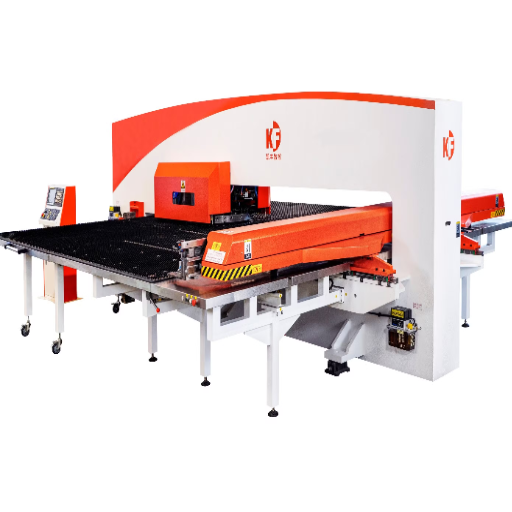
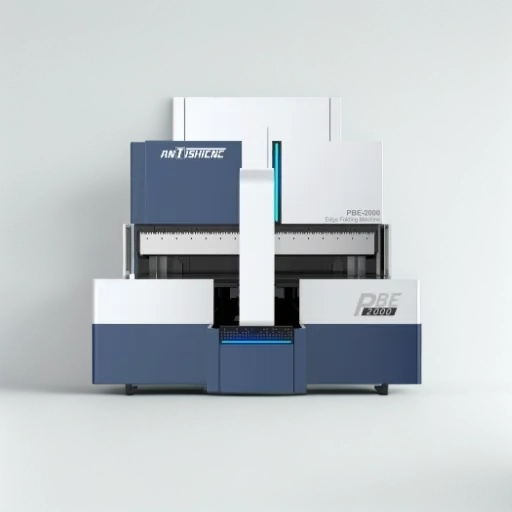
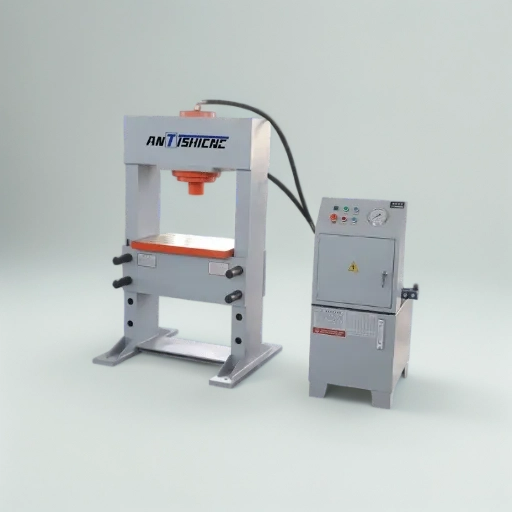
With the ability to reach the utmost precision and reliability, CNC turret punches use a CNC program system for punching, which ensures defect-free and repeatable results.
Using the AI-based nesting software, material waste can be reduced by 35%, predominantly addressing waste through inefficiency of around 15-20%.
Great productivity and low labor costs help close a deal with an aggressive price while still offering good profit margins.
Complex geometry can be accommodated by a multi-operation and advanced tooling system in a single setup.
Hands-on training programs with intuitive user interfaces help decrease learning curves and lessen the dependency on specialized operators.
Industry-leading performance that transforms your manufacturing capabilities
±0.01mm positioning accuracy provides consistent output results of metal fabrication projects with higher quality.
60 tools in the rotating turret system allow for complex part geometries without manual tool changes, thus enhancing throughput.
Able to do punching, forming, marking, tapping, and nibbling on different materials like steel, aluminum, and composites.
Attain an incredible speed of 800 strokes per minute with the servo-driven system, massively decreasing the production time while still assuring high precision.
🛠️ Our quality and precision machinery offer you the upper hand in all your commercial projects.
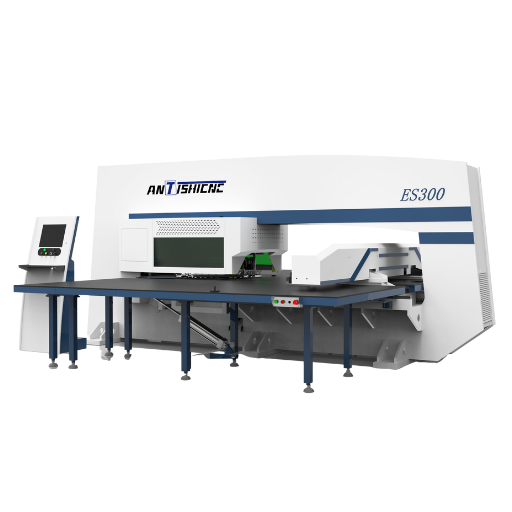
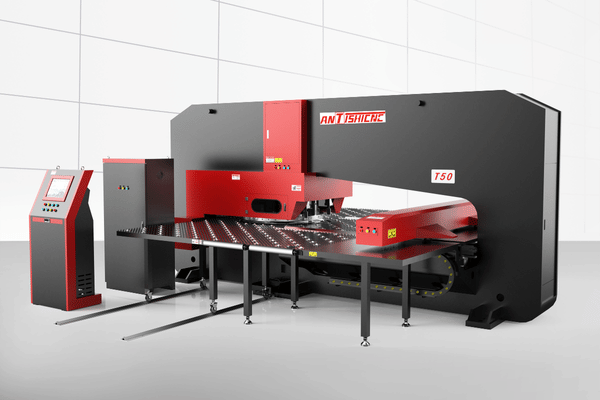
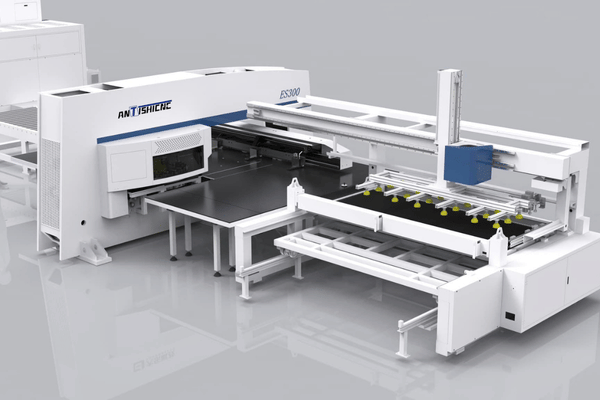
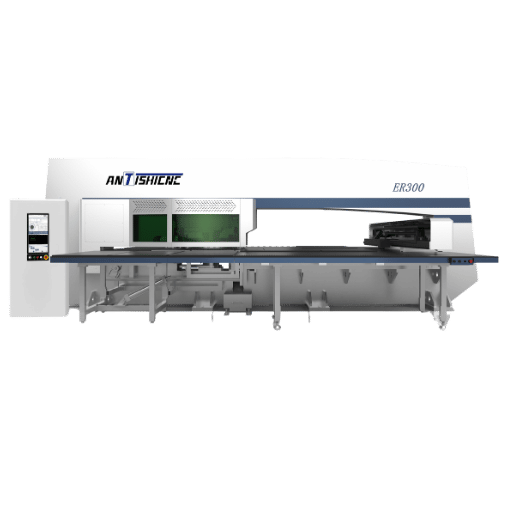
The CNC turret punch is another type of machine used in metalworking that employs computer numerical control (CNC) for automation of the punching process. The machine carries and punches various hole shapes in metal sheets with precision and efficiency by the use of several punch tools mounted on a rotating turret.
Key Market Drivers
| NO. | Name | Specification | Unit | |
|---|---|---|---|---|
| 1 | Press Capacity | 300 | KN | |
| 2 | Transmission Type | Servo | ||
| 3 | Frame Construction | O-frame | ||
| 4 | Max. Sheet size | X axis | 5000 (With one re-positioning) | mm |
| Y axis | 1250*1500*2000 | mm | ||
| 5 | Max.Sheet Thickness | 6.35 | mm | |
| 6 | Max.Diameter | Φ88.9 | mm | |
| 7 | Max.Punching Stroke | 32 | mm | |
| 8 | Max.Nibbling Speed | 2100 | hpm | |
| 1 mm pitch, 6mm punch stroke | 750 | hpm | ||
| 25.4mm pitch, 4mm punch stroke | 400 | hpm | ||
| 9 | No.of Clamps | 3 | pcs | |
| 10 | No.of Re-positioning Cylinder | 2 | set | |
| 11 | Turret Stations | 32 | pcs | |
| 12 | No.of Controlling Axis | 5(X, Y, T, C, A) | pcs | |
| 13 | Tool Distribution | 16A/ 10B/ 2BZ/2C /2D | ||
| 14 | Worktable Structure | Brush and ball mixed | ||
| 15 | Max. Feeding Speed | X axis | 90 | m/min |
| Y axis | 80 | m/min | ||
| X, Y combined | 110 | m/min | ||
| 16 | Turret Speed | 30 | rpm | |
| 17 | Rotational Tool Speed | 40 | rpm | |
| 18 | Punching Accuracy | ±0.10 | mm | |
| 19 | Max. Sheet Weight | 150 | kg | |
| 20 | Air Pressure | 0.6 | mpa | |
| 21 | Power | 63 | kw | |
| 22 | Clamp Dead Area Detection | Yes | ||
| 23 | Clamp Splint Loose Alarm Device | Option | ||
| 24 | Plate Warping Alarm | Yes | ||
| 25 | Clamp Automatically Float Down | Yes | ||
| 26 | Roller Auxiliary Feeding | Yes | ||
| 27 | Overall Size | Length | 5170*5670*6670 | mm |
| Width | 5200*5200*5200 | mm | ||
| Height | 2300*2300*2300 | mm |
Trusted by 2000+ manufacturers worldwide
The maximum thickness a turret punch can handle typically ranges up to 6mm for aluminum and 3mm for mild or stainless steel
This punching process has advantages when it comes to cost, speed, and mass production efficiency, but disadvantages include material thickness limitations and insertion deformation.
Machines use a dot-punching operation where the pin strikes particular marks on texts, logos, or serial numbers on a surface around precise locations. Thus, this offers simple, efficient, and versatile industrial marking applications.
Punching machinery enhances and increases productivity by automating monotonous tasks that may invite human errors, lessening the production time, and minimizing material usage through very precise and efficient operations.
The Turret Punch Press Operator works the machines to punch holes or marks into sheet-metals, sets up and calibrates equipment, and makes sure that product specifications are adhered to.
Materials not suited for laser processing include PVC, carbon fibers, polycarbonate, epoxy resins, and materials emitting toxic gases like ABS or containing chromium (VI).
Punching holes and shapes in sheets of metal is the specialty of CNC turret punches, while a press brake would lend itself much better to precision bending and forming, thus complementing each other in metal fabrication.
The HS Code for CNC turret punch machines is typically 84624910, covering punching machines, including turret types
Depending on the specifications and features, the price of a CNC turret punching machine ranges widely from $18,500 to $49,000.
Small CNC turret punch presses are compact mini-machines, suitable for prototyping, short runs, and long run punching operations with easy-to-use CNC control systems.
Take a look at the newest blog posts introducing turret punch technology, including practical strategies, tips, and industry knowledge bits.
In manufacturing today, sheet-metal punching is used to precisely transform or cut flat sheets into components as demanded by many industries. The sheet-metal-punching process involves cutting, shaping, or drilling...
Manufacturing firms must strike a balance between accuracy, speed, and innovation, all of which are essential for thriving. Take, for instance, the CNC punching machine, a modern tool in...
Its precision and efficiency make the turret punch press the powerhouse of modern sheet metal fabrication. The industries of automotive, construction, and electronics all depend on it because of...
Manufacturers and fabricators often struggle to find a balance when choosing the most effective and accurate sheet metal processing method. The advantages of turret punching and laser cutting have...
Join the 2000+ manufacturers who have transformed their production through our CNC turret punch machines. Request a tailor-made quote today!
A turret punch machine has various advantages, which include quick tool-changing capacity for different operations, precision in metal sheet processing, and the ability to form complex shapes. Alongside this, CNC programming ensures greater versatility and efficiency of the machine, thereby making it one of the most sought-after solutions in the metalworking trade.
CNC turret punches are engineered to process a broad spectrum of materials, although their predominant application lies in metal sheet fabrication. Mild steel, aluminum, and brass are the primary substrates within a typical operation, and the apparatus accommodates material variants from thin skins to thicker blanks.
Generally, a CNC turret punch is mainly meant for punching operations. Some hybrid models are capable of assisting in bending or forming operations, thereby increasing their applications in metalworking. While such facilities can speed up processes and reduce the need for auxiliary machinery, their bigger appeal is in multitasking.
The installation time varies between 3-5 days, consisting of the activities of setting up the machine, calibration, and initial testing. The full training runs for 40 hours over a period of one week encompassing training on operation, programming, and maintenance, as well as safety procedures. Extra training could be arranged anytime upon request.
Yes! Our machines are compatible with most of the larger CAD/CAM software packages including AutoCAD, SolidWorks, Inventor, or specialized sheet metal software such as TruTops, MetaCAM, and Lantek. We can furnish API documentation and offer help with custom integrations if desired.
Our machines are fitted with IoT sensors measuring specifications such as vibration, temperature, oil pressure, and tool wear. Having been collected, it is then subjected to analysis by AI algorithms to foresee problems before they manifest, thereby allowing maintenance to be arranged at convenient times and ensuring that there is lesser downtime and more component life in exchange.
A CNC turret punch includes ten basic parts, among which are the upper turret, the lower turret, the striker, the clamp, the turret key, the lifters, and the die holder.
WhatsApp us