




Introduction to CNC Water Jet Cutters

What is a CNC Water Jet Cutter?
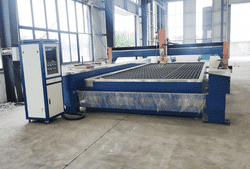
A CNC Water Jet Cutter performs precision work by introducing high-speed water, usually containing some abrasive, to cut the material with exact accuracy. CNC stands for Computer Numerical Control, indicating that the cutting system is programmed through a computer to follow exact patterns and designs.
PSI Pressure
Tolerance
Max Thickness
Material Waste
Waterjet technology is renowned for its ability to cut materials without creating heat-affected zones, making it suitable for materials that react to high temperatures. Water jet cutters are capable of producing pressures up to 60,000 pounds per square inch (psi) or even beyond, which, when combined with abrasives like garnet, allows them to cut hard materials such as steels, titanium, ceramics, and even glass with thicknesses of several inches.
How Waterjet Cutting Technology Works
Waterjet cutting technology utilizes the pressure of water or water combined with abrasives, such as garnet, to cut materials with precision into diverse shapes. The process begins with a pump that increases water pressure to levels as high as 60,000 psi (4,000 bar) or more.
Key Process Steps:
- High-Pressure Generation: Water pressure reaches up to 60,000+ PSI
- Nozzle Focusing: Pressurized water passes through a tiny nozzle
- Abrasive Addition: For hard materials, abrasives like garnet are mixed
- Cutting Action: Stream exits at speeds approaching 3x the speed of sound
- Cold Cutting: No heat-affected zones are created
Pure water can often suffice when the matter is cutting rubber, foam, or softwoods. Should abrasives be added, then cutting harder materials will become possible: metals, stone, or glass. It is said that modern waterjet machines can work with a tolerance of ±0.001 inches high, pitching them as high precision resultant industries.
Advantages of Using CNC Water Jet Cutting Machines

Exceptional Precision
The CNC water jet cutting machines achieve tolerances as close as ±0.001 inches, effectively duplicating intricate designs, making them suitable for aerospace applications and custom prototypes.
Versatility in Material Cutting
One of the great advantages is that it can cut most materials, including soft ones such as foam and rubber and hard ones like steel, titanium, and ceramics. Because of the cold cutting technique, thermal distortion of materials gets prevented.
Environmentally Friendly
Waterjet cutting produces limited waste (typically less than 10 percent of material is scrapped). The water used for cutting is coupled with abrasive (commonly garnet), a non-toxic and recyclable material.
No Heat-Affected Zones (HAZ)
Unlike laser or plasma cutting, CNC waterjet cutting does not create heat-affected zones. This ensures materials do not suffer from warping, cracks, or any heat-induced stress.
Improved Speed and Efficiency
Modern CNC waterjet machines can cut materials at speeds of up to 600 inches per minute (IPM), making them one of the quickest cutting solutions available.
Applications of Water Jet Cutters Across Industries

Manufacturing and Fabrication
Water jet cutters are transforming manufacturing and fabrication as they present powerful means for cutting a wide variety of materials with the utmost precision. CNC water jet machines can tolerate measurements of ±0.001 inches, making them most suitable for fabrication of components used in aerospace, automotive, and medical devices industries.
- Aerospace component manufacturing with titanium and composites
- Automotive part production including engine blocks and panels
- Medical device manufacturing requiring high precision
- Custom fabrication projects with minimal waste
Aerospace and Automotive Applications
The worldwide water jet cutting machinery market is expected to go beyond $1.8 billion by 2030, chiefly driven by production lines for the automotive and aerospace sectors. Water jet cutting is valued in aircraft manufacture for maintaining material integrity without heat-affected zones.
Art and Design Uses
Water jet cutting has established itself as an invaluable tool within the realm of art and design, offering precision and creativity not seen in any similar technique. The global water jet cutting machines market is forecasted to hit $1.6 billion by 2027, with significant contribution from creative industries.
- Architectural decorative panels and mosaics
- Sculptural elements in metal, stone, and glass
- Jewelry manufacturing with intricate designs
- Custom signage and artistic installations
Comparing CNC Water Jet Cutters to Other Technologies

Water Jet vs. Laser Cutting
| Feature | Water Jet Cutting | Laser Cutting |
|---|---|---|
| Material Compatibility | Versatile, almost any material | Limited, struggles with reflective/heat-sensitive materials |
| Material Thickness | Up to 200+ mm | Best for materials under 20–25 mm |
| Precision | Very high | Excellent for thin materials, less ideal for thicker cuts |
| Cutting Speed | Slower for thin materials | Faster on thin materials |
| Environmental Impact | No fumes, minimal waste | May release some hazardous fumes |
| Cost | Better for thicker materials | Lower for thin materials |
Water Jet vs. Plasma Cutting
| Feature | Water Jet Cutting | Plasma Cutting |
|---|---|---|
| Cutting Method | High-pressure water stream with abrasive | Electrically conductive gas (plasma) to melt and cut |
| Material Compatibility | Almost any material including non-metals | Primarily conductive metals (steel, aluminum, copper) |
| Thickness Range | Up to 12 inches thick with high precision | Best for metals up to 2-3 inches thick |
| Cutting Speed | Slower, especially for thicker materials | Significantly faster on thinner metals |
| Precision | Extremely precise (±0.005 inches), no HAZ | Moderate precision (±0.02 inches) with HAZ |
| Environmental Impact | Clean process with no harmful fumes | Produces fumes, requires ventilation |
| Operating Costs | Higher ($15-$30/hour) | Lower ($8-$15/hour) |
Understanding Waterjet Cutting Machines

Components of a CNC Waterjet Machine
Critical Components:
- Cutting Table: Installs in sizes 4×4 feet to 12×24 feet or more
- High-Pressure Pump: Must create water pressure of 40,000 to 90,000 psi
- Nozzle and Cutting Head: Made of wear-resistant materials like sapphire or diamond
- Abrasive Delivery System: Feeds abrasive at the rate of 0.5 to 1.5 pounds per minute
- Controller and CNC Software: Programs exact cutting paths and controls accuracy
- Drive System: Maintains steady movement along the axes of X, Y, and Z
- Water Filtration System: Reuses water and thereby reduces the environmental impact
- Chiller Unit: Controls the temperature for consistent performance
Choosing the Right Waterjet System
Selecting the appropriate waterjet system depends on several key considerations:
- Material Compatibility: Abrasive or pure waterjet cutting depends on the material.
- Precision Requirements: High precision systems can hold tolerances to ±0.001 inch.
- Pump Pressure: Consider that modern systems restore pressures between 40,000 and 90,000 PSI.
- Bed Size: Size of your workpieces is to be considered.
- Budget: You need a first investment of about $50000-$300000.
- Environment Affects: Consider the fact that we can recycle.
Maintenance and Optimization
Regular Maintenance Practices
Essential Maintenance Tasks:
- Monitor Nozzles: Replace every 80-120 hours of operation
- Check High-Pressure Lines: Check for leaks and deterioration on a daily basis
- Maintain Abrasive Systems: Clean the hoppers daily and monitor consumption
- Service Pumping System: Replace the seals every 500-1,000 hours
- Update Software: Monthly checks for software updates which can improve performance
- Monitor Water Quality: Ensure TDS is found within range of 50-250 ppm
Common Issues and Solutions
| Problem | Cause | Solution | Prevention |
|---|---|---|---|
| Low System Pressure | Blocked filters, leaks, worn pump parts | Clean/replace filters, fix leaks, service pump | Regular filter maintenance |
| Excessive Noise | Air entrapment, cavitation, damaged bearings | Bleed system, ensure water supply, replace bearings | Proper system setup |
| Overheating | Inadequate cooling, improper lubrication | Improve cooling, use proper lubricants | Regular maintenance schedule |
| Water Quality Issues | High TDS, mineral deposits | Install filtration, regular descaling | Monitor water quality |
The Future of CNC Water Jet Cutting Technology

Innovations and Trends
The waterjet cutting industry continues to evolve with several key innovations:
- AI Integration: Algorithms reduce material waste by up to 30%
- Abrasive Recycling: Systems can reduce media costs by 70%
- Automation Impact: Increases production speeds by 30%, reduces labor costs by 25%
- Hybrid Systems: Combining waterjet with other machining processes
- Sustainability Focus: Low-pressure systems reduce water consumption by 50%
Market Size by 2026
Annual Growth Rate
Productivity Increase
Cost Reduction Potential
Frequently Asked Questions
Waterjet Cutting Machine and Its Working Principle
Waterjet cutting machine uses a very high-pressure jet of water or a mixture of water and abrasive substances to cut materials. Cutting action takes place when a high-pressure pump generates a stream of water sometimes above 60000 psi and forces it through a fine nozzle, under which sits the material.
What Materials Would the CNC Water Jet Cutter Possibly Cut?
The CNC water jet cutter will almost cut anything: from the relatively soft materials such as rubber and foam to more rigid materials such as metals and ceramics. Abrasive water jet cutting is employed for hard materials and pure water jets are used for soft materials.
Which Is Better: CNC Water Jet or Laser?
Both are meant for varying functions. Water jet cutting can only be done on thick materials without heat being generated, while laser cutting would perform these operations much faster and with finer accuracy on thin materials. Depending on the specific needs of a project would determine the choice.
What Are the Benefits of Using CNC Water Jet Cutting Systems?
The main advantages encompass the superior quality of the edges processed, versatility when machining materials, precise cutting processing, eco-friendly technology, and the property to cut material without any heat-affected zone. The variable-sized cutting table can accept workpieces of varied sizes.
What Industries See the Use of CNC Water Jet Cutters?
Major areas of industries include manufacturing, aerospace, automotive, and architectural applications wherever there is a requirement for precision cutting. The areas of application range from cutting of complex parts for aerospace to architectural designs in stone and glass.
Conclusion
CNC waterjet cutting is the epitome of precision manufacturing for the cutting edge, offering versatility, environmental responsibility, and cutting accuracy. As demanding enforcers of even greater precision and sustainability, waterjet cutting forms the leading edge of advanced manufacturing solutions. Be it aerospace, automotive, manufacturing, or creative industries, a firm grasp of this technology can help you enhance production capabilities to ensure top quality at all times.
Reference Sources
-
Development of CNC Lower Pressure Water Jet Cutter
This paper introduces a CNC lower pressure water jet cutter, combining PREMAJET and CNC techniques, and discusses its applications.
Link to source -
Control System for the Waterjet Cutting Machine
This study focuses on the control systems and algorithms for water jet cutting machines, developed at the Institute of Robotics, University of Maribor.
Link to source -
Research on 3D Metal Sculpturing by Water Jet Cutting Versus CNC Machining
This research compares abrasive water jet cutting with traditional CNC machining for manufacturing complex 3D parts.
Link to source -
CNC Water Jet Set Design for Educational Purposes and Its Implementation
This paper explores the design and implementation of CNC water jet cutting machines for educational purposes, focusing on cost-effective solutions.
Link to source -
Risk Analysis of Five-Axis CNC Water Jet Machining Using Fuzzy Risk Priority Numbers
This study analyzes the risks associated with five-axis CNC abrasive water jet machining, providing insights into its safety and efficiency.
Link to source