




In precision manufacturing, an Electrical Discharge Machining Drilling Machine is something of a revolutionary tool; also called EDM drilling, it has the capability of making very tiny holes and shapes in hard materials with great precision, thereby serving a vital function for industries like aerospace, automotive, and medical device manufacturing. But what is it that sets the EDM drilling apart from conventional drilling methods? This blog article will give you an in-depth look into the EDM Drilling Machines’ unique features, their benefits, and uses. You will learn why EDM drilling is a force of change in precision and efficiency, whether you are a professional in manufacturing or simply intrigued by cutting-edge industrial processes. So stay with us while we explore how this technology works and why it is making its way into shaping today’s advanced manufacturing process.
Introduction to EDM Technology

Definition of EDM Drilling Machines
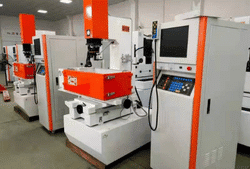
Electrical Discharge Machining (EDM) drilling machines–commonly called hole poppers or small hole EDMs–are specialized manufacturing tools that produce precise, small, and deep holes in electrically conductive materials. This process carries out erosion of material by electrical discharges (sparks) formed between an electrode and a workpiece to produce the needed hole. Unlike the conventional drilling methods that involve mechanical force, EDM drilling is a non-contact method, and hence, it is very much suitable for manufacturing hard and brittle materials such as carbide, titanium, and superalloys.
Key Specifications:
- Hole diameters: Less than 1 mm
- Tolerance: ±0.01 mm
- Applications: Aerospace, medical devices, electronics
Base contemporary EDM drilling machines can punch holes of diameters less than 1 mm and with a tolerance of ±0.01 mm. Such equipment is needed in the aerospace, medical device manufacturing, and electronic fields. With recent developments having taken place, the machines can now be equipped with automatic electrode changers, multi-axis control, and intelligent software to make them more productive and less labor-intensive.
Furthermore, EDM drilling is highly heavily regarded for its capability to drill holes into awkward geometries or extreme hardness materials, which traditional methods can almost never process. It is most used for application cases such as cooling holes in turbine blades, microdrilling for semiconductor components, or milling fine features in complicated molds. Trends in EDM technology also exhibit an approach to sustainability by considering the use of dielectric fluids with less environmental impact in hopes of achieving complete bio-friendly manufacturing processes.
Basic Principles of Electrical-Discharge Machining
EDM is a unique procedure in that it removes a material from a workpiece by a succession of minute, precisely controlled electric discharges. The processes of discharge take place between the electrically conductive workpiece and the tool electrode, which is in an appropriate dielectric fluid. EDM operation begins by applying voltage between the tool electrode and the workpiece. Due to the application of voltage, a spark is created between the entrepreneur and the workpiece with intense heat generation amounting to approximately 12,000°C (21,632°F), enough to melt the material into the thin layer and vaporize it, carried away by the dielectric liquid.
Operating Temperature: 12,000°C (21,632°F)
One principle of EDM is keeping a small gap, called the spark gap, between the tool electrode and the workpiece, such that this gap is very strictly controlled to ensure consistent electrical discharges. The dielectric fluid does the cooling and debris flushing work but also behaves as an insulator until the voltage finally reaches the breakdown voltage to produce a spark.
EDM technology can be divided into two major types:
Sinker EDM
(or die-sinking EDM): This uses a shaped electrode that is gradually lowered into the workpiece to create complex cavities and intricate shapes.
Wire EDM
(or wire-cut EDM): The electrode in this case is a thin conductive wire that cuts through the workpiece to produce thin and fine contours both 2D and 3D with exquisite precision.
Latest Trends and Data Regarding EDM Technology
Recent advancements in EDM are aimed at creating precision and reducing the cost of operation. According to a newer study in the Journal of Manufacturing Processes (2023), newer EDM systems have achieved tolerances as small as ±1 micron with the finest surface finishes of Ra 0.2 microns. This certainly makes the EDM system capable of micro-manufacturing operations.
AI-Optimized Performance Improvements:
- 30% reduction in machining time
- 25% improvement in electrode life
Further developments in the field have seen the implementation of Artificial Intelligence and machine learning into EDM systems to allow machining parameters to be optimized in real time, thus minimizing tool wear and machining time. One data point indicating, possibly, a 30% reduction in machining time and a 25% improvement in electrode life using AI-optimized EDM machines.
Another emerging trend is to have environmentally friendly dielectric fluids with bio-based ingredients. These fluids reduce the environmental impact of the process, while improving the cooling and rinsing away of debris. Recent market studies have revealed that the sector for EDM machines with green dielectric solutions is expected to develop at a CAGR of 7.4% all through 2030, owing to rigid environmental policies and industry sustainability objectives.
How EDM Machines Work

In EDM, spark erosion under control is used for the machining of conductive materials with utmost precision. Generally, this principle acts when a series of electrical discharges is made between a consumable electrode and the workpiece, there being a dielectric fluid in between. Since no mechanical force acts on the workpiece, this showcased machining appeared best for very soft or single-type composites.
It is considered started by the creation of an electric field between the tool, that is an electrode, and the workpiece. When the breakdown voltage of the dielectric fluid is exceeded, an electrical discharge occurs, releasing immensely intense heat in the region of 8,000-12,000 degrees Celsius. This is the heat which instantly vaporizes or melts the material that is then washed away by the dielectric fluid, guaranteeing accuracy and cleanliness.
Due to the advancements in the EDM technology, its efficiency and applications have witnessed numerous favorable developments along the way. Modern-day EDMs consist of automated tool changers, adaptive process monitoring, and are capable of high-speed machining. As per a 2023 report from the industry, wire EDM holds a leading share in the global market, accounting for more than 40% of total EDM sales. Therefore, wire EDM is usually named as the method to make parts that can have complex geometries and tight tolerance, such as turbine blades or medical implants.
Market Share: Wire EDM accounts for 40%+ of total EDM sales
Furthermore, the incorporation of IoT and AI capabilities into EDM machines is expected to increasingly foster evolutions in manufacturing practices. Smart EDM solutions enable machine monitoring in real-time along with predictive maintenance that could cut the downtime of machinery by 25%. With such developments, EDM still continues to create frontiers in precision engineering in automotive, aerospace, and medical domains.
Functionality of EDM Drilling Machines

Unique Process of Electrical Discharges
Working on the exterior part of a component through electrical and thermal forces, imprinting electrical discharges have been created in this sense as an option to rolling or conventional machining methods under electric discharge machining. These sparks are generated between the electrode and the workpiece via a dielectric fluid in this non-contact machining process, to erode the material to the desired dimension. Since the electrode and workpiece never actually touch, the possibility of damage or deformation caused by mechanical forces during machining is virtually nil.
AI-Based Improvements: Up to 20% reduction in surface roughness
Recent developments in EDM technology, up to 2023, have seen the advent of better discharge control through AI-based algorithms. Such systems can now recognize the ideal spark frequency, voltage, and energy values corresponding to their spark time, allowing them to improve all parameters of the process for accuracy and efficiency. For example, it has been found through research studies that by controlling discharge frequency, surface roughness could be reduced by as much as 20% as compared to older EDM techniques.
Industries such as aerospace and medical devices must process what are called micro-holes, measuring from 0.1 mm or lesser in diameter. New EDM drilling machines can just do that. The studies further pointed out the highly precise nature of EDM drilling, offering tolerances of ±0.005 mm at hole level, and further said it remains high speed, thereby enhancing production rates.
This particular type of electrical discharge enables one to say that the EDM ranks as one of the very best solutions when it comes to working with hard-to-machine materials such as titanium, tungsten, and hardened steel. The integration with AI and micro-machining capabilities are areas where EDM is progressing further and setting more demanding standards on precision manufacturing.
Precision in Material Removal
Material removal needs precise milling in the contemporary manufacturing processes, and in this very regard, matrix EDM stands unparalleled in precision. With the advent of technology, EDMs are able to achieve limits as tight as ±0.001 mm, thus favoring industries such as aerospace, automobile, and medical device building processes. Recent developments have witnessed real-time adjustments of machining through AI-based optimization algorithms, thus minimizing chances of error and maximizing repeatability of results.
Market Growth & Efficiency Improvements:
- CAGR: 6.7% (2023-2030)
- Energy Efficiency: 30% improvement over older models
According to recent industry reports, the global EDM market is forecasted to grow at a CAGR of 6.7% between 2023 and 2030, marking the steady rising demand for precision manufacturing. The report also brings insights that average EDM systems are about 30% more energy-efficient today (on a relative basis) as compared to their predecessors, thus lowering their environmental footprint and operating costs. Another favorable thing on the plate is the advent of hybrid technologies that allow the EDM process to be paired with laser-assisted machining to extend precision and versatility in the material removal phase even to the most complex design application requirements.
The transformation is still underway in the manufacturing industry and has served to enable industry sectors to produce parts with tight tolerances, nearly perfect surface finish, and complex geometries with utmost reliability.
Comparison with Traditional Drilling Methods
Since techniques such as Electrical Discharge Machining (EDM) or laser-assisted machining were compared to the more traditional-method of drilling, they should have been seen through the prism of varying degrees of precision and efficiency, capability, etc. The conventional method of drilling involves mechanical contact between the drill bit and the material being drilled. While this approach is great for keeping it simple, and drilling materials that are soft to moderately hard, it will hamper any attempts at highly intricate geometries, materials that are brittle and demanding in terms of tolerances.
Looking into another extreme, advanced machining methods do not use mechanical force. EDM causes electric discharges to shape conductive materials with supreme accuracy so that holes-in-the-micrometer grade, sharp corners, and complicated features can be formed, which are not possible with traditional ways of drilling. The literature denotes that the electrical discharge machining method can obtain tolerances down to ±0.0001 inches, whereas the traditional one is usually limited to ±0.001 inches.
Laser-assisted machining further enhances capabilities by supplying energy during the cutting process, which helps to achieve better cuts and could even be applied to cutting harder materials–like ceramics or titanium alloys. Reliability of components is a key factor in aerospace and medical industries. Furthermore, these advanced processes reduce tool wear considerably, thereby promoting cost efficiency in fine manufacturing.
The reports from industries themselves indicate that this method of machining has witnessed an increase of up to 30% in production efficiency when compared against traditional drilling due to: lesser setup times, no physical wear to the tools, and fewer secondary operations such as deburring. These advancements are transforming industries by allowing the production of designs that were previously impossible to make and delivering parts with better surface topography and structural integrity.
Advantages of EDM Drilling

Working with Hard Materials
When there is a need to work on hard or high-strength materials-WC, titanium, or hardened steel-EDM drilling is especially preferred. Conventional machining finds these materials challenging precisely because the tool wears down or it just cannot accommodate very tight tolerances. Given the circumstances, where controlled electrical discharges are used to erode the material, EDM drilling is obviously suitable.
Capability: Materials with hardness >60 HRC
Recent or actual industrial experience and data show the ability of drilling through EDM in aerospace, medical, and automobile industries for materials with a hardness rating above 60 HRC with little electrode wear. For example, titanium is used in aerospace due to the highest strength-to-weight ratio; therefore, EDM drilling enables one to precision machine complex parts like turbine blades and engine components.
This method may also prove useful for machining thin or delicate features on hard materials that would otherwise suffer deformation or cracking if mechanical stresses were applied. According to a report from 2023, EDM drilling increases the efficiency of the production of medical implants from biocompatible material, e.g., cobalt-chrome alloys, to dimensional accuracies within ±0.005 mm.
Complex Shapes and Designs
EDM opened up the possibility of creating shapes so intricate and complex that could not be made before through the traditional machining process. Electrically discharged machining uses controlled electrical discharges to shape materials, making it one of the few processes capable of handling titanium, tungsten carbide, and ceramics, all being difficult to machine with conventional tools.
Precision Achievement: Tolerances of ±0.002 mm
In respect to recent times, advancements have evolved within EDM mechanisms and technology to enable the machining of microfeatures and freeform geometries with supreme precision. According to an industry report in 2023, the EDM systems as of modern times are able to hold very fine tolerance of ± 0.002 mm, thereby standing in great need for aerospace and electronic industry applications where fine precision is required. In essence, turbine blades bearing intricate cooling channels and micro-injectors for automotive systems are being manufactured with geometrical complexities existing with very tight design and performance specifications.
Additionally, EDM has been equated with the high level of technology and innovation necessary for the medical field. Implantable devices of an intricate nature with utmost precision now employ advanced lattice structures for maximized strength with less weight. It is the high precision EDM process that achieves such designs with the maintenance of surface integrity and extreme tolerances.
Nowadays, this precision is achieved through AI and machine learning incorporated into these EDM setups. They recognize patterns, adjust parameters in anticipation, and assist cutting work efficiency. The other factor that has given designers almost limitless freedom to push engineering boundaries with their creativity is this hybrid EDM: Welding additive manufacturing to electrical discharge technology. This hybrid approach allows for quick manufacturing of very customized components, with lead times and costs greatly reduced compared with traditional means.
Improved Accuracy and Efficiency
EDM stands better than conventional processes owing to its greater accuracy and efficiency. Modern EDM machines make use of latest trends with CNC technology, giving machining accuracies of the order ±0.002 mm. This degree of precision is deemed necessary by aerospace, automotive, and medical device manufacturing industries having very narrow tolerances.
Performance Improvements:
- 30% increase in machining speed
- Reduced energy consumption through optimized power delivery
Innovations like high-speed EDM drilling and robotic systems for electrode changing have harvested much production efficiency from an albeit cycle time perspective. Recent industry reports claim that the advanced models of EDM machines can increase the rate of machining by up to 30% as the power delivery system consumes less energy. All these factors reduce the cost of operations and increase manufacturers’ productivity to stay ahead of growing global demand for complex customized components.
Applications of EDM Drilling Machines

Industries Utilizing EDM Technology
Being machining processes, EDM drilling machines find applications in various industries because they provide accuracy in scenarios involving machining hard-to-work materials into complex shapes. Some major industries, along with their applications of EDM technology, include:
🚀 Aerospace Industry
EDM finds substantial use in the aerospace manufacturing industry, especially for turbines, engine components, and airframe parts. For turbine blades, holes need to be drilled through EDM drilling machines with precision so that the blades can efficiently handle extreme temperatures.
Market Size: $990 billion by 2031
⚕️ Medical Industry
EDM is an indispensable process by which surgical tools, implants, and highly elaborate components for medical equipment can be made. In the realm of very needlelike tiny holes and complex geometries for minimally invasive surgical tools are fabricated by EDM processes.
Market Size: $964.9 billion by 2030
🚗 Automobile Industry
In the automobile industry, high-performance components and fuel injectors, engine components, and transmission systems are created by means of EDM. EDM drilling for precision assures exact tolerance levels, which are important for performance maximization of any vehicle.
Focus: Hybrid-electric vehicles
🔧 Tool and Die Manufacturing
EDM is used by the tool and die industry in particularly complex processes where molds, dies, and punching tools are designed. These are fabrication processes for consumer goods, electronic applications, and industrial purposes.
Market Value: $189 billion (2022)
⚡ Energy Sector
For power generation, the energy industry uses EDM for processing turbines, fuel systems, and equipment used in renewable energy and conventional energy production. All this, with utmost precision, ensures that the energy systems are efficient and sustainable.
💻 Electronics Industry
At a micro level, EDM helps to manufacture electronic components like connectors, semiconductors, and PCB components. Going with the trend of miniaturization, EDM drilling is deployed to realize very complex designs with quality in electronics.
These major industries serve as testimony to the versatility and significance of EDM drilling machines in today’s manufacturing activities. This also stresses making businesses more efficient, scalable, and innovative. EDM techniques are expected to find newer applications and see wider adoption with technological improvements.
Precision Requirements in Aerospace and Automotive
The aerospace and automotive industries always require very high precision manufacturing to ensure safety, performance, and reliability. Very precise operations are conducted by EDM drilling to achieve these high precisions. In aerospace, it is imperative to manufacture extremely accurate cooling holes on turbine blades so that they can resist very high temperatures and stresses. EDM drilling is capable of drilling hard materials like titanium and nickel alloys used in aerospace, and hence become central to the production process.
EDM Market Growth: 6.5% CAGR (2022-2030)
Hence, within the automotive space, EDM is used as a high precision method in view of efficiency and innovations. Just consider for a split second fuel injectors or transmission parts and engine parts. These components require intricate machining in order to function well. Latest figures in 2022 indicate increased investment by the global automotive industry in EDM technology to meet the emerging requirements of electric and autonomous vehicles that require highly intricate and reliable parts.
In Grand View Research’s 2023 report, the EDM market is forecasted to grow at a CAGR of 6.5% between 2022 and 2030, keeping the aerospace and automotive industries as key growth drivers. These developments are in line with constant evolution in electronically ignited EDM machines, toward better accuracy and better energy efficiency, together with the ability to work on advanced materials. Hence, the EDM remains one of the foundation tooling blocks of precision manufacturing to produce parts to harsh industry specifications.
Applications in Medical Manufacturing
Previously, EDM was utilized for finishing operations in steel mold tools; presently, it has evolved into a production operation in the medical field, allowing intricate work to be done. In view of minimally invasive surgical procedures and high-end medical technologies, highly complex components are manufactured with pinpoint accuracy using methods like EDM. Examples of EDM applications are surgical instruments, implants, prosthesis components, and intricate micro-tools.
Medical Device Industry Growth: 5.5% CAGR (2023-2030)
According to market reports recently issued, the medical device industry will grow at 5.5% at CAGR from 2023 to 2030, impacting the EDM technology’s adoption heavily. EDM is employed in such instances where the materials are titanium, stainless steel, and cobalt-chrome alloys, which are metals typically utilized in the fabrication of medical parts because of their biocompatibility and strength. Besides, EDM is required for keeping super close tolerances and excellent surface finishes, which are very crucial in the effective functioning of stents and orthopedic implants within the human body.
With the introduction of CNC-controlled EDM machines, this technology responds to the increasing demand for personalized medical devices, which come with very complicated customizations on the path of individual patient needs. EDM also enhances 3D printing on additive manufacturing for medical components in terms of precision and quality, thus powering the innovation in this sector.
Comparative Analysis of EDM and Other Machining Methods

Efficiency and Cost Considerations
EDM is reputed to render a phenomenal degree of accuracy and complexity to the machining process. Whereas conventional machining processes such as milling or turning cannot provide very intricate shapes and fine features due to tool deformation, EDM being a non-contact method makes those forgeries feasible. This particular trait renders more efficiency for scenarios where conventional tools would be inadequate or need more than one implementation to give the expected output.
Cost-wise, EDM machines are generally expensive to operate as the electrodes get used up along with the consumption of dielectric fluids; the initial cost of purchase being on the higher side for some good machinery. Working life, however, is offsetly compensated for by very little secondary processing time involved, if at all, and by machining hardened material outright, thereby foregoing the need for heat treatments prior to machining.
Productivity Increase: 30% compared to early-generation systems
Recent data show that modern CNC-controlled EDM machines have indeed granted much greater processing speeds, offering up to 30% higher productivity compared with early-generation systems. Additionally, the ability to go unmanned for longer hours also makes it a cost-saving method when making complex, expensive parts, say, for aerospace and medical manufacturing.
A comparative study published in 2023 reports that traditional CNC-milling may probably achieve nearly 2.5 mm^3/min of material removal against complex alloys, whereas the advanced EDM system may have achieved 5 mm^3/min of MRR against the same materials, showing almost double efficiency in some way of applications. This enhancement makes EDM an attractive competitor complemented to the process in modern-day manufacturing.
Accuracy and Precision Comparisons
Accuracy and precision constitute pivotal factors that incubate an expansive spectrum of application in aerospace, automotive, and medical device manufacturing for EDM and CNC milling.
The general perception about EDM is that it has superior capability to retain delicate geometries in materials. Modern EDM equipment can be run with a tolerance of ±0.0001 inches, allowing it to be used for manufacturing where intricate detail and surface finish on a part have been of prime importance. In addition, undercuts are produced without imparting mechanical stresses that might disturb the structure of delicate materials such as titanium alloys and high-strength ceramics. Furthermore, in EDM, since the wear of tools is quite less of concern related to the accuracy, its precision remains consistent throughout prolonged use.
On the other side are the CNC milling machines; the degree of precision considered would need to be specified, but advancements in motors and drivers etc. have allowed it to achieve high accuracy in any case. For instance, in the realm of high-end 5-axis machining, CNC mills nowadays operate within tolerances of about ± 0.0002 to ± 0.0005 inch, and the installation of real-time monitoring sensors, adjustable feed rates, and AI-enhanced decision-making allows them to follow intricate cutting paths with minimal deviation.
Recent findings suggest that various industry studies identified that their choice between EDM and CNC milling depends on the client’s specifications for the end product. For geometries demanding extremely fine features or even sub-micron accuracy, EDM is almost never not chosen. For larger components, which require a strong structural presence with consistent tolerances, CNC milling, on the other hand, is more effective.
The EDM vs. Other Methods
Very foreign processes are brought together by EDMs, which possess ultimate precision and offer the ability to machine extremely hard or delicate materials. The machining of quite intricate or complex shapes very rarely can be achieved better with the EDM process. Going by industries and standards, EDM is preferred and ensures tolerances within ±0.0001 inches in aerospace, automotive, or med-tech industries, among others.
The other critical parameter is hardness. EDM is the right machining method for materials that pose difficulty when being machined with conventional ways, for example, titanium alloys, tungsten carbide, or hardened steels. To contrast one with CNC milling, direct contact occurs between the cutting tool and the material in CNC milling. With the EDM process, an electrically charged spark that erodes the material is applied, thus working without having any contact and making it best for brittle or heat-sensitive materials.
EDM Growth in Niche Applications:
- 15% annual growth in die-making and micro-machining
- Wire thickness: Down to 0.001 inches diameter
Statistical indications reveal that EDM use seems to grow approximately at a rate of 15% every year for niche applications like die-making and micro-machining. Because of recent developments, sinker and wire EDM machines can now accept thinner wires (down to 0.001 inches in diameter) for micro-precision cutting, a feat no other machining process seems to be able to accomplish. Automated EDM systems also allow continuous operation for longer periods compared to manual intervention, thereby increasing production efficiency when stakes are high.
Lastly, EDM can be used as a machining process to obtain a low surface roughness (as smooth as 0.1µm Ra), which is necessary when molding parts or when surface finish affects the function of the molded part, such as injection molds for medical devices and high-performance engines. In conjunction with this advantage and its ability to process parts not machineable by any other means, this makes EDM the method of choice for high precision, high complexity manufacturing needs.
Frequently Asked Questions (FAQ)
What is an EDM Drilling Machine?
An EDM drilling machine, also called an electrical discharge machining machine, has a specialized orientation for machine tool that make tooling in precise holes into conductive materials. It works with electric discharges that generate sparks, and erode material from the workpiece to make it produce deep holes and complex shapes unusual with conventional machining. EDM drilling is mostly utilized to power small holes, i.e., holes required by turbine blades or aerospace parts. The manufacturing process involves procedures by controlling parameters of discharge energy, and speed are especially useful to high precision machining. This technology is quite important for any industry requiring tight tolerances and top-notch surface finish.
How does an EDM drill work?
Electro-discharge machining is a special kind of drilling operation in which drilling is carried out by electrical discharges occurring between the electrode and the workpiece under the dielectric fluid. As soon as the electrode comes to the approximate distance from the work surface, spark strikes, and a little material gets eroded during discharge. This is done so quickly that holes are created down to 0.1 mm in diameter. This is very essential for drilling tiny holes on aerospace components. The control system of the machine is arranged so that the required amount of material is removed, saving time and increasing precision. EDM machining can also be used for tap removal or are able to form complex shapes from hardened steel.
In what applications is EDM hole drilling suitable?
This is an adaptable method of hole drilling and finds usefulness in a variety of fields such as aerospace, medical, and automotive. Usually, it is employed to drill holes in turbine blades and jet engines, in molds, and so on since it can drill very deep holes in conductive materials at very precise angles. EDM drilling machines can surface-treat workpieces made of tungsten and carbide, in particular those tough to machine in the conventional sense. Apart from this, the EDM process is quite capable of carving very intricate designs and features on a part-a blessing for manufacturing technology where quality is paramount. EDM also creates holes for wire EDM setup-so that the part can be machined further.
What is CNC EDM and how does it differ from traditional EDM?
CNC EDM, or Computer Numerical Control Electrical Discharge Machining, is a machinery type that automates the EDM process to increase the precision and repeatability of machining. While conventional EDM may require manual response, CNC EDM programming automatically drills with set conditions, thus affording higher machining speeds and accuracy. This advantage is especially considered when tight tolerances are involved in working with intricate shapes, such as aerospace and medical device manufacturing. Moreover, CNC EDM machines can run in multi-axis setups to obtain much more complex geometries and features posed as an obstacle from being handled in conventional sinker EDM machines. The incorporation of CNC technology greatly increases productivity and consistency for applications which demand closely precise results.
What benefits does EDM provide in drilling operations?
Using EDM services for machining operations offers several benefits, especially when tackling hard materials and complex shapes. Foremost, certain industries like aerospace industries and manufacturing technology require tight tolerances and very high precision. Therefore, EDM drills can drill small holes with almost mirror finishes, making them perfect for fine detail work, molds, and dies. At the same time, owing to the principal methods of material removal, the heat generated will be minimal and thus limit thermal distortion of the workpiece. A good stream of dielectric fluid keeps debris away and extends machining efficiency. It can also serve for extracting broken taps and other obstacles while keeping the surrounding material safe.