




These machines have served as essential tools in the machining world, enabling precise and detailed cuts and designs. Whether you are a professional machinist, an aspiring engineer, or simply someone interested in industrial machinery, a deeper understanding of slotter machines —encompassing their components, working mechanisms, types, specifications, and applications —opens up a whole realm of possibilities. This guide is meant to serve as an instructor for those wishing to dive deeper into the world of slotter machines by listing out their parts, describing their operation, going through available types, and enumerating their practical applications in various industries; With that, you will be quite convincing of the slotter machine’s usefulness in modern manufacturing and engineering.
Overview of Slotting Machines
Slotting machines are essentially mechanical devices used for shaping and cutting materials, commonly metal, to the required size and form. The vertical reciprocation of a single-point cutting tool allows this machine to slot, groove accurately, cut internal shapes, and the like. The machine, being immensely accurate and efficient, finds wide application in industries such as automotive, manufacturing, and metalworking. Slotting machines are used because they give a very detailed and uniform finish to the job that requires keyways, gears, or more specialized machining.
What is a Slotting Machine?
The slotting machine belongs to the family of vertical shaping machines and is used for providing precise slots, grooves, keyways, and internal shapes in the workpiece. The operation is carried out by a single-point cutting tool that moves up and down in a reciprocating motion; hence, the slotting machine is best suited for all sorts of precision work and detailed machining operations. Slotting machines are utilized in the automotive, manufacturing, and metalworking industries, as they provide uniform results with great precision. They are required for making gears, keyways, and other tricky shapes where complex machining work can be done very efficiently.
Basic Functionality of a Slotter Machine
The method of operation of slotter machines involves the reciprocating vertical movement of a single-point cutting tool, which creates accurate and intricate shapes. The workpiece is securely held in place on the stationary table while the tool removes material in increments. The cutting tool moves vertically, and the worktable may move in various directions to facilitate the production of mechanical features such as slots, grooves, and internal keyways. These machines also allow for angular cutting and contouring. Depending on the requirements, the slotter machine can adjust the speed of cut, depth of cut, and feed rate, which enhances its capability and precision, making these machines mandatory for intricate machining across various industries.
Importance in Manufacturing Processes
Slotter machines are crucial in production processes, as they can create very fine and intricate shapes, which are essential for producing high-quality parts. Meanwhile, their operations allow machining of complex keyways and unique geometries, including internal grooves, profiles, and dimensions, for automotive, aerospace, and heavy equipment manufacturing. In addition to reducing time involved in production and operational efficiency, slotters can facilitate heavy customization and offer guaranteed accuracy. They are capable of machining various types of materials across different sectors, ranging from metallic to composite materials. By these features, the flow of work gets comparatively easier and has a lower cost in modern industries.
Classification of Slotting Machines
Slotting machines can be classified according to their type of construction, purpose, and nature of motion. The major types of slotting machines are:
Puncher Slotter Machine
Generally, puncher slotters work on smaller tasks with intricate designs or in many precision-required applications, such as tool-making or component shaping. Since it is designed for light operations, it is primarily used in workshops for creating precise slots and keyways.
Precision Slotter Machine
Specifically, this type supports applications where utmost precision is required, such as manufacturing fine gears, automotive components, and small mechanical parts. Used for super-fine work and requires a finish, such as delicate machinery parts.
Heavy-Duty Slotter Machine
Capable of handling heavy jobs efficiently on significant metal parts, these machines are used in heavy industries such as shipbuilding, civil construction, and scaffolding. Designed for industrial purposes, this machine can handle large and heavy workpieces, making it suitable for manufacturing heavy machinery.
Special Purpose Slotter Machine
These imitations are designed to meet special needs with higher efficiency for versatile projects, ranging from highly complex notches to specialized hole patterns. Customized to perform specialized operations in manufacturing, these machines strike a balance between efficiency and flexibility.
Mechanical vs. Hydraulic Slotting Machines
While mechanical slotters operate with the help of a power transmission system, hydraulic machines tend to provide much smoother, more powerful movements and are therefore preferred for heavy-duty or precision work.
Common Types of Slotter Machines
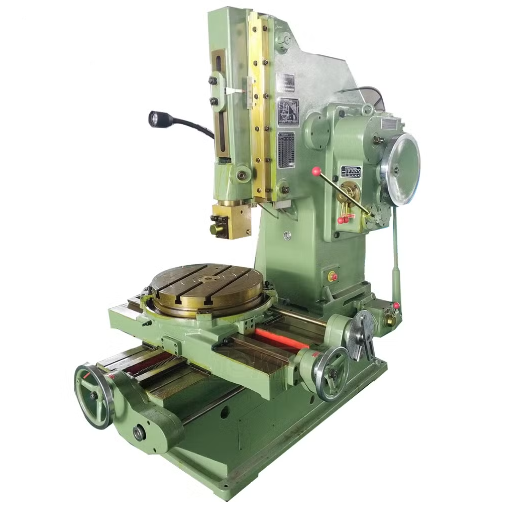
Vertical Slotter Machines
The vertical slotter is one of the most common kinds of slotters, where the ram moves vertically. They are the most versatile and are commonly used for machining slots in all materials. Being highly adaptable to various types of work, these machines efficiently produce vertical keyways in shafts.
CNC Slotter Machine
With CNC slotter machines, the perfection of slotting technology has been realized. Their application ranges from automated controls and programming at the highest precision level, enabling the execution of complex operations with minimal reliance on human intervention, following a predetermined procedure. Based on recent industry trends and advancements, it can be stated that the introduction of CNC technology has indeed drastically improved production speeds while considerably reducing material wastage.
Keyway Slotter Machine
Keyway slotters are used to slot keyways into shafts and are typically found in the manufacture of gears and pulleys. Emphasis is placed on producing repetitive, uniformly machined components.
These slotter machines serve various industrial needs, ranging from small-scale craftwork to heavy-duty manufacturing, enabling industries to achieve higher productivity while maintaining the same quality. With a continued surge in technology, automation and precision control are two factors that, when introduced into slotter machines, continue to provide the impetus for further evolution, thereby meeting the ever-demanding competitive market scenario.
Comparative Analysis of Slotter Types
| Type | Design Features | Best Applications | Industry Usage |
|---|---|---|---|
| Punching Slotter Machines | Heavy machines with a robust design | Machining large workpieces and cutting deep slots | Industries where heavy cutting is involved |
| Precision Slotter Machines | CNC systems for enhanced control and repeatability | Fine and precision machining with tight tolerance | Small, precise components manufacturing |
| Universal Slotter Machines | Flexible and versatile design | Light to medium-duty work | Small- and medium-sized industries |
Each type of slotter machine performs a specific function best and is chosen according to the suitable material type, the required precision, and the size of the work. Until today, the evolution of slotter machines has enabled their viability in meeting the ever-changing industrial requirements.
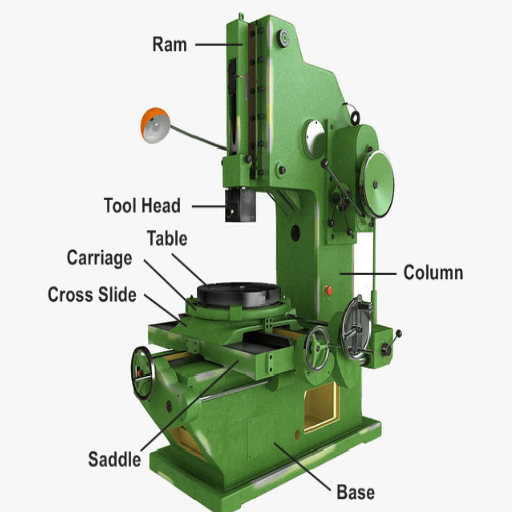
Main Parts of a Slotter Machine

Base
The base takes the full weight and ensures stability during operations. It is usually made of cast iron to absorb vibrations. The base is the foundation of a slotting machine, providing structural support and stability to all other components during operation. Additionally, it absorbs vibrations and provides precision in its work.
Column
It is the vertical part that contains the ram mechanism, giving decisive rigidity to the ram movement. The vertical column supports the ram and the tool head. Thus, it guides the vertical movement of the ram and maintains its alignment for smooth operations.
Ram (or Slide)
The ram performs the cutting operation by executing a reciprocating movement. The slotter mechanism operates it and carries the cutting tool. The ram is chiefly engaged in cutting in a slotting machine. It moves in a vertical path, carrying the cutting tool that shapes the workpiece to the desired specification.
Table
The table is the supporting surface on which the workpiece is mounted. The table can usually rotate or be adjusted vertically or horizontally to provide flexibility in machining. The workpiece is mounted on a sliding table that moves in horizontal linear or angular directions for rigging cuts. It enables precise positioning and adjustment of the workpiece during machining.
Tool Head
The tool head is the holding device for the cutting tool, which can be adjusted in position and angle depending upon slotting requirements. Holds the tool or cutter and permits the setting of the cutter at various angles or positions as may be required during the operation.
Feed Mechanism
The feed mechanism incrementally moves the workpieces to maintain consistent and precise cutting during operations. This mechanism enables the incremental and controlled movement of the workpiece during cutting, ensuring continuous and accurate cutting and contributing to high accuracy in the machining operation.
All these parts work collectively to ensure efficient slotting processes, which guarantee that the machine is versatile and practical in a variety of industrial applications. These components combine to produce a well-balanced working together for whichever machining process is required, and hence slotting machines are needed for the shaping and finishing of industrial materials.
Mechanism of Slotting Machines
Slotting machines operate through a systematic mechanism that involves precision engineering and cyclical motion. At the very center of the process is the ram, the tool head that moves vertically. A crank and connecting rod arrangement causes the ram to move up and down at regulated intervals so that the cutting tool may cut precise slots or grooves in the workpiece.
Hydraulics and electronics have been integrated into modern slotting machines, significantly enhancing their speed and accuracy. For example, depending on the material being machined, many contemporary slotting machines operate at a speed of between 20 and 40 strokes per minute. Moreover, CNC integration in advanced slotting machines enables programmable operations with tolerances as small as ±0.01 mm.
Another essential part of the mechanism is the worktable, which may also impart rotation to perform cutting at multiple angles. With feeds and speeds adjustable to various materials, including those that tackle hardened steel, aluminum, and composites, these machines are the ideal solution for a wide range of industries. These developments make modern slotting machines indispensable in sectors such as the automotive, aerospace, and tool-making industries, where precision and productivity are key.
Indeed, combining traditional mechanical components with modern technology affords superior flexibility and precision to machining operations on today’s slotting machines.
Role of Each Part in Operation
Slotting machines comprise several major components, all of which play essential roles in transforming raw material. The primary components are the ram, table, tool head, and feed mechanism, which work together to accurately shape the workpiece.
- Ram: The ram is a reciprocating member that holds and drives the cutting tool in a vertical direction into the workpiece. Today, modern slotting machines commonly utilize hydraulic or servo-drive systems for the ram, providing improved accuracy and control. For example, advanced machines have positional accuracy within microns and are used in excellent manufacturing.
- Table: The work table holds the material to be machined and provides stability during operation. In many slotting machines, the tables are rotary tables with an adjustable angle of table, permitting complicated cutting operations. Contemporary designs incorporate CNC functionality, enabling automated adjustment and seamless, multi-directional slotting.
- Tool Head: It holds the cutting tool, allowing accurate cutting on various materials, including hardened steel and composites. Advancing tool materials, such as carbide and diamond coatings, enable the tool heads of modern slotting machines to withstand extreme wear conditions, maintaining their sharpness for significantly longer periods and thereby increasing operational efficiency.
- Feed Mechanism: It assists in the gradual movement of the workpiece or tool, one after another, in continuous cutting processes. Programmable feed systems on newer machines maintain consistent material removal rates and reduce manual intervention by operators. Thus, these systems reduce errors and enhance throughput, thereby significantly improving productivity.
The harmonious synchronization of these components is primarily responsible for improved machining accuracy, reliability, and speed, thanks to technological innovations. Featuring intuitive controls and high-performance materials, these machines are raising the industry benchmark in precision engineering.
Working Principle of the Slotter Machine
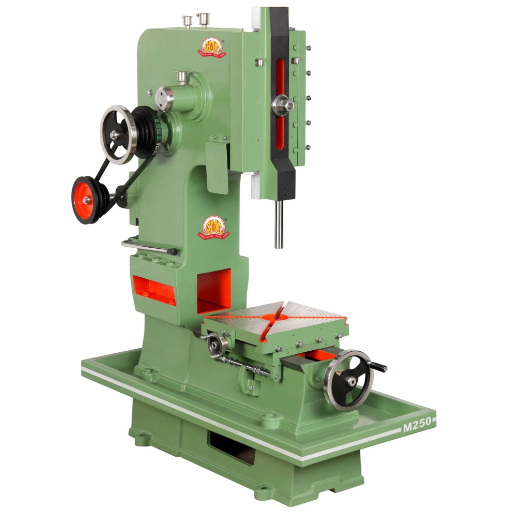
Slotting m/c converts rotary into linear reciprocating motion using a crank and slotted link mechanism. The tool, fixed on a ram, moves up and down while the workpiece is clamped on the table. The downward stroke is the working stroke when the cutting of material takes place, and the upward stroke is an idle stroke, whereby the tool is repositioned. The table can also be set to move horizontally or rotated to bring the job into position for the machining of different shapes and surfaces. This simple yet efficient working principle makes a slotter ideally suited for creating slots, grooves, and internal shapes on metal parts.
Description of Operational Procedures
Slot machine operating procedures encompass several vital steps that ensure efficiency, accuracy, and safety. The workpiece is initially clamped onto the machine table using suitable fixtures or clamps in a manner that prevents any movement as the operation proceeds. This step involves selecting the tool to mount on the vertical ram, based on the material and the desired shape of the slot, such as a rectangular, T-shape, or dovetail slot. Specifying the ram stroke length is an adjustment occasionally made by operators depending on the depth of the cut.
Feeding, whether manual or automatic, must be precisely controlled, allowing for the movement of the table to transition from horizontal to vertical or rotary positions. Modern slot machines, for example, feature automatic feed mechanisms that enable minute incremental changes to feed rates, thereby minimizing human error. Additionally, the cutting speed and feed rate are determined by the type of material; a softer material, such as aluminum, will be cut at a higher speed than steel, which is harder, to maintain tool life and achieve a quality surface finish.
Lubrication is a crucial part of the process, with coolant fluids being a common lubricant to minimize heat generation and thereby preserve tool life. It is therefore essential to monitor and adjust the coolant flow to ensure uniformity in the results. Slotter operators maintain the slots or grooves within tolerance by monitoring tool wear and replacing cutters before their wear affects the accuracy of the slots.
In addition to such capabilities, modern slotter machines correspond to CNC (Computer Numerical Control) systems capable of program-based operation. The invention enhanced the precision of the machine and reduced the setup time. In today’s world, CNC slotters can position workpieces to within micrometers and create layouts for complex slot designs by executing pre-programmed tool paths.
Regular maintenance checks, such as ram alignment, table movement, and lubrication, are essential to prolong the lifespan of these machines and minimize downtime. The operation of these machines enables industries to produce complex internal shapes, grooves, and precision slots for use with a variety of metal components.
Cycle of Operation in a Slotting Machine
The operation cycle in a slotting machine is a well-coordinated chain of movements that achieves high precision cutting. First, the preparatory stage begins, during which the workpiece is securely clamped to the machine table. At this stage, correct alignment is crucial to ensure consistent cutting action and minimize potential errors. It is now possible for the reciprocating vertical motion of the ram to commence, a trademark action peculiar to the slotting machine. During the downward cutting stroke, the ram draws the tool vertically downward into the workpiece, engaging and removing material progressively. The return stroke is executed very quickly, allowing the tool to be withdrawn from the work without engaging it, thereby ensuring maximum machine productivity.
Next, the feed mechanism continues to function in this cycle, wherein the table holding the workpiece moves automatically or manually, with a slight displacement of the workpiece under the cutter for a cut. Modern slotting machines now employ CNC technology for accurate table movement capable of quite intricate slot designs and varying dimensions with micron-level accuracy.
Special consideration must be given to speed and feed adjustments as parameters influencing the quality and output of the operation. Modern slotting machines accommodate such adjustments, allowing operators to set the speed and feed according to material hardness and desired finishing. A speed of approximately 6 to 12 meters per minute is generally recommended for hard alloys, whereas those for softer materials can be considerably higher.
Furthermore, lubrication systems built into the machine would prevent it from overheating and reduce tool wear, thereby extending the machine’s life. At the end of the operation, a quality control check is entered, which verifies that the slots are within the requisite tolerances.
The slotting machine’s operational improvements and cycle optimizations have thus increased productivity and accuracy while reducing manual interventions and operator errors.
Interaction Between Parts During Operation
Each component assumes a crucial role in delivering precision and efficiency during slotting-machine operations. The primary motion is carried out by the ram moving vertically for the cutting action. This motion greatly depends on the coordination between the crank mechanism and the connecting rod to provide constant and controlled strokes. The bed plate of the machine securely holds the workpiece, while the clamps and fixtures offer additional stability, reducing vibrations that would otherwise affect accuracy.
Modern-day slotting machines utilize advanced ball screw mechanisms and automated motor drives to enhance synchronization between components. Such advances have been proven to enhance cutting precision by as much as 20%, especially for very delicate machining. Additionally, many of these machines come equipped with lubrication systems that maintain smooth interaction between their moving parts, preventing wear and tear on these components.
Equation-less monitoring systems prevail in modern slotting machines, utilizing sensor-based control and time tracking of working component interactions. For instance, torque and load sensors measure the impact on individual components of a machine to keep them operating within safe limits. Data demonstrate that these machines reduce downtime by 15% through alerts that prompt preventive maintenance, supporting uninterrupted flow and longer-lasting equipment.
Such integration between components and technological evolution ensures that the machine can consistently produce high-quality outputs while maintaining operational reliability and efficiency.
Advantages and Disadvantages of Slotter Machines

Advantages of Slotter Machines
- Versatility: These are used to handle a variety of operations, including making keyways, grooves, and internal gears with great precision.
- Accuracy: These types of machines have the highest degree of dimensional accuracy, combined with the best surface finish on the components.
- Cost-Effective: The smaller quantities of special parts machined by a slotter machine approach the center of machining costs.
- Easy to Use: The simplicity of design and operation, supported by a straightforward layout, enables even operators with minimal training to work on these machines.
- Durability: Heavy construction ensures vibration-free operation and a long lifespan.
Disadvantages of the Slotter Machine
- Lower Speed: A slotter machine is slower and less suitable for large-volume productions.
- Limited Applications: These machines are primarily designed for specific tasks, and therefore may not be as versatile as CNC or milling machines.
- Manual Intervention: More manual adjustments and monitoring are often required with slotter machines, which is time-consuming.
- Maintenance Requirements: The machine must be properly maintained to prevent wear and tear, which can disrupt its operation.
- Less Efficient: A slotter machine is generally less efficient in terms of productivity compared to newer automated machinery.
Benefits of Using Slotting Machines
- High Precision in Shaping Internal Surfaces: The slotting machine provides a precise fit for internal surfaces, keyways, or grooves. This enables them to be needed where accuracy is required, like in producing components for the automotive and aerospace sectors.
- Economical Production: Slotting machines are typically competitive with CNC machines in small- to medium-scale industries. It enables any company with, say, strict budget limitations for manufacturing a product to an acceptable standard while cutting costs.
- Flexibility for Specialized Tasks: Slotting machines can be customized to operate on a wide range of complex processes. From cutting splines to manufacturing square and irregularly shaped keyways, their versatility makes them ideal for a wide range of specialized engineering applications.
- Durability with Regular Maintenance: Slotting machines are known for their ruggedness. When well maintained, they last for many years in operation, thus requiring less frequent replacement of machinery and lower long-term costs.
- Efficient Material Utilization: The utilization of raw materials by these machines in creating intricate designs is so efficient that it is an essential aspect for industries seeking proper resource utilization.
- Supports Vertical Operations: The vertical movement of the cutting tool is beneficial when the slotting machine processes workpieces that cannot be governed effectively on other types of machines.
- Importance in Specialized Workmanship: The slotting machine remains essential in certain areas, such as internal spline machining, which modern automated methods cannot entirely replace.
By carefully balancing the use of slotting machines, industries can achieve reasonable accuracy at a reasonable cost, a fact that lends the machine relevance even in more modern machining applications.
When to Choose Slotting Over Other Machining Processes
Slotting is used sparingly on special jobs that require precise internal or external keyways, grooves, or slots in materials that are otherwise challenging to machine by alternative means. This method suits low- to medium-volume production, where complexity and automation are not primary considerations. It is, again, the right choice when alternative processes, such as milling or broaching, cannot achieve the required geometry or complete machining in a confined space. For one-off works, repairs, or custom jobs that require high accuracy in detailed features, slotter machines are a cost-effective and reliable solution.
From my perspective, one of the main disadvantages of slotting machines is their slow working speed compared to other modern machining alternatives, which may result in higher production times. They are less versatile and cannot perform complex functions with reasonable efficiency. It requires higher maintenance and needs close monitoring, thereby increasing operational costs. In scenarios where scalability and automation are the demands, slotting machines may not provide the necessary adaptability.
Reference Sources
“Development of Quick Return Mechanism for Experimentation Using SolidWorks”
Frequently Asked Questions (FAQs)
What is the working principle of a slotter machine?
Its working principle is based on the reciprocating action of a ram holding a single-point cutting tool. During cutting or forward stroke, the tool removes material from the workpiece by creating keyways or grooves. The motor actuates the ram, which can be a reversible electric motor, enabling efficient operation of the machine during various machining tasks.
What are the main parts of a slotting machine?
Slotting machines comprise various main components, including the ram, tool head, worktable, and column. The ram is attached to the tool head and moves vertically along the column. The worktable supports the workpiece and is adjustable for the stroke position. The machine is primarily made of cast iron to provide a sturdy frame.
What are the different types of slotting machines?
Several types of slotting machines exist, including the vertical shaper, key seating machine, and puncher slotter. Each is designed for a specific job and tackles given machining tasks, such as producing flat surfaces or internal and external grooves. Having understood the particular requirements of the operation, one can hence choose any.
What are the disadvantages of slotting machines?
Disadvantages of slotting machines include their limited capability for machining complex shapes compared to other, more versatile machines, such as shaper machines. Another drawback is the relatively slow cutting speed, which can result in longer production times. Additionally, maintaining a slotter machine can become challenging due to the complexity of its mechanism.
How does the mechanism of a slotting machine work?
The mechanism of the slotting machine works through the reciprocating movement of the ram. An electric motor drives the ram, to which the tool is attached. As the ram is pushed up and down, the tool cuts into the workpiece. The feeding mechanism positions the workpiece table to align the workpiece with the cutting tool.
What are the uses of a slotter machine?
Slotter machines are primarily used for cutting keyways, grooves, and flat surfaces in various materials. They cut away unwanted material from the workpieces, especially during the manufacture of internal and external gears. Aside from this, forging uses slotter machines to shape metal components.
How do slotter machine operations differ from shaper machine operations?
Although both slotter and shaper machines operate through a one-way reciprocating motion during the cutting process, their operation varies according to their application. Slotters are commonly used for machining slots and grooves, whereas shapers offer more versatility and can project a broader range of shapes and surfaces. The shaper machine mechanism then further lends to arrangements of tools for greater flexibility in machining tasks.
What is the length of the ram in a slotter machine?
The length of the ram in the slotter machine varies depending on the design and application. A longer ram will accommodate larger pieces for work and greater depth in cutting. The length of the RAM is indeed an important specification, along with qualities that define the overall performance of the machine and hence its suitability for a particular job.