




EDM has changed the way precision manufacturing was once perceived. Sinker EDM is a much newer method that can offer higher accuracies, greater versatility, and efficiency in making complex parts required in various designing fields – from aerospace to medical devices. Then why is Sinker EDM nicknamed the next generation of electrical discharge machining? This article lays down all the scintillating peculiarities of Sinker EDM, its areas of application, and how it solves cases once deemed impossible to solve in manufacturing. Get ready to take a big leap forward as Sinker EDM takes center stage in defining the future of precision engineering!
Understanding Sinker EDM

What is Sinker EDM?
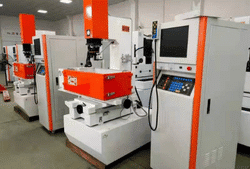
Sinker EDM, or Die-Sinking EDM, is a manufacturing technology utilizing electrical discharges to precisely wear a portion of material away from the working piece. Unlike mainstream manufacturing processes of machining with cutting tools, the Sinker EDM uses alternative controlled spark discharges between the electrode and workpiece, both placed in the dielectric fluid. This fluid acts as an insulator against sparks preventing them from going in an undesired path; it also cools the workpiece being eroded and helps remove the debris. Sinker EDM is offered in a designer shape with tight dimensions and complex geometry onto materials difficult to machine, like hardened steels, titanium, and carbide alloys. In this respect, Sinker EDM machines very well where conventional machining methods are almost incapable of producing particular shapes-hardly anything in aerospace, medical, or tool and die industries. Modern Sinker EDM machines thus assure their very important positioning in high-precise engineering domains because they have newer technology systems and suitable operational flexibility and precision.
Process of EDM
This process is known as electrical discharge machining or EDM, which is one of the specialized manufacturing techniques that employ electrical discharges or sparks to shape materials. At first, an electrically conductive material is located opposite an electrode, which is essentially made of graphite or copper. The workpiece being machined is immersed in a dielectric liquid that insulates the sparks and keeps the workpiece cool. These high-intensity electric discharges that occur between the electrode and material shape precisely into the desired objects upon the application of a voltage.
This technique is especially good for working on materials that are tough or need intricate designs such as aerospace components or medical implants. By automated workflow and CNC controllers, new-age EDM has considerably better improvements in performance, accuracy, and material utilization. Search data also highlights the upsurge in EDM application for 3D micro-mold and its use in emulsifying intricate features where traditional methods seem to lack. This growing demand marks the capability of EDM and its importance in the future of high-precision manufacturing.
How Sinker EDM Machines Perform
In a Sinker Electrical Discharge Machine, the spark from an electrical discharge is used to erode materials from the working piece. The treatment involves the electrode and workpiece being under a dielectric fluid which controls the spark path as well as cooling the workpiece and flushing away debris. This current is attentively controlled to create intense heat at the very point where the spark occurs to vaporize the sublimated molten metal and in very precise locations. This is called a non-contact machining process, which is best suited for machining complicated shapes, intricately shaped cavities, or features too detailed to be produced traditionally by conventional means.
According to ‘s search data, there is observed growing interest in sinker EDM being applied in niche industries such as aerospace, medical devices, and mold making. Users are querying how these machines can perform better in terms of precision for materials such as superalloys and conductive ceramics-Z thus showing how sinker EDM is increasingly recognized for its machining prowess in meeting advanced challenges in modern manufacturing.
Capabilities of Sinker EDM

Precision in Working with Sinker EDM Services
For very complex and precise applications that require tolerances and complex geometries, sinker EDM services are required. Users have consistently looked for information from search trends as to the accuracy guaranteed by sinker EDM when machining materials such as stainless steel, tungsten carbide, or titanium alloys. Precision is granted by the process where it electrically erodes a workpiece through a controlled charge from an electrode, without any mechanical force in the process.
That allows manufacturers to develop components with micrometric accuracy and consequently is a must for mold cavities, aerospace turbine components, and medical device parts of very high precision. The ability of sinker EDM to ensure repeat precision combined with CAD/CAM software integration has led to it becoming the technology player in fighting modern-high specification manufacturing challenges.
Designs and Complex Geometries
Sinker EDM is the ideal option for the delicate shaping of really intricate designs as well as for complex geometries for which conventional machining is simply incapable. Because the electrical discharge process is controlled with extreme precision and the electrodes can be custom shaped, this technology exhibits an excellent ability to construct details consisting of features such as sharp corners, deep cavities, and thin walls. Searches of the latest available data show a growing interest in application where these abilities are of importance, such as aerospace, automotive, and medical industries. The frequently asked questions revolve around how sinker EDM can address such challenging requirements as minimizing material deformation or achieving an excellent surface finish, which are the hallmark capabilities of a sinker EDM. This highlights its importance as a preferred manufacturing process to accomplish high-precision, highly technical manufacture.
Milling and Turning
In contrast with conventional machining operations, such as milling or turning, the major selling point of a sinker EDM is that it can operate on workpieces that are either very hard or delicate without restricting the stress on these in excess. Machining, by virtue of conventional operations, forces direct contact and cuts in the material, which most of the times lead to deformation of the material or wear of the cutting tool, and other times all these may actually be undesirable when building complex geometries. The sinker EDM is, however, capable of removing material through erosion with very fine precision according to a set of constrained geometrical designs.
In recent times, the data of the search engines of have reflected a growing interest in terms of comparing the sinker EDM against conventional machining regarding precision and materials versatility-The queries highlight its application in situations where conventional methods dare not tread, especially when talking about exceptional surface finishes and intricate designs involving hard materials like titanium, or carbide. Further, it may be very advantageous to sinker EDM with respect to secondary handling since often the parts it produces require little or no further operations, thereby cutting lead time and cost considerably. These qualities are definitively building a very strong force behind rapid acceptance of sinker EDM as an indispensable tool in the current manufacturing arena.
Applications of Sinker EDM

Some Benefiting Industries of Sinker EDM
Due to its accuracy, sinker EDM favors manufacturers for custom jobs requiring precision and for intricate designs. Aerospace application is natural as many parts need very tight tolerances and are made out of a stern material, titanium in particular. The device can also be very useful in the manufacture of complex parts for surgical instruments, implants, and diagnostic equipment with extremely high specifications. Another use of sinker EDMs is the production of high-performance engine components, molds, and dies for the automotive industry. Electronics with small products that require high precision, such as connectors and precision molds for semiconductors, will also require it. Manufacturers focusing on these industries are using sinker EDM to increase efficiency and try to break the mold in their fields.
Real-world Examples of Sinker EDM Applications
Aerospace Components
A vivid example of sinker EDM applications is the production of highly detailed aerospace components such as turbine blades and fuel injector nozzles with supreme precision. Such complexity along with perfect tolerances warranted by sinker EDM ensures the functioning of these components under extreme conditions.
Medical Devices
Medical device producers utilize the same sinker EDM technology to fabricate complex surgical tools and implantable devices like stents and orthopedic implants, which require extremely stringent standards to guarantee patient safety.
Microelectronics
Another great example shows microelectronics. Due to device miniaturization, sinker EDM is critical in making tiny, intricate parts such as micro molds and connectors.
Automotive Manufacturing
Automotive manufacturers also use this technology in the design and manufacture of special engine components and injection molds for enhanced performance and efficiency.
These applications in the real world underscore the ever-important role sinker EDM plays in the formation of numerous high tech industries.
Specific Applications of EDM in Manufacturing
Electrical Discharge Machining (EDM) has witnessed applications in modern manufacturing as an essential-making technology, especially for industries that have a near-obsession for precision. From the recent search trends and updates brought to the fore by sources, EDM is widely used in aerospace manufacturing for the fabrication of turbine blades, fuel system components, and other complicated components that need to sustain great stress and temperature conditions. Equally, the medical industry makes extensive use of the EDM for surgical instruments and implants that demand unmatched accuracy and biocompatible material. In addition, the jewelry industry benefits from EDM in crafting delicate and intricate designs in short periods with great detail in precious metals. These applications show the vastness of EDM and how continuous technological evolution of EDM, as captured in the search trends, is widening the spectrum and reach of EDM across industries.
Advantages of Sinker EDM over Wire EDM

Analysis of Sinker and Wire EDM
Since Wire and Sinker EDM technologies have very different working principles, they do not compete against each other per se. So, the choice depends entirely on some considerations for a particular project. In Sinker EDM, electrode systems thicken cavities or burn in shapes on workpieces. It is suitable for mold-type applications or die casting, wherein high depth of field and complex details in geometry are required to be accomplished. Hence, non-flat-shaped workpieces and also thicker materials are acceptable. Meanwhile, Wire EDM is more suited to thin or flat materials and high-precision cuts for intricate contours and fine tolerances and so has load applications in industries requiring high-precision parts such as aerospace or medical devices.
Recent survey trends suggest Sinker EDM’s ever-growing fame for being versatile and applicable in situations requiring unique 3D designs. Compared with Wire EDM, search trends for Sinker EDM focus more on toolmaking and mold-making industries, indicating its versatility to be put to use in projects involved in intricate engraving or recessed features. Conversely, the interest in Wire EDM remains strong in areas that highlight fine cuts and geometric accuracy, a testament to the specialized use of this technique in such applications.
Interestingly, search-driven analysis vividly draws attention toward the fact that, according to their unique needs, professionals are paid attention to and actually trying to seek the strengths of both technologies. While Sinker EDM tends to be the foremost in applications requiring complexity and depth, Wire EDM is taken as dominant by precision-oriented technicians working with flat or thinner materials.
Advantages Unique to Sinker EDM
Sinker EDM is preferred where an application demands complexity of design and depth in detailing. It is mainly used for making highly specialized cavities, molds, or dies in materials difficult to machine through the conventional machining methods. Because of its capability of precision 3-dimensional sculpting, it is held in high esteem in industries such as aerospace, automotive, and mold making. Further, mechanical stress on workpieces is almost negligible since the process is a non-contact type-one wherein utmost accuracy can be achieved without compromising symmetry of the material.
Together with the latest trends within , it is becoming quite apparent that people have shown a higher degree of interest in how Sinker EDM achieves handling harder materials while achieving micro level precision in conductive metals. There is an active pursuit of knowledge within professional circles of real-life applications where extreme accuracy and customization are of paramount importance. This trend in search really serves to make plainly visible the new-awakening recognition of the Sinker EDM and its usages in stretching the capability of manufacturing innovation.
When Sinker EDM is Properly Selected
When deciding whether to choose the Sinker EDM, consideration has to be given to exactly what the particular requirements of the job at hand are and the material problems being confronted. Based on the newest set of data from the search engine of ‘s, the Sinker EDM is considered most commonly when dealing with the machining of harder conductive materials like tungsten carbide or titanium alloys, for which it is otherwise quite difficult to proceed by way of conventional methods. It is impeccable for industries where micro level precision is extremely important in design, such as aerospace, medical device making, and mold-making. This technique becomes quite useful whenever custom shapes, fine cavities, or intricately shaped items are involved. At present, this method of extremely precise technology is gaining in recognition and in demand to develop modern-day applications in intricate scenarios.
Future Trends in Sinker EDM Machining Services

Technological Advances in EDM Machines
Recent technological developments in EDM machines have enormously amplified precision, timeliness, and versatility. Nowadays, such machines are fitted with sophisticated CNC systems and AI-integrated software adjusting machining parameters in real time, thus increasing both productivity and accuracy. More recently, the integration of sensors for monitoring the dielectric fluid and adaptive control has made the EDM process somewhat automatic, minimizing electrode wear and achieving performance uniformity. Concurrently, with the advancement of 3D printing technology, highly customized electrodes can be made for virtually complicated geometries with minimal lead times; this gives further impetus to EDM with latest developments being toward automation and smart technology in manufacturing. The EDM thus becomes a frontier technology for high-precision industries.
The Evolution of Sinker EDM in Modern Manufacturing
Sinker-type Electrical Discharge Machining continues to dispute the puzzling requirements of industries that require high precision in modern manufacturing techniques. According to the latest data and trends coming from searches, an increasing interest is evident in the applications of Sinker EDM in areas such as aerospace, medical machinery, and tool and die making. One of the main reasons for this prominence is its ability to machine the hardest of materials, complex shapes, and micro-scale components with precise accuracy.
With the newer developments of automated electrode changers and automated monitoring systems, efficiency and downtime have been held at bay by the users of Sinker EDM systems. Sustainability is becoming the major issue in all processes of industry; hence never-before machines designed for Sinker EDM are now using energy-efficient systems and less dielectric fluid for green manufacturing goals. These developments indicate Sinker EDM is evolving with time to meet the challenges of an increasingly competitive and technology-oriented manufacturing setup.
Dispatches Regarding the Sinker EDM Services for the Coming Years
As precision engineering and automation continue to evolve at a very fast rate, the demand for Sinker EDM services will maintain its steady rise within this coming decade. There is the whole emphasis of producing fairly complicated, very best quality components for the aerospace industry, for medical devices, and for electronics. Thus, Sinker EDM becomes a tool in the hands of manufacturers searching for the highest degree of accuracy and consistency. It is expected that AI will be integrated into these systems so as to optimize efficiencies in real time viz a viz, defect detection, and process optimization.
Further, the sustainability trends could trigger additional innovations, ensuring the new drafting with energy-saving technology, and recyclable dielectric mediums becomes a reality in line with global eco-conscious manufacturing standards. This will be contributed by the evolving needs of Industry 4.0 and smart factory drive as these machines are fitted with IoT connectivity and advanced analytics for seamless integration into automated production lines. Added to this are the rising search interest globally on topics related to precision manufacturing and sustainable processes, hence positioning Sinker EDM services as a solution that must always be found in the Industries that require the utmost standards of machining precision and technological sophistication.
FAQ
What are the benefits of sinker EDM machining?
Sinker EDM machining services reach extremes of precision and complexity that are necessary for manufacturing parts for industries such as aerospace and automotive. In the sinker EDM process, electrical discharges erode the conductive materials in the work, achieving machining tolerances impossible with traditional machining methods. Meanwhile, design precision in Sinker EDM is coupled with superior surface finishes, especially in the execution of very intricate parts. Moreover, Sinker EDM machines can work with several types of workpieces, thus imbuing it with great versatility in the making of EDM parts. Such features thus may give the advantage to Sinker EDM when it comes to precision machining.
How is the sinker EDM process different from wire EDM?
Though both sinker and wire EDM utilize the electric discharge phenomenon and hence are grouped as EDM processes, there are substantial differences in the principles on which they operate. In the former, an electrode, usually shaped, is used to create features in the workpiece; for the latter, a thin electrically charged wire is used in cutting through the materials- the presence of the wire makes sinker EDM processes actually well suited for creating cavities and somewhat complicated geometries while wire EDM processes are suitable for making accurate cuts on flat materials. Both methods have unique advantages, and the decision to choose one over the other is often dependent on the specific requirements of the machining process and EDM parts desired.
What industries take full advantage of the sinker EDM service?
Such sinker EDM services find application in most industries, those relating to aerospace, automotive, and medical device manufacturing, for instance. The capability of achieving tight tolerances and complex shapes renders it suitable for intricately challenging parts required in aerospace. Also, its capability to machine conductive materials provides another perspective in manufacturing parts requiring utmost precision. It further finds usefulness in die and mold making, and hence is extremely valuable to the tooling industry. However, the vast applications allowed by sinker EDM machining services address quite a number of manufacturing problems.
What materials can be machined using sinker EDM?
Sinker EDM is an effective technique to machine any kind of conductive materials: hardened steels, aluminum, copper alloys, etc. So, with high versatility in conductive material machining, creating complex shapes and details is usually of demand in precision machining applications. The process is also capable of machining materials which are not easily machined by conventional machining processes, making it ideal for specialized jobs:- Hence, the use of sinker EDM facilitates generating very fine features whose surface finish is generally better than conventional machining. So, this is a good solution for manufacturers looking to produce first-class EDM parts.
Reference Sources
- University of North Carolina at Charlotte – Electrical Discharge Machines (EDMs)
https://mees.charlotte.edu/electrical-discharge-machines-edms/
This resource provides insights into sinker EDM machines, including their capabilities for fine-detail machining and electrode wear compensation. - University of California, San Diego – Machining and Additive Prototyping Services
https://machining.ucsd.edu/machines/index.html
This page discusses machining services, including the use of specialized equipment like EDM machines for custom fabrication. - Dunwoody College of Technology – Machine Tool Technology
https://dunwoody.edu/manufacturing/machine-tool-technology/
This program highlights the use of sinker EDM in mold and die making, as well as its role in advanced manufacturing.