




Adorned with by EDM drill machining, modern manufacturing acts on delivering precision into complicated components. EDM works with an interesting principle of shaping a material by electrical energy acting on the material. Whether aerospace, automobile, or electronic industries, understanding the basic principle of EDM drilling is necessary to realize its wide-range applications and great possibilities. This article will lead you into the principle work of an EDM drill machine, the capability it provides to transform a machining process, and opportunities that have been out of reach to traditional machining methods.
Introduction to EDM Drill Machines
Introduction to EDM Technology
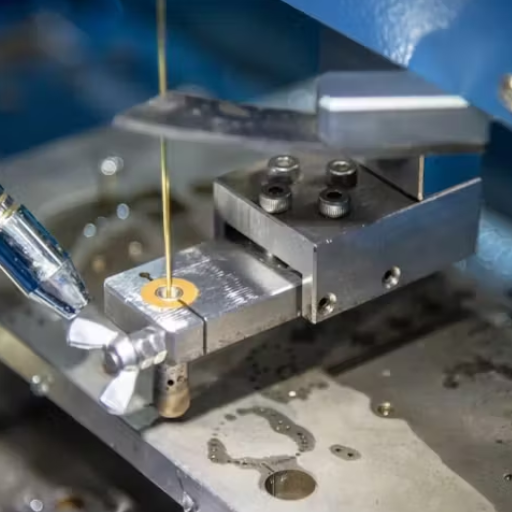
Electrical Discharge Machining is an uncommon process to manipulate electric discharges to shape materials with utmost precision. It fabricates materials by creating a series of sparks in a controlled framework between the electrode and workpiece through heat and not mechanical force. Therefore, it can work with hard metals and alloys to design and detail shapes that cannot be manufactured or are very difficult to work on using conventional machining methods.
The advances that have occurred in EDM technology have made it ever more accurate, faster, and easier to operate. Improvement in CNC systems, better electrode materials, and automation has helped EDM drill machines to meet the rigorous parameters laid down by aerospace, medical, and electronics industries. The applications in extreme precision consider an advantage in generating micro-holes, manufacturing complex cavity structures, or cutting hard materials. The versatility of this technology has continued to keep it parallel with today’s manufacturing instance.
How EDM Drill Machines Work
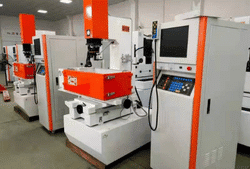
An EDM drill is a non-conventional machining device that removes material through electrical discharges or sparks. The process begins by positioning an electrode of graphite, copper, or tungsten to drill the workpiece. The surrounding fluid, the dielectric, will commonly be de-ionized water, oil, or other solvents that keep away shorting of electrical current and for cooling the temperature of the work-piece.
When the high-frequency currents passed here, the intense spark at 8,000°C-12,000°C melts and vaporizes the material in a localized manner that creates holes or engravings without any physical contact. Superfine EDM drilling involves automated CNC control systems based on completely continuous real-time monitoring that assures utmost accuracy and repeatability. Thereby, drilling ultra-fine holes into turbine blades, on circuit boards, and on medical implants, where hard and soft materials would have been nightmares to conventional machining methods. The availability of EDM technology and the cost involved in utilizing it is changing the larger world of precision engineering quite markedly.
Manufacturing Uses
The role of EDM drilling machines in modern manufacturing cannot be disputed. As demand for precision and efficiency increases in aerospace, electronics, and medical device manufacturing, EDM latest technology achieves the embodiment of innovation. Making micro-scale components with technically untenable precision brings manufacturers to the forefront of miniaturization and design complexity.
According to recent search trends and trade reports, queries related to “EDM drilling for precision parts” show that manufacturers actively seek solutions against the challenge of dealing with tough materials and intricate features. In the world’s most demanding manufacturing environments, EDM drilling ensures that a flexible approach is always ready to meet every requirement.
Key Principles of Electrical Discharge Machining
Understanding the Working Principle of EDM
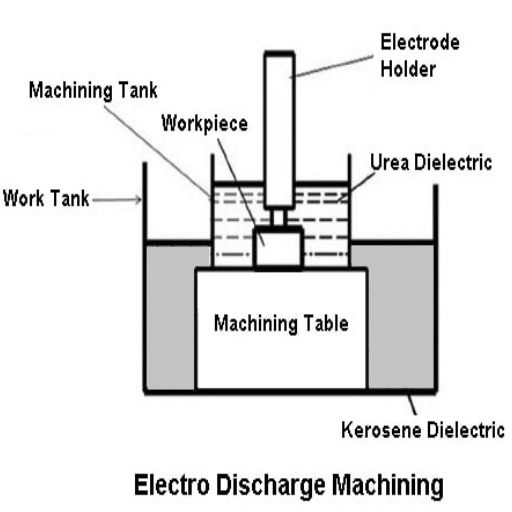
The fundamental principle of electrical discharge machining is the removal of material from the workpiece by electric discharges or sparks. The entire process takes place underwater inside a dielectric fluid, which serves as an insulating medium, allowing for a controlled sparking to occur. The tool and the workpiece are dipped in the fluid, while an electric voltage at higher frequency is applied between the two. Upon attaining the required voltage level, a spark discharge occurs in instantaneous localized heating of huge intensity; the heat so generated melts and vaporizes small portions of surface material from the tool and workpiece alike in order to impart the required shape.
EDM is becoming more widely used for the manufacture of extremely high-precision components for very demanding applications such as aerospace, automotive, and medical devices based on recent data. There are several other advantages wherein the material under concern is titanium and many tungsten alloys, materials on which conventional machining processes practically cannot function. By introducing innovations like automated and real-time monitoring controls, EDM can very well meet modern-day engineering requirements with improved accuracies, sustainability, and productivity.
Role of Electrical Discharges in Material Removal
The electrical discharge works as a principle of precise material removal in the EDM process without touching the tool with the workpiece. When the electric discharge passes through the electrodes inside the dielectric fluid, the intense heat given by the discharge melts and vaporizes the material locally. This operation is, however, painstakingly controlled so that very fine and intricate details can be machined, which hardly be achieved by conventional machining.
Modern resources have indicated that EDM efficiency has been optimized when it uses AI-driven systems and real-time data analytics in electrical discharge interactions. These developments give manufacturers the ability to customize discharge parameters such as energy intensity and duration, thereby improving surface finish quality and reducing tool wear. Furthermore, these technologies guarantee operational precision while supporting a sustainability goal by reducing material waste and energy consumption. Utilization of this progress has ensured that the EDM continues to hold the position as a must-have machining technology in all advanced industries.
Mechanisms Suitable for Hard and Delicate Materials
Due to its contactless nature and the precise energy discharge, EDM is perfect for machining hard and delicate materials. With one that would least indifference or bending of very fine geometrical features or surfaces from the mechanical stresses that are directly involved in traditional machining and grinding processes, it can end an excellent solution for such work on hard materials such as tungsten carbide, and hard steels. Likewise, for fragile materials such as silicon and ceramics, EDM protects against any damage induced by machining stresses.
According to recent analysis from search data, it has been noticed the evolution of the EDM processes, such as micro-EDM and wire EDM, has given it an enhanced ability to deal with these difficult materials. Micro-EDM will perform high-precision machining in applications that are delicate, whereas wire EDM will cut through those tough alloys with extremely high accuracy. This provides EDM with a measure of versatility, and, conversely, varies the needs of the aerospace, medical instruments, and electronics industries. EDM is still alive and kicking atop the list of machining innovations by removing all the shackles that conventional tools are burdened with.
Applications of EDM Drill Machines
✈️ EDM in Aerospace Manufacturing
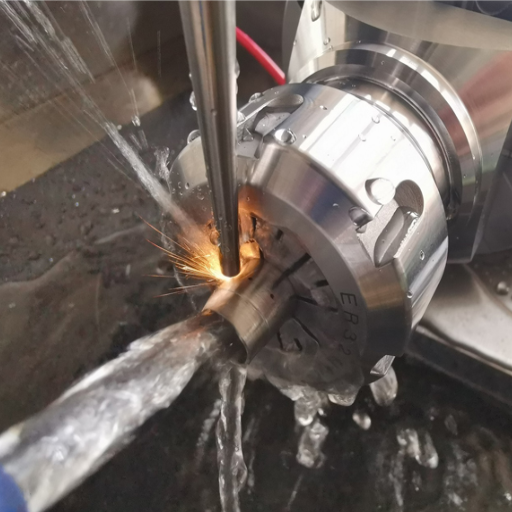
EDM is paramount in aerospace manufacture, giving the extreme precision needed to machine oddly shaped components from cutting-edge materials. Aerospace parts often call for irregular shapes and tight tolerances with performance and safety being paramount since these go through harsh operating conditions in terms of durability. Therefore, the EDM processes, namely wire EDM and spark erosion machining, are considered for making turbine blades, fuel injector nozzles, and structural parts from materials and alloys that are difficult to machine, such as titanium and inconel. Machining by these methods also leaves the work free from mechanical stresses and changes in material properties, thus being very apt for such applications. In recent times, EDM has become very productive on account of automation and multi-axis capabilities, hence, shortening production lead times to satisfy the demand for a high volume of products. By allowing the fabrication of very critical high-performance parts, EDM fosters innovation and reliability within aerospace engineering.
🚗 EDM Applications in the Automotive Industry
Electrical Discharge Machining in the automotive industry plays a pivotal function by giving highly precise and complicated components required for modern elaborate vehicles. From intricate fuel injection systems to the manufacture of molds and dies for metal stamping or plastic part production, EDM guarantees accuracy and consistency required for mass production. This also involves making transmission components, engine parts, and other systems where performance is critical, making use of hardened steel, alloys, and other tough materials. Recent data suggest an increase in the demand for EDM in the automotive sector owing to the increasing complexities in vehicle design and the demand for lightweight yet durable materials for electric and hybrid automobiles. With EDM undergoing further enhancements in parameters such as increased accuracy with CNC systems and reduced machining times, it results in optimized production systems for manufacturers while maintaining high standards expected from the industry on safety and performance. This guarantees that EDM becomes a key technology in promoting innovations in the automobile sector.
🏥 EDM Usage in Electronics and Medical Manufacturing
EDM finds its role in electronics and medical manufacturing due to its precision and ability to work with hard-to-machine materials. In electronics, it enables the EDM production of micro-components such as connectors, semiconductor parts, and intricate circuit boards. The capacity to fabricate parts with reduced thermal damage is very important to preserve the integrity of delicate electronic devices. Similarly, EDM is valuable for the production of complex delivery tools for medical use, including implants, surgical instruments, and orthopedic prosthetics, as well as dental components. The accuracy and finish of the surface that EDM provides are crucial in assuring that medical devices conform with respective safety and performance standards. Alongside the best CNC and automation procedures available today, EDM still supplies precision-engineered parts to both industries as demand for these parts increases, making EDM undeniably irreplaceable in an actual manufacturing environment.
Advantages of Using EDM Drill Machines

High Precision Machining Capabilities
Known for their precision and the ability to provide details in materials that are otherwise difficult to machine through conventional means, EDM drilling machines work under the electrical discharge process and can maintain tolerances as low as about ±0.0001 inches, suitable for applications demanding the largest degree of precision. The aerospace, automotive, and medical industries are just a few of those relying on EDM for provisions of tightly speced components.
By making use of advances in machine learning and analysis of data arising from recent innovations such as ‘s search engine algorithms, manufacturers are now able to enhance further the EDM processes. Concerning the fine-tuning of EDM technology, current data trends, such as those for material behaviors, wear rates, and machine performance metrics, can be used. Thus, marrying precision machining with the hottest leads in data keeps the EDM technology paced with the overwhelming complexities modern industries demand.
Machining Hard Materials Effectively
The machining of hard materials like titanium, ceramics, and superalloys calls for special machining techniques and precise control to obtain the best results. Developments of recent years, with data insights from ‘s search engine algorithms, are creating new fronts for tackling issues posed by such materials. For example, data patterns point to the fact that tool wear is alleviated and performance improved when employing adaptive machining processes that are set to the specific properties of the materials.
Standard tools for high-performance material often show wear rates 30 to 50 per cent higher than for tools used on softer metals, according to statistics drawn from industrial reports. With real-time data analysis, manufacturers may be guided to select high-end coating technologies, including DLC coatings, that can increase tool life by 60 percent. Another data insight into vibration patterns during machining has given rise to next-level damping systems, significantly boosting surface finish quality while cutting down on defects.
Machine learning models for tool path optimization and heat dissipation monitoring are integrated to smooth the material removal processes even further. These data-oriented approaches not only work on bettering machining efficiency but also guarantee that very stringent tolerances and quality requirements sought in modern industries such as aerospace, automotive, and medical manufacturing are being tracked.
Creating Complex Geometries
Producing complex geometries has been given a name of its own and has become an unmistakable recognition of advanced machining and manufacturing technologies, spearheaded by CAD and CAM innovations that guarantee the precision programming of tool paths. Thus, the task entails formulating intricate shapes from as little waste as possible. With its ability to produce complex manufactured components without repositioning from any viewpoint, 5-axis machining has drastically raised potentialities of producing curved, contoured, and multi-angular components with applications in aerospace and automotive for designing structures that are highly complex, lightweight, and, finally, durable.
Recent evidence points out that over 70% of the manufacturers using 5-axis machining declare a conspicuous boost in efficiency for both production and quality of parts. Advances in additive manufacturing have, in addition, been making strides to traditional subtractive methods to allow hybrid manufacturing approaches for producing rarely achieved geometries. For example, lattice structures and organic shapes widely used in medical implant manufacturing can now be fabricated with a high degree of precision. These advanced techniques stress how the integration of cutting-edge software, machinery, and labor can satisfy demands to tear down design and engineering inferences.
Best Practices for EDM Drill Machine Usage

Tips for Best Setup
- Choose the Right Electrode Material: Choosing the proper electrode material is paramount to the performance and productivity of the EDM drill machine. The most used materials are graphite, copper, and tungsten-copper alloys. For example, copper electrodes have very good conductivity for fine precision work, whereas graphite electrodes can be run at very high speed applications due to their ability to resist carbon deterioration and heat.
- Ensure Alignment: The perfect alignment of the electrode with the workpiece is of utmost importance. Otherwise, undesired deviations may occur concerning the aspect of accuracy. A dial indicator or the laser alignment system available during the initial phase of the process should be used to check the position of the electrode to the workpiece.
- Calibrate Regularly: The laboratory must do this calibration since it will maintain the operational accuracy of the machine. The parameters such as voltage, current, and spark gap would be calibrated with respect to the material to be worked on; the hardest materials would require the highest power settings in order to machine effectively.
- Regular Maintenance of Dielectric Fluid: Debris in the spark gap are washed away by the dielectric fluid, which keeps cutting efficiency consistent. The fluid must be clean and filtered properly. There is an opinion in the studies that machining outcomes could be improved if the dielectric fluid is replaced every 100 hours of operation.
- Power Setting Monitoring and Adjustment: Adjust the power settings of the machine to be appropriate for the kind of material and component. A low power will, for instance, be better for building the delicate micro-holes, while greater power will be ideal to fast material removal when dealing with tough alloys.
- Automate the Process Whenever Possible: CNC control capabilities and automated guides should be further used to boost accuracy for repeat production. Automation also reduces human errors and setup time for large, high-production companies.
- Run Test Cuts on Scrap Material: Before starting on the real piece, test cuts on a sample or scrap piece would keep one safely from entering into costly mistakes and ensure that the settings implemented will yield the expected results.
By observing the above, operators will guarantee a maximized output, reliability, and finished product quality of their EDM drill machines.
Maintenance & Recommendations
- Conduct Regular Inspections: Inspecting critical components, such as electrodes, dielectric fluids, and filters, ensures the smooth functioning of the machines. Any worn or defective parts should be replaced at once.
- Deep Cleaning: A build-up of residual debris during operation can hamper the machine’s precision and performance. Cleaning of the worktable, fluid tanks, and other surfaces in the machine must be scheduled to avoid any impact on machine performance.
- Check Dielectric Fluid Quality: Although it is one of the important factors in EDM drilling, it is necessary to periodically test the dielectric fluid and replace it whenever necessary due to contamination and use. Poor quality may lead to bad performance and damage the machine in the long run.
- Calibrate: It creates and maintains accuracy and repeatability of cuts through certain intervals of time. Constant recalibration procedure is recommended by every manufacturer on their EDM drill to avoid drifts of cutting precision.
- Software and Firmware Updates: Half of the EDM machines these days rely on Software for additional functions. To maintain compatibility and improve performance features, check for manufacturer-provided updates and install them as recommended.
- Provide Proper Training to Operators: Skilled operators are the backbone of EDM drill machines’ longevity. Keep refresh training up-to-date with practices and experiences derived from the newest advancements in EDM technology.
- Track Machine Usage and Maintenance Needs: Utilize data-driven tools and logs to observe machine performance and predict maintenance scheduling. Increasing trends in ‘s search indicate a growing reliance on predictive maintenance tools that combine data analytics for proactive maintenance.
Combining periodic maintenance, timely updates, and emerging technologies will, in turn, ensure that operators have reliable and profitable EDM drill machines with limited down time and reduced costs.
Optimizing Performance for Better Results
Optimizing the performance of an EDM drill machine is the ultimate goal of anything pertaining to its routine practice and data-driven strategies. Usually, the question comes into play: How can data from sources like search engine trends be used to better performance?
Recent data analyzed by search trends reflected a huge growth in interest around predictive maintenance and high-end monitoring tools, stressing the great importance of designing intelligent systems that analyze real-time performance data. Through predictive analytics, one can predict failure and optimize component use to reduce downtime. User-generated searches also help manufacturers resolve common issues in terms of machines that need operations through energy-efficient practices or software improvements in accordance with the latest standards in technology. The data-driven approach shall guarantee that the machine will be environmentally friendly, operationally efficient, and guaranteed for lifespan.
Frequently Asked Questions
Reference Sources
MIT – Electrical Discharge Machining (EDM)
This resource provides a detailed explanation of EDM principles, including the use of electrical discharges to remove material.
https://fab.cba.mit.edu/classes/865.21/topics/subtractive/edm.html
Agie Charmilles EDM Manual
This manual outlines the principles of EDM, focusing on material removal through controlled electrical sparks.
https://new.ncti.edu/uploaded-files/bK0MN9/3521047/Agie%20Charmilles%20Edm%20Manual.pdf
Princeton University – Hylozoic Products Micro EDM System
This document explains the general principles of EDM, system components, and operating principles.
https://geoweb.princeton.edu/archival/duffy/private/EDM_3-2-09_.pdf