




Historically speaking, the cutting of metal must be done with utmost precision for it to be serviceable. Also known as spark erosion cutting, wire EDM cutting is one of the most precise cutting methods. Knowledge of this detailed process is essential for any industrial professional or curious learner, as it provides insight into the crucial role this wire-cutting machine plays in producing components for various industries, ranging from aerospace to medical instrumentation. This article will cover the working principle behind wire cut machines and provide insights into the science and technology that enable these machines to achieve their renowned precision. Ultimately, you will appreciate more how these machines operate and why they are so crucial in high-precision manufacturing processes.
Introduction to Wire Cut Machines

These manufacturing tools offer precision cutting for complex shapes in electrically conductive materials. They operate a welding wire with an electric charge to erode the material through electric discharges. According to the process, there is no need for physical contact between the wire and the piece being cut; therefore, the machinery can be delicate. Higher wire-cut machines are capable of finer, more intricate cuts, essential in industries such as aerospace, automotive, and healthcare.
What is a Wire Cut Machine?
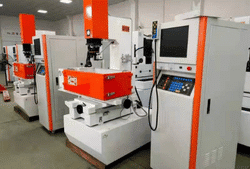
A wire cut machine, also known as a wire electrical discharge machining system, is a tool used to precisely cut complex and delicate shapes from electrically conductive materials. It functions by discharging electrical sparks between a thin brass or copper wire and the workpiece, thus eroding the material. The process happens without any physical contact, so that the materials do not get damaged or distorted. These wire-cut machines are used in the aerospace, automotive, and medical manufacturing industries, where they are required to produce intricate, high-precision components with exceptional accuracy.
Overview of EDM Technology
One peculiar and advanced manufacturing technique is EDM, in which electrical discharges help shape the material into accurate components. It works by producing sparks in a controlled manner between an electrode and the workpiece, thereby removing material layers in a process that does not involve physical contact. The two major types of EDM are Wire EDM, which uses a thin wire to cut intricate shapes, and Die Sinking EDM, which uses a shaped electrode to produce fine cavities.
It is primarily used for machining hard materials, such as titanium, tungsten, and hardened steel, and is therefore beneficial in the aerospace, automotive, and medical device manufacturing industries. Significant advantages include the ability to create complex geometries, maintain high precision, and cause minimal thermal damage to the workpiece. However, it can be slower than standard machining and is therefore generally used for special tasks that require exceptional precision.
Importance of Precision in Cutting
Accuracy in machining is central to the modern manufacturing process. For industries such as aerospace, automotive, and medical, the parts must be made to the tightest tolerances. For example, in aerospace, turbine blades must be accurate to within ± 0.0001 inches to achieve optimal performance and safety. In the medical field, surgical instruments and implants are manufactured to exact specifications to ensure precise alignment with human anatomy and optimal patient safety.
The evolution of precision cutting processes, such as EDM and laser cutting, has significantly improved accuracy and efficiency. Today, the most sophisticated cutting machines achieve dimensional accuracy to the micrometer level, which, in turn, positively affects the final product quality. This also ensures that the processes involved in precision cutting result in less wasted material and reduced production costs, thus complying with the idea of green manufacturing.
Precision machining is essential when working with expensive and challenging materials, such as titanium, which is primarily used in aerospace and medical applications. Micro-milling and EDM, for example, enable manufacturers to achieve intricate design details and complex geometries that were previously impossible through conventional methods. The degree of precision satisfies not only the technical requirements but also enhances the product’s dependability and longevity.
Working Principle of EDM Wire Cut Machines

Won by a thin wire that carries the electrical charge, the EDM wire-cutting machine can cut the conductive material. Electrical discharge, or sparks, are set between the wire and the workpiece. These sparks erode the material very precisely along the programmed path. The wire remains freely suspended, never touching the workpiece; hence, the method ensures high precision and minimal tool wear. This process is widely used for high accuracy in creating intricate shapes, sharp corners, and complex geometries.
Basic Components of Wire Cut Machines
Wire-cut machines comprise several critical components that work together to achieve high precision machining. Here’s an overview of the main components and their respective functions:
Wire Electrode
The wire electrode acts as the cutting tool in a wire EDM process and is usually made of brass or copper. Wire diameters are available in a range depending on the diameter and the required precision-thickness from 0.1 mm to 0.3 mm. The wires of the highest specifications, with special coatings, will enhance both the speed of cutting and the quality.
Workpiece Holder (Fixture)
The holder secures the workpiece to the platform on which it sits. It should be able to sustain vibrations, allowing the cutting process to be performed with high precision, especially in cases involving intricate geometries or delicate parts.
Dielectric Fluid System
The system releases deionized water near the point of cutting. The dielectric performs the following functions: cooling of the wire and its workpiece, flushing action to remove eroded material, and electrical insulation at the cutting zone. Maintaining the quality of the fluid is always very important, as it has a direct impact on surface finish and accuracy in machining.
Power Supply Unit
The power supply unit generates electrical discharges that remove the material. Modern power supplies typically feature a range of variable frequencies and voltages, allowing them to adapt the cutting parameters to a specific material and thickness. They are also very energy-efficient and offer better performance.
Wire Feed Mechanism
This mechanism feeds the wire electrode through the machine at a constant tension. Wire feeding systems typically consist of a spool holding new wire and a container for used wire. Maintaining constant tension is essential for achieving a uniform finish and preventing wire breakage.
Computer Numerical Control (CNC) System
CNC systems: These are truly the brains of every machine, converting programmed designs into precise movements of the wire. Higher-level CNC controllers support multi-axis machining, thus enabling the making of very complex and finely detailed parts. Typically, they also incorporate user-friendly interfaces and software for operation and programming.
Guiding Mechanism
The guiding mechanism ensures the wire moves correctly along the programmed path. Diamond guides are used to minimize vibrations in the wire, ensuring that machined parts are perfectly cut, even at high speeds. The guiding mechanism is obviously of utmost importance in ensuring overall excellence in the machine’s performance.
Cooling and Filtration System
The machine is equipped with a cooling system to maintain operating temperatures and a filtration system to keep the dielectric fluid clean. If the filtration is not performed correctly, a buildup of debris can compromise cutting accuracy and surface finish.
Implemented by these components, a modern wire cut machine achieves precision and efficiency seldom attained by other machining operations, and thus inevitably finds applications in aerospace, automotive, and medical equipment manufacturing. With constant technological advancements, these machines are now capable of pushing the limits of precision machining.
How EDM Wire Cutting Works
Operating EDM-Wire Cutting uses sparks from electrical discharge with maximum precision on any material. The cutting tool wire is an excellent wire carrying an electrical charge, usually made of brass or copper. The wire, of course, never comes into contact with the workpiece; it generates this precise erosion of the material through a series of electrical sparks.
The entire process takes place within a bath of dielectric fluid, which not only cools the workpiece but also washes away debris and sustains the electrical discharge, resulting in clean and smooth cuts.
Performance Capabilities
- ✓
Tolerance: As tight as ±0.001 inches - ✓
Wire Thickness: 0.001 to 0.013 inches - ✓
Material Efficiency: Up to 97% efficiency - ✓
Surface Finish: Ra value as low as 0.2 µm
There have been some recent developments in EDM technology that have made the processes more efficient. For instance, multi-axis wire EDM machines can make cuts at complex angles, while innovations in automatic threading systems reduce downtime between successive operations. With a state-of-the-art design, one can achieve up to 97% efficiency in material removal, thereby minimizing waste and reducing the cost of production. These factors, combined with the ability to obtain smooth surface finishes (with an average Ra value as low as 0.2 µm), make this wire-cut EDM the machining technique of choice for top-precision machining work.
Electrical Discharge Mechanism
One must know that the electrical discharge mechanism is the core principle behind EDM processes, wherein controlled electrical discharges erode material from the workpiece. The entire process occurs in a dielectric liquid, which acts as an insulator until a very high voltage is applied, producing an electrical spark between the wire electrode and the workpiece. The sparks generate heat of about 12,000°C within a fraction of a second, leading to the localized melting and vaporization of the workpiece material.
Recent Technical Improvements
- 30% reduction in power consumption with new pulse generators
- 15-20% enhanced debris removal through optimized dielectric circulation
- Tolerances maintained down to ±2 µm
- Real-time monitoring systems for consistent spark gaps
The latest developments have established a precise and efficient approach: now, pulse generators with low power consumption allow for very strict duration and frequency control of the sparks, reducing power consumption by nearly 30% while still ensuring cutting speed. The data also confirm that the optimized circulation of dielectric fluids increases the flushing ability by approximately 15-20%, thereby enhancing debris removal and maintaining surface quality during machining. Modern EDM plants have thus been able to retain tolerances down to ±2 µm, as required by industries where extreme precision is necessary, such as aerospace and medical device manufacture, thanks to maintaining consistent spark gaps and implementing real-time monitoring systems.
Advantages of Using Wire Cut Machines

Wire-cut machines are equipped with some great benefits:
🎯 Precision
These machines attain exceptionally tight tolerances. Therefore, they provide that extra accuracy in aerospace or medical manufacturing, where precision is paramount.
⚙️ Versatility
Wire-cut machines withstand just about anything they are asked to work with, including very hard metals and alloys, consistently maintaining high quality.
🔄 Complex Shapes
It enables the creation of intricate geometries and designs that would be challenging to achieve using traditional machining methods.
♻️ Waste Minimization
Contactless cutting avoids potential material deformation and minimizes waste.
🤖 Automated Operations
Most wire-cut machines provide real-time monitoring and automation, which improves productivity and reduces human error.
Efficiency in Material Removal
Wire EDM machining is an ideal solution for material removal processes when working with complex or delicate materials. In recent years, wire EDM technology has made significant strides in improving cutting speeds and precision. New-age wire EDM machines can remove material at a rate as high as 500 mm²/min and thus offer the highest industrial applications in the world. These machines also provide highly accurate dimensions, often down to ±1 micrometer, precisely what is needed for components in the aerospace, medical, and electronic industries.
Of higher consideration are innovations such as wire guides and adaptive control mechanisms that enhance the process’s efficiency. Specialized wires, including coated brass or composite cables, are used to tailor the cutting speed and minimize wire breakage. Another study supports the notion that this process generates up to 70% less material waste than conventional machining processes, thereby facilitating cost savings and promoting environmental sustainability. Evolving wire EDM continues to provide unmatched precision and efficiency for even the most demanding manufacturing needs.
Benefits of Precision in Manufacturing
The benefits of precision manufacturing extend to increased efficiency and quality of production. Precise, toleranced components are made with diminished need for manual adjustments, so less error creeps in. Such increases in reliability reduce the number of inspections required, with times now better suited for quicker assembly, thereby keeping raw inventories grounded in actual production capacity.
Industry Impact Statistics
- Assembly Line Defects: Reduced by up to 50% in automotive and aerospace
- Material Savings: Up to 30% reduction through precision Wire EDM tools
- Tolerance Achievement: Within ±0.001 inches for enhanced product performance
In turn, the use of precision technologies enables the production of intricate geometries with unmatched accuracy—the actual doorway to innovation in medical devices, electronics, and many more applications. These processes can meet industry standards that require tolerances within ±0.001 inches, thereby enhancing product performance. Such precision satisfies operational requirements and creates the perception of the manufacturer as an innovator in the field.
Cost-Effectiveness of Wire Cutting Technology
Wire cutting technology, including EDM, offers precision and is cost-effective, particularly for industries that produce highly accurate components. Reducing material wastage is at the forefront of cost reduction offered by this technology. Wire cutting is a technology that provides a narrow kerf. As a cutting mechanism, this means minimal material is melted away and wasted.
🤖 Automation Benefits
Multiple identical components can be produced from a single workpiece, optimizing efficiency and reducing setup time.
The wire cutting methodology is renowned for its automation, which results in less manual intervention in the long term, thereby reducing labor costs. The industry states that an automated EDM wire cutting machine can achieve a production capacity of 90% or more uptime, thus significantly improving productivity. Moreover, since wire cutting is versatile, it can be made capable of cutting several objects simultaneously; this way, it allows the manufacturer to produce multiple identical components from a single workpiece, thus optimizing efficiency even further.
One added advantage is that maintenance and tool replacement costs come down. It would do so since wire cutting follows a dithering approach, which differs from traditional machining processes; tool wear is hence minimal. For many companies, this translates to long-term cost benefits, as the wastage of consumables and replacements is ultimately reduced.
For their part, industries that compete in the aerospace, automotive, or medical device thrusts appreciate wire cutting for ensuring the treatment of demanding hard materials such as titanium and hardened steel without sacrificing quality. With a reduced scrap rate and a uniform output, wire cutting is therefore economically beneficial for both small and large production levels.
Applications of EDM Wire Cutting

EDM wire cutting, due to its precision and versatility, is employed in all industries. Typical applications are as follows:
✈️ Aerospace
Making intricate components from high-performance materials such as titanium and nickel alloys.
🚗 Automotive
Production of precise parts such as gears, molds, and engine parts.
🏥 Medical
Manufacturing surgical instruments and implants while meeting strict tolerances for smooth finishes.
🔧 Tool and Die Making
Cutting for complex shapes and details for molds, punches, and dies.
💻 Electronics
Such precision for manufacturing components for circuit boards and connectors.
Such applications highlight EDM wire cutting’s ability to meet the demands of industries that require precision and reliability.
Industries Utilizing Wire Cut Machines
Wire-cut machines hold very pivotal functions in industries for their ability to manufacture excellent, intricate components with utmost precision. The major sectors benefiting from this technology are outlined below:
🚀 Aerospace Industry
EDM wire cutting is used in the manufacturing of turbine blades, engine components, and other high-performance parts that require precise tolerances and superior finishes. The aerospace industry needs to ensure reliability and safety, so wire-cut machines with their precision are a must-have.
🏥 Healthcare and Medical Devices
The health sector demands competent EDM wire-cutting machines that can create surgical instruments, implants, or diagnostic equipment. For example, the global medical devices market has experienced phenomenal growth in recent years, driven by advances in machining capabilities that enable the manufacture of highly accurate components.
🚗 Automotive Sector
Wire-cut machines are used for fabricating special gears, engine parts, fuel injectors, and prototype components. The growth of electric vehicle manufacturing has increased demand for wire-cut technologies, as they facilitate the production of complex, high-performance parts.
💻 Electronics Industry
As electronic devices become increasingly smaller, wire-cutting machines have emerged as a must-have for producing small, finely detailed parts such as connectors and microchip housings. The industry itself is still growing, with innovations in consumer electronics demanding tighter tolerances and efficiency.
🔧 Tool and Die Manufacturing
EDM wire cutting meets the high demands of this industry by cutting precise molds, dies, and complex tooling with ease. It shortens production time and allows manufacturers to meet cost efficiency and consistency at very high levels.
⚡ Energy Sector
Wire-cut machines are of utmost importance in the energy sector, as they help manufacture parts for renewable energy installations, such as those used in wind turbines and solar cells. Since the machines guarantee the exactness required by renewable and efficient energy solutions, they are very much needed.
With the increasing demand for precision machining from these industries, the global EDM wire cutting machine market is expected to experience steady growth over the coming years, indicating the critical importance of the technique in modern manufacturing.
Common Components Manufactured
EDM wire cutting machinery remains widely employed in the manufacture of precise components for various industries. Usually, turbine blades, medical implants, and electronic connectors constitute the components. These machines cut out aerospace parts, injection molds, and automotive gears that require precise cutting and tight tolerances. Additionally, they are used in the manufacture of components for renewable energy systems, including specific parts for wind turbines and solar panel connectors, highlighting the diversity and criticality of these machines in contemporary manufacturing processes.
Turbine Blades
High-precision aerospace components
Medical Implants
Biocompatible precision parts
Electronic Connectors
Miniature precise connections
Injection Molds
Complex tooling solutions
Automotive Gears
Precision transmission parts
Wind Turbine Parts
Renewable energy components
Case Studies of Successful Implementations
📈 Case Study 1: Advances in Aerospace-Related Manufacturing Through CNC Machines
A major aerospace company incorporated advanced 5-axis CNC machines into their production line to achieve an unprecedented level of precision. These machines enabled them to manufacture complex turbine blades with tolerable dimensional differences of ±0.005 mm, thereby maximizing aerodynamic efficiency. This allowed lead time to be reduced by 30%, with material utilization improved, resulting in nearly 20% cost savings. Through advanced machining procedures, the company was able to satisfy stringent aerospace requirements while enhancing its capacity.
Lead Time Reduction
Cost Savings
Precision Achieved
🚗 Case Study 2: Breaking New Grounds in Automotive Parts Production
One automobile manufacturer was an early adopter of CNC machining centers to facilitate the production of essential components, such as gearbox assemblies and fuel injectors. The high-intensity machining and multi-functionality of these CNC machines enabled the company to reduce cases of rejection by 40% and increase productivity by 25%. One notable achievement was the manufacture of lightweight aluminum parts, which contributed to a 15% improvement in overall vehicle fuel efficiency. This transformation helped steer the company towards compliance with stringent environmental legislation and consumer demand for green vehicles.
Rejection Reduction
Productivity Increase
Fuel Efficiency Gain
⚡ Case Study 3: Understanding Maintenance of Renewable Energy Systems
A renewable energy company focused on manufacturing wind turbines used CNC machines to manufacture precise gear components and shaft systems. The high precision of CNC machining ensured that the gearboxes could operate smoothly under heavy loads, thereby increasing the life of the turbines by 50%. Optimized machining processes also reduced cycle time by 20%, hence speeding up wind farm construction. The company experienced a 10% increase in energy generation capacity from its improved turbine design over a two-year period, supporting the growth of sustainable energy solutions.
Turbine Life Increase
Cycle Time Reduction
Energy Capacity Gain
These case studies demonstrate how CNC machines spur innovation in various industries, enabling them to increase precision and reduce costs while delivering high-quality results for the project at hand.
Future Trends in Wire-Cut Machines

In the future, wire-cut machines are expected to become highly automated, precise, and efficient. AI and machine-learning technologies are likely to enhance performance by incorporating real-time adjustments and optimizing cutting paths. The integration of IoT allows remote monitoring and predictive maintenance, thereby reducing downtime and operational costs. On the other hand, manufacturers are working to engineer environmentally friendly options, including those that prioritize energy efficiency and minimize material waste. Based on these trends, wire-cutting machines appear to remain in high demand for industries that require precise manufacturing, such as aerospace, automotive, and medical facilities.
Innovations in EDM Technology
Machining by way of Electrical Discharge Machining is an ever-dynamic field that undergoes constant innovations to increase efficiency and precision while providing versatility. Undeniably, one of the significant advances is the implementation of Artificial Intelligence and machine learning algorithms in EDM systems. This sets parameters for various EDM systems uniformly, enhancing the speed and accuracy of machining with minimal need for manual intervention. Research has suggested that the application of AI in EDM can improve productivity by up to 20 percent in specific applications.
🤖 AI & Machine Learning
Implementation of AI algorithms enhances speed and accuracy with minimal manual intervention, improving productivity by up to 20%.
🔬 Hybrid Systems
Additive-based processes combined with EDM create flexible designs and enable complex geometries previously impossible.
🌱 Eco-Friendly Fluids
Biodegradable dielectric fluids yield 15% increase in material removal rate while reducing electrode wear.
⚙️ Multi-Axis Machines
Enable creation of intricate 3D shapes for aerospace, medical, and electronics manufacturing industries.
🔬 Micro-EDM
Advanced micro-EDM machines create components with features as small as a few microns for high-tech industries.
Further developments involve additive-based processes in conjunction with EDM, producing hybrid systems that combine the best of both worlds. These systems enable a more flexible design, opening up a plethora of avenues for creating complex geometries that were previously unheard of in conventional manufacturing.
Additionally, the advent of new-age dielectric fluids is playing a significant role in these developments. Environment-friendly formulations, such as biodegradable dielectric fluids, not only enhance machining capabilities but also promote environmental conservation. Data reveal that next-generation fluids yield a 15% increase in the material removal rate while reducing electrode wear.
Moreover, multi-axis EDM machines are finding growing applications in industries that demand complex designs. These machines enable the creation of intricate 3D shapes, which are helpful in the aerospace, medical, and electronics manufacturing industries. Simultaneously, the advancement of micro-EDM machines empowers the creation of components with features as small as a few microns, responding to the growing demand in several high-tech industries for miniaturization.
Combined, these innovations are steering the future of EDM technology and ensuring its place at the forefront of contemporary precision manufacturing.
Impact of Automation on Wire Cutting
Automation has brought about significant changes in wire cutting, making the process, based on my experience, much faster, more precise, and more efficient. An automated system reduces the margin for human error and provides continuous running, hence increasing productivity. Automations can ensure that cuts are consistent, even for intricate designs, making it easier to meet tight tolerances and rigorous quality criteria. To some extent, I believe that automation has revolutionized wire cutting by streamlining operations and enhancing work performance.
Predicted Advancements in Precision Cutting
Artificial intelligence, machine learning, and intelligent automation systems will pave the way for the future of precision cutting. AI-powered applications will calculate the cutting path and process in a manner that minimizes waste while retaining maximum accuracy. Cutting systems will become more adaptive to the environment in which they function; therefore, machine-learning algorithms will analyze the operating data of previous applications to improve subsequent performance. The integration of the IoT into precision cutting tools will allow real-time monitoring and predictive maintenance, hence minimizing downtime while ensuring consistent quality output. Ultrafast lasers and nanotechnology-based emerging technologies can further develop cutting capabilities to achieve finer tolerances and advanced material processing. Besides efficiency improvements, this will open up new avenues in areas of aerospace, medical, and manufacturing.
🧠 AI & ML Integration
Smart path optimization and waste minimization with adaptive learning systems.
🌐 IoT Connectivity
Real-time monitoring and predictive maintenance capabilities.
⚡ Ultrafast Lasers
Next-generation cutting with finer tolerances and advanced material processing.
🔬 Nanotechnology
Precision at the molecular level for advanced manufacturing applications.
🎯 Conclusion
Wire EDM cutting machines represent the pinnacle of precision manufacturing technology, offering unmatched accuracy, versatility, and efficiency across diverse industries. From aerospace turbine blades requiring tolerances within ±0.001 inches to medical implants demanding biocompatible precision, these machines have revolutionized how we approach complex manufacturing challenges.
Key Takeaways
As we advance into an era of AI-driven manufacturing, IoT connectivity, and sustainable production methods, wire EDM technology continues to evolve, promising even greater precision, efficiency, and environmental responsibility.
“The future of manufacturing lies in the perfect marriage of traditional precision engineering with cutting-edge digital intelligence – and wire EDM machines are leading this transformation.”
📚 Related Topics for Further Reading
CNC Machining
Advanced computer-controlled manufacturing processes
Laser Cutting Technology
High-precision optical cutting methods
Precision Manufacturing
Modern approaches to high-accuracy production
Industry 4.0
Smart manufacturing and automation trends
📊 Technical Specifications Summary
This comprehensive guide covers the essential aspects of Wire EDM cutting technology, from fundamental principles to future innovations.
For the most current developments in precision manufacturing technology, consult with industry professionals and equipment manufacturers.
Reference Sources
“Design and Research on Household Food Slicer”
“Design and Research on Mini Type Slicer for Cereal Product”
Frequently Asked Questions (FAQs)
What is the working principle of EDM wire-cut machines?
The working principle of an EDM wire-cut machine is to remove material by electrical discharge machining. This thin metal wire, primarily made of copper or brass, serves as the electrode to generate high-frequency pulses that produce sparks during short-circuiting between the wire and the conductive workpiece, resulting in erosion and enabling intricate, high-precision jobs.
How does the wire-cutting machine aid in the cutting process?
A wire-cut machine facilitates the cutting process by utilizing a continuous wire electrode that moves through the material. Electrical discharges between the wire and the workpiece facilitate the accurate and clean discharge of metal, resulting in improved cutting quality. This process is also highly effective when designing complex-shaped workpieces and intricate metal artworks.
What are the advantages of having an EDM wire-cut machine?
It is possible when you use an EDM wire cut machine to have the advantages of making intricate, precise cuts in steel and titanium. This process has applications in industries that manufacture various parts, including mold making and automotive components. Additionally, it can create complex shapes that may be impossible to achieve with any other conventional procedure, thereby speeding up the process.
What roles do parts play in a wire-cut machine?
Some key components of a wire-cut machine include the wire electrode, power supply, control system, and cooling system. The wire electrode is responsible for spark generation, while the power supply provides the necessary voltage for the electrical discharges. The control system ensures accurate positional movement, and the cooling system stabilizes the entire procedure by cooling the electrode and flushing away debris.
How, then, does wire EDM achieve precision in cutting?
As the name implies, the wire EDM machine utilizes electrical discharge machining principles to accomplish its cutting action. The wire EDM machine is designed to achieve high precision in cutting by maintaining a controlled gap between the wire and the workpiece. This fine control allows parameters such as voltage and pulse duration to be adjusted, thereby affecting cutting force and quality. The high-frequency pulses provide stability to the cutting process, resulting in extremely high-quality surface finishes on the workpiece.
What kind of materials can be processed by a wire-cut machine?
Wire-cut machines are capable of processing a wide range of conductive materials, including various metals such as steel, titanium, carbide, and copper. Due to its ability to cut through strict and rigid materials, wire cut machining complements precision machining and serves the aerospace and automotive industries. It can handle both simple and complex shapes.
What is the importance of the cooling system for wire-cut machines?
The cooling system in wire-cut machines is crucial, as it cools the electrode and flushes away debris generated during the cutting process. In short, the method prevents the system from overheating, thereby maintaining operational stability and efficiency. When kept cool, electrodes enable the machine to continue the discharge at high frequency, resulting in better cutting quality and improved wire life.
How does the wire-cutting machine maintain the stability of the cutting process?
The stability of the cutting process in wire-cut machinery is maintained by precise process control mechanisms that monitor the gap size between the wire and the workpiece. Sensors are used to detect changes in cutting conditions, allowing for real-time adjustments to ensure optimal performance. This stability is primed to yield consistent results, especially when dealing with high precision and complex components.