




- R8, the collet system most associated with milling precision, is directionally reported as having the widest runout tolerance among common collet systems — keyway and drawbar stack-up costs it accuracy a pure taper does not lose.
- REGO-FIX’s DIN 6499-B / ISO 15488 Form B spec covers ER8 through ER50, each collapsing roughly 1mm per size, with ER8-ER40 the common shop sizes.
- 5C collets run 1/16in to 1-1/8in, confirmed independently across four separate machine-tool catalogs including Haas Tooling.
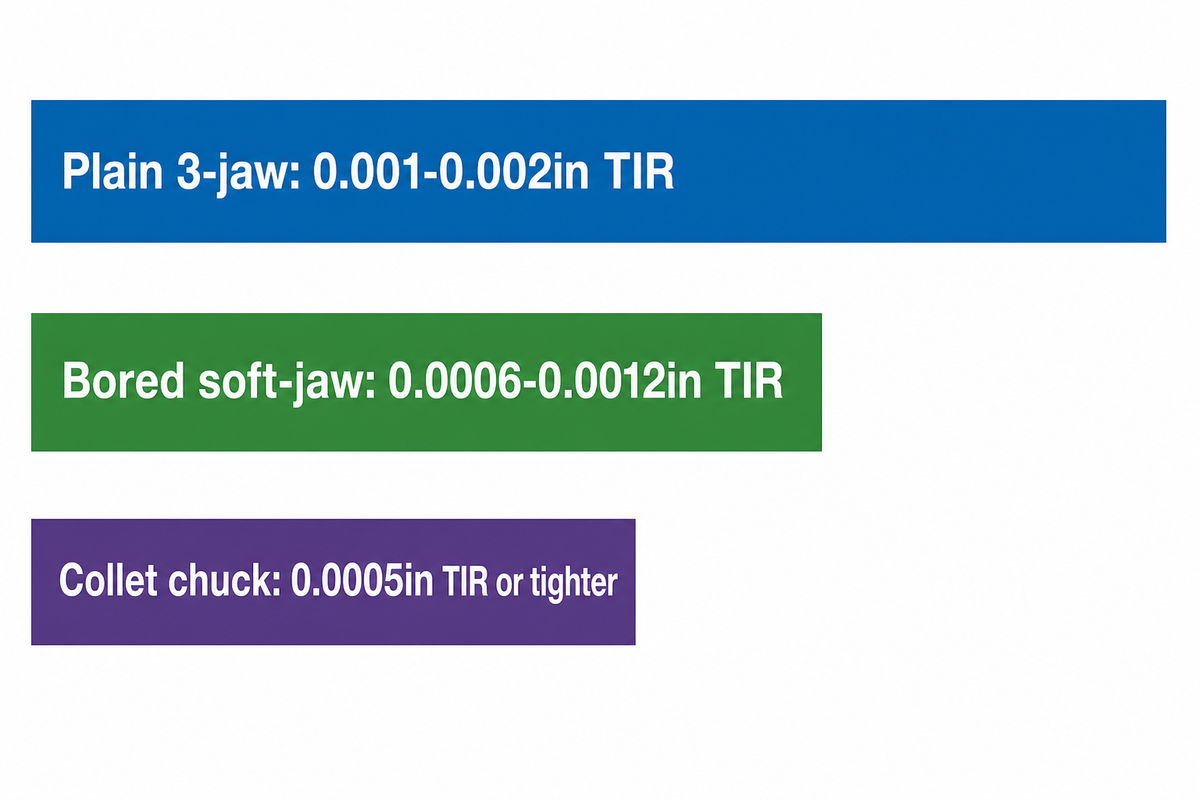
- Typical runout is 0.0005in TIR or better for a collet chuck versus 0.0006-0.0012in for a bored-soft-jaw 3-jaw chuck — though a purpose-built precision power chuck can close that gap.
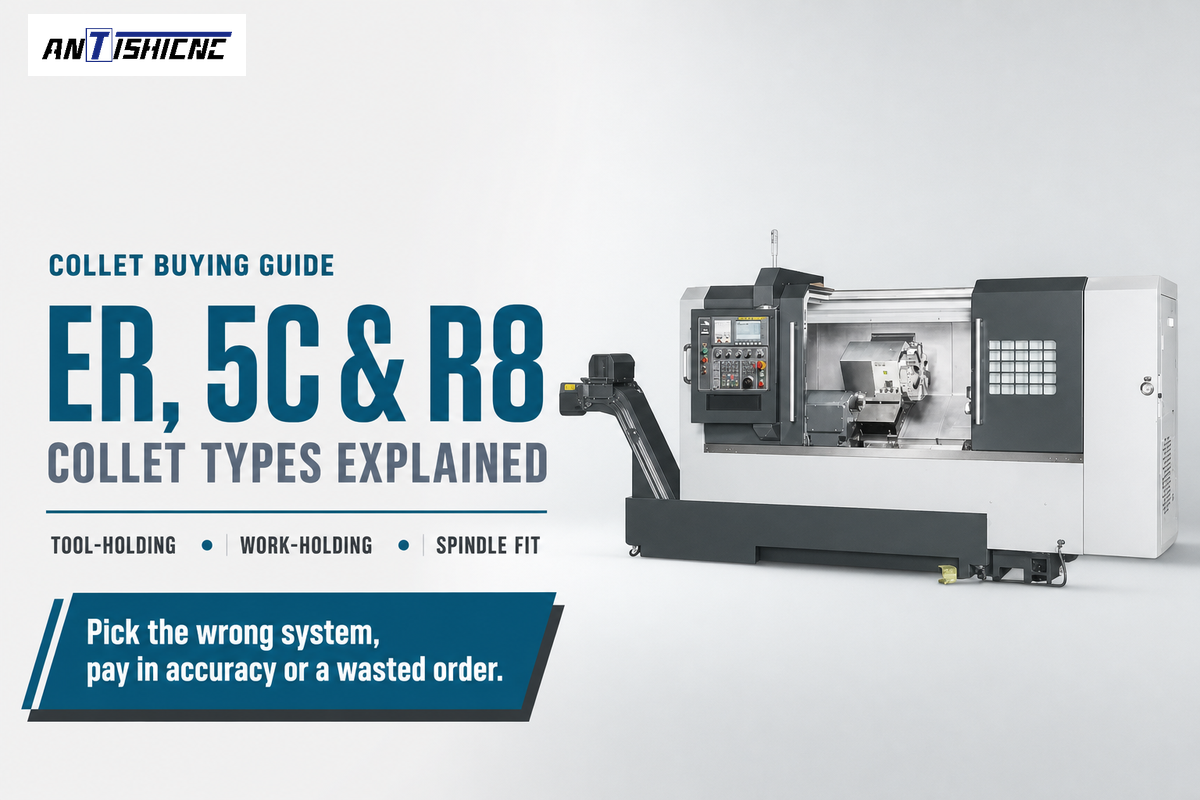
Collet types are three systems that between them cover almost every machine shop: ER, 5C, and R8. Each one clamps a tool or a workpiece by compressing a slotted, tapered sleeve, but the taper angle, the host machine, and what the collet actually grips (tool shank or bar stock) differ enough that picking the wrong one costs you accuracy, tool life, or a wasted purchase order. Antishi builds both CNC lathes and milling machines, so the collet a shop chooses is directly tied to which spindle taper and workholding architecture its machine already runs.
What Is a Collet, and How Does It Work?
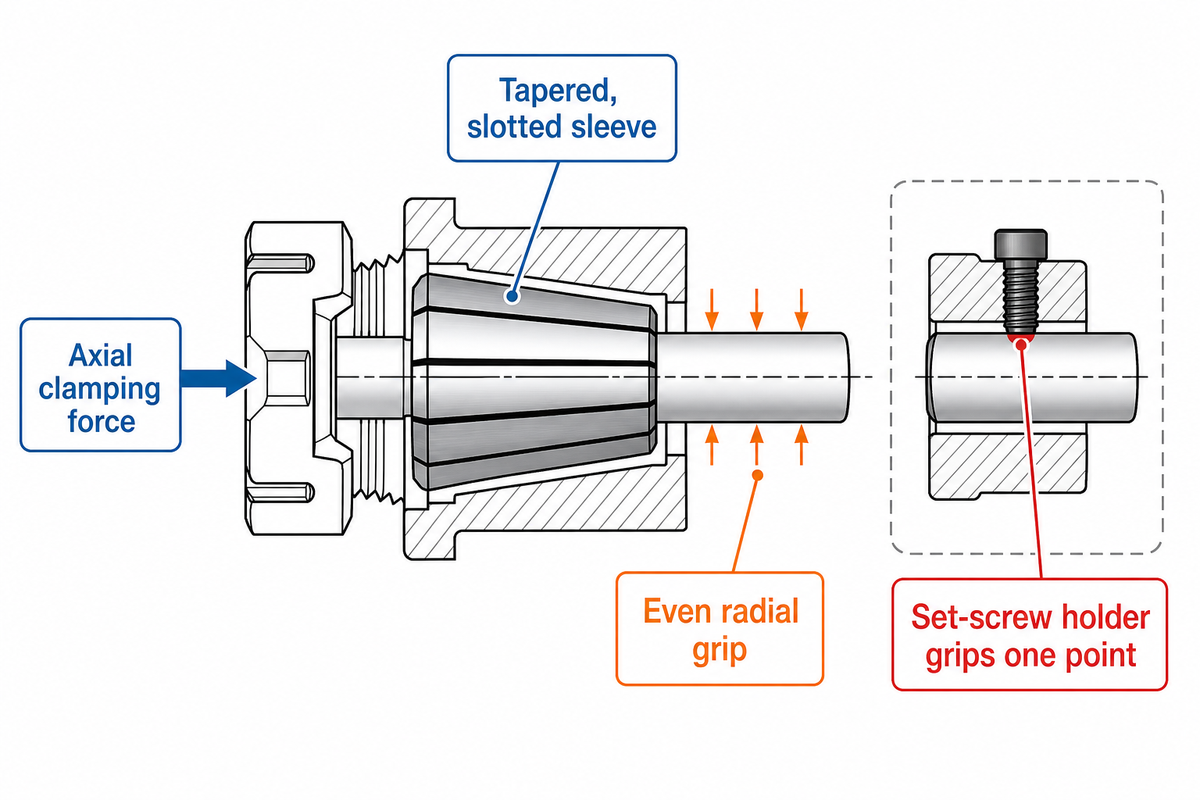
In practice, a collet is a tapered, slotted sleeve that clamps a tool shank or workpiece when a nut or drawbar drives its outer taper into a matching pocket. As the collet is pushed (or pulled) into the pocket, the slots let the bore collapse and apply uniform clamping pressure around the full circumference — unlike a set-screw holder, which grips at a single point and leaves the tool free to walk under cutting load.
This is why collets became the default choice wherever concentricity matters: the tapered fit centers the tool as it clamps, so accuracy and grip happen in the same motion rather than as two separate adjustments. This distinction is basic enough that it shows up early in formal training, too — Ohlone College’s CNC machinist program lists chucks, collets, and vises as a dedicated curriculum module.
The practical result is fewer stack-up errors. Set-screw holders rely on the screw tip biting into the shank at one point, which both marks the tool and leaves it slightly off-center. A collet distributes that same clamping force through several slots at once, so the shank centers itself against the taper instead of getting pushed off to one side. Picture a 3/8in end mill dropped into a plain set-screw holder versus a spring collet: the set-screw version marks one side of the shank immediately, while the spring collet’s slotted taper closes evenly around it. That is also why collets wear out gradually rather than failing suddenly: the slots lose spring tension over thousands of clamp cycles long before the sleeve itself cracks.
Collet Types at a Glance: the 9-Row Collet Compatibility Matrix
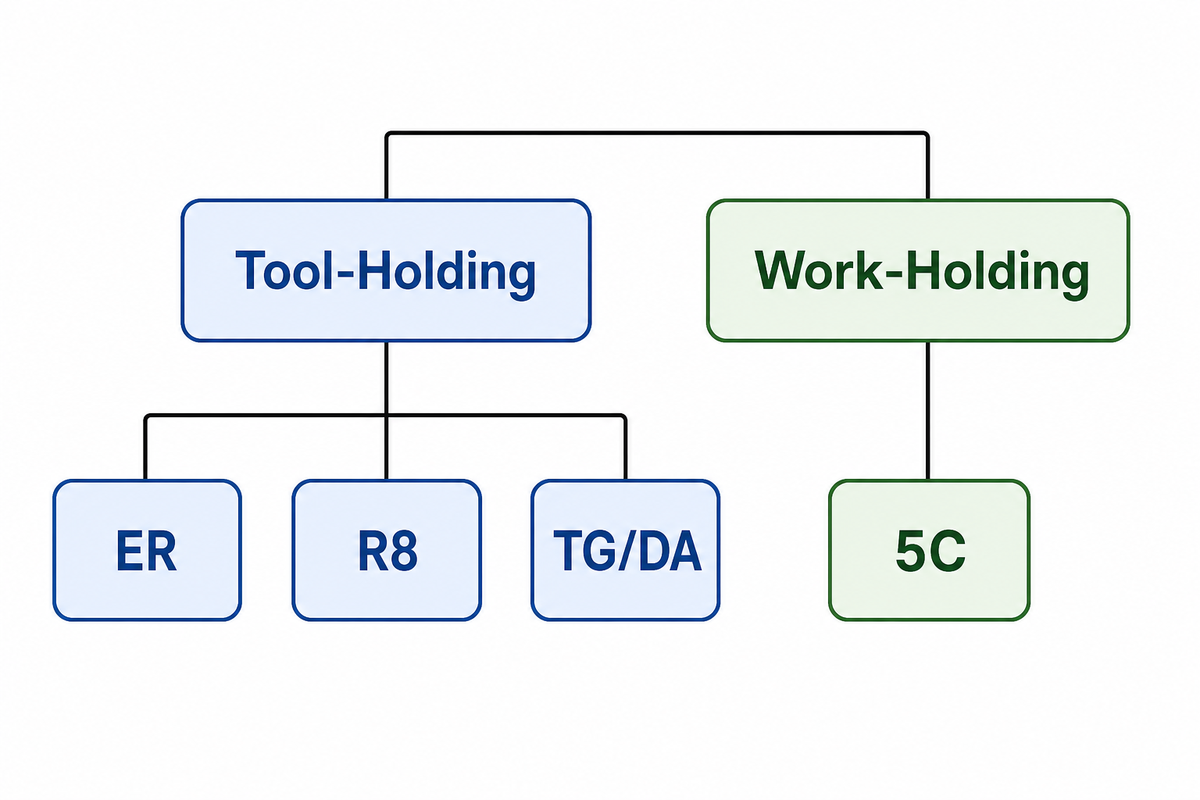
The Collet Compatibility Matrix below answers the two questions a Google AI summary of “collet types” currently leaves unanswered — are you holding a tool or a workpiece, and what machine are you running — in one table instead of a follow-up search.
| Collet Type | Holds | Clamping Range | Typical Host Machine | Best For | Limitations / Not Suitable For |
|---|---|---|---|---|---|
| ER8 | Tool | 0.5-5mm (~1mm/size) | Mill/drill spindle, small taper | Micro drilling, engraving | Not for shanks over 5mm |
| ER11 | Tool | 1-7mm | Mill/drill spindle | Light-duty milling, PCB drilling | Limited torque for heavy cuts |
| ER16 | Tool | 1-10mm | Mill/drill spindle | General hobby/small-shop milling | Not for shanks over 10mm |
| ER20 | Tool | 1-13mm | Mill/drill spindle | General-purpose mid-size machines | Not for shanks over 13mm |
| ER32 | Tool | 3-20mm | Mill/drill spindle | Most popular shop-floor choice | Larger nut can crowd tight pockets |
| ER40 | Tool | 6-26mm | Mill/drill spindle, larger taper | Heavy-duty industrial milling | Overkill for small tooling |
| 5C | Workpiece | 1/16in-1-1/8in (round/hex/square) | Lathe, collet chuck, grinder | Bar-stock turning, second-op work | Fixed range per collet, no give beyond nominal size |
| R8 | Tool | Fixed per size, fractional/metric | Bridgeport-style manual mill spindle (some CNC retrofits) | Manual milling, drawbar-retained tooling | Industry comparisons place its runout wider than ER or 5C |
| TG/DA | Tool | Narrow, single-size fit | Mill spindle, high-speed finishing | Higher clamp force, longer grip length | Needs more collets to cover a size range than ER |
Read the “Holds” column first: ER and R8 clamp a cutting tool inside a mill or drill spindle, while 5C clamps the workpiece itself on a lathe or collet chuck — that distinction alone rules out roughly half the table for most jobs. The industry comparison behind R8’s wider runout figure comes from a single trade source rather than an independent lab test, so treat it as a directional signal, not a certified number; REGO-FIX’s own published spec for standard-grade ER, by contrast, is a manufacturer-verified 10 micron TIR. This tool-holding-vs-work-holding split is exactly the framework taught in formal CNC training, too — see, for instance, Northwood Technical College’s machinist curriculum.
ER Collets — The General-Purpose Standard
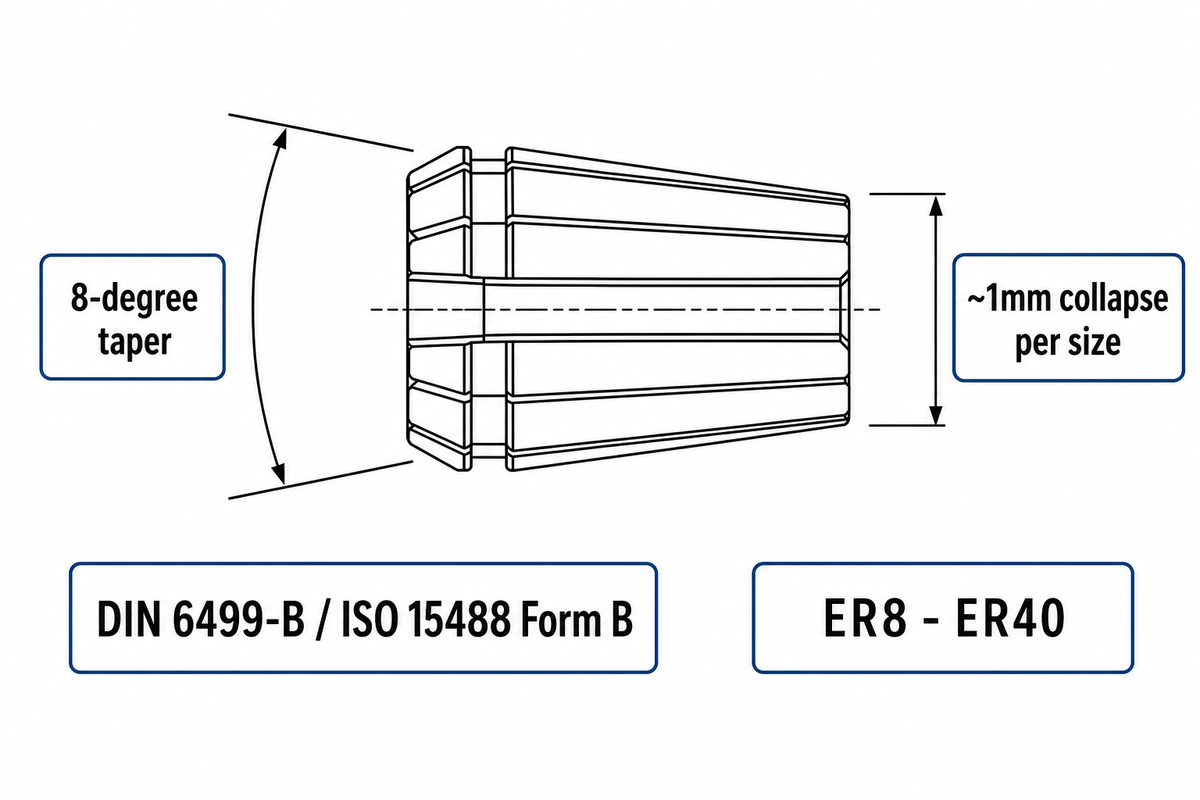
ER collets are the general-purpose standard among the many types of collets on a shop floor, because one holder swaps between shank sizes with a roughly 1mm collapse range per collet, covering ER8 through ER50 under DIN 6499-B / ISO 15488 Form B (ER8-ER40 are the common shop sizes; the table below covers that range). Coolant-through variants, tap collets, rigid-tapping compensation collets, and even step collets built for odd shank steps all build on the same ER collet system base — and most shops also keep a set of emergency collets (soft, machinable blanks) on hand for the rare shank size that falls outside a standard set. One ER32 set can outfit an entire small shop where a fixed-size type of collet would need a much larger inventory.
| ER Size | Clamping Range | Runout (TIR), Standard Grade |
|---|---|---|
| ER11 | 1-7mm | ~10 micron (0.0004in) |
| ER16 | 1-10mm | ~10 micron (0.0004in) |
| ER20 | 1-13mm | ~10 micron (0.0004in) |
| ER32 | 3-20mm | ~10 micron (0.0004in) |
| ER40 | 6-26mm | ~10 micron (0.0004in) |
Q: What’s the difference between ER collets and TG collets?
Each ER collet uses an 8-degree taper that gives it roughly 1mm of collapse range per size, so one collet covers a small band of shank diameters. TG collets (often expanded in trade literature as “Tremendous Grip”) use a steeper single-angle taper that grips harder per unit of tightening force but only fits one shank size, so a shop running TG needs more collets to cover the same size range an ER set would handle.
Andy Moon, Guhring’s product manager for milling and toolholders, put it directly in comments to Cutting Tool Engineering: “For high-performance applications, especially in milling, I generally steer people away from an ER collet chuck” — toward a tighter-tolerance system instead, because the same compression flexibility that makes ER versatile also allows more runout under heavy load. DA collets (Double-Angle) sit between the two — an older double-taper design that’s mostly been superseded by ER and TG in new tooling purchases. Published TIR figures for all three are static, catalog measurements; actual cutting accuracy also depends on tool overhang and how precisely the nut was torqued. It’s the same caveat instructors give students in formal CNC machining programs: catalog numbers describe the collet, not the finished setup.
5C Collets — Work-Holding Standard for Lathes and Grinders
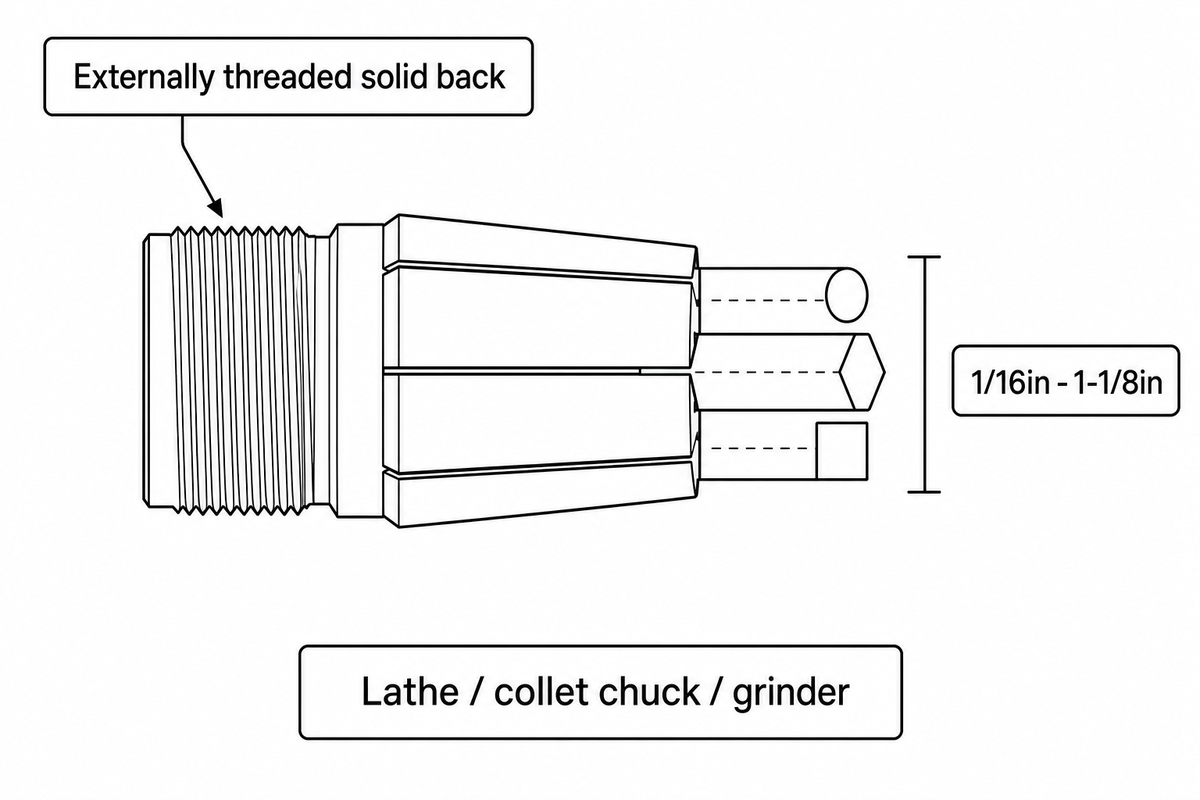
5C collets are the work-holding standard for lathes and grinders, clamping round, hexagonal, or square bar stock from 1/16in up to 1-1/8in as commercially manufactured — a catalog range confirmed independently across four separate machine-tool suppliers, including Haas Tooling, where the system is also labeled 385E (any individual shop’s own stocked collet set will typically cover a narrower slice of that full range). Unlike ER or R8, a 5C collet has an externally threaded, solid back rather than an internal taper alone, and the collet itself (not a separate chuck jaw set) determines the exact stock diameter it will hold.
Because the collet’s own bore does the centering, a 5C setup delivers tighter, more repeatable concentricity than a scroll chuck for round or hex stock that’s already close to nominal size — which is exactly why second-operation work on a part that was first turned in a 3-jaw chuck often gets finished in a 5C collet instead. The tradeoff is flexibility: a scroll chuck’s jaws adjust to a range of diameters, while a 5C collet only grips its one nominal size, so a shop running mixed stock sizes needs a broader collet set on hand. One caveat worth flagging: some smaller historical variants of the collet family, such as 3C, have largely disappeared from current commercial catalogs in favor of 5C and 16C — worth checking before standardizing tooling around anything other than the current mainstream sizes. Lathe workholding fundamentals like this are covered directly in Northwood Technical College’s machinist curriculum.
R8 Collets — Built for Manual Milling Machines
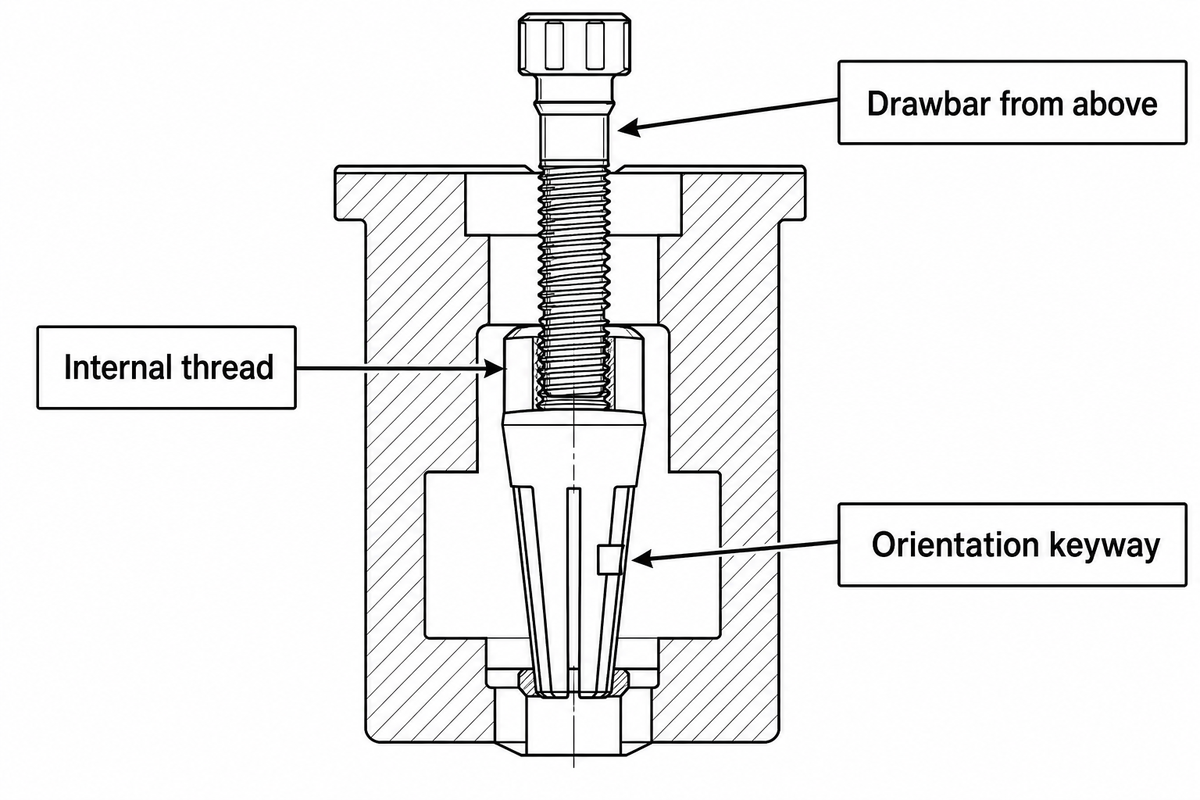
R8 collets are built primarily for manual milling machines, using an internal thread and an orientation keyway that locks into the spindle bore and is retained by a drawbar threaded down from above. UC Berkeley’s own mechanical engineering shop documents this directly on its manual Bridgeport vertical mill, a 2 hp machine running 60-4,200 rpm with an R8 spindle taper; UC Santa Barbara’s shop procedure for a similar PM-25MV mill (1 hp, 50-2,500 rpm) confirms the same drawbar-threading retention method. R8 is not, however, exclusively a manual-machine design — some CNC retrofit conversions of Bridgeport-style mills keep the original R8 spindle taper while adding G-code-controlled axes, so the taper itself outlives the manual-only framing that is common in casual descriptions of the system.
The keyway that gives R8 its orientation feature is also its accuracy tradeoff: because the collet must index against that key rather than seating on a pure taper alone, industry comparisons of published runout figures place R8 wider than ER or 5C for a given collet grade — a genuinely counterintuitive result given how often R8 gets marketed toward milling precision. Antishi’s own CNC lathe and mill product line runs a 50-4,000 RPM electronic variable-speed spindle across its range, wide enough to run a 5C work-holding collet near top speed for small-diameter finishing passes or throttle down for heavier stock removal — the point being that spindle capability, not just collet choice, sets the ceiling on what a given setup can actually deliver.
Collet Chuck vs Scroll Chuck: Which Wins on a Lathe?
Spring collet chucks — the most common design — typically win on accuracy and speed for consistent, pre-machined stock under about 3 inches in diameter, while a scroll (jaw) chuck wins on flexibility for larger stock or parts with inconsistent, varying diameters from piece to piece.
Trade coverage of shop-floor workholding puts a plain 3-jaw chuck’s repeatability around 0.001-0.002in TIR, tightening to 0.0006-0.0012in once the jaws are bored soft to the part, while a quality collet chuck consistently holds around 0.0005in TIR or tighter — and because a collet chuck clamps force evenly around the full circumference instead of at three discrete jaw contact points, it also handles higher spindle speeds without losing clamping force the way a jaw chuck can under centrifugal load.
- Tighter typical TIR (0.0005in or better vs 0.0006-0.0012in for bored-soft-jaw 3-jaw chucks)
- Full-circumference clamping avoids jaw marks on finished surfaces
- Collet swap takes seconds, versus several minutes to change out scroll-chuck jaws
- Clamping force stays consistent at high spindle rpm
- Fixed capacity per collet — machine-shop training materials, including University of Florida’s own equipment guide, commonly cap collet-chuck capacity around 1.75in and require stock within +/-0.002in of nominal size
- Poor fit for hot-rolled, cast, or forged stock with inconsistent diameter
- A purpose-built precision power 3-jaw chuck can match or beat collet-chuck TIR — “always more accurate” isn’t a safe assumption
On an antishi CNC lathe machine, that tradeoff plays out the same way: run a collet chuck for consistent-diameter, cold-rolled bar work where speed and repeatability matter most, and keep a scroll chuck on hand for castings, forgings, or any job where stock diameter varies piece to piece.
Integration & Utility Requirements: Matching Collets to Your Machine’s Spindle
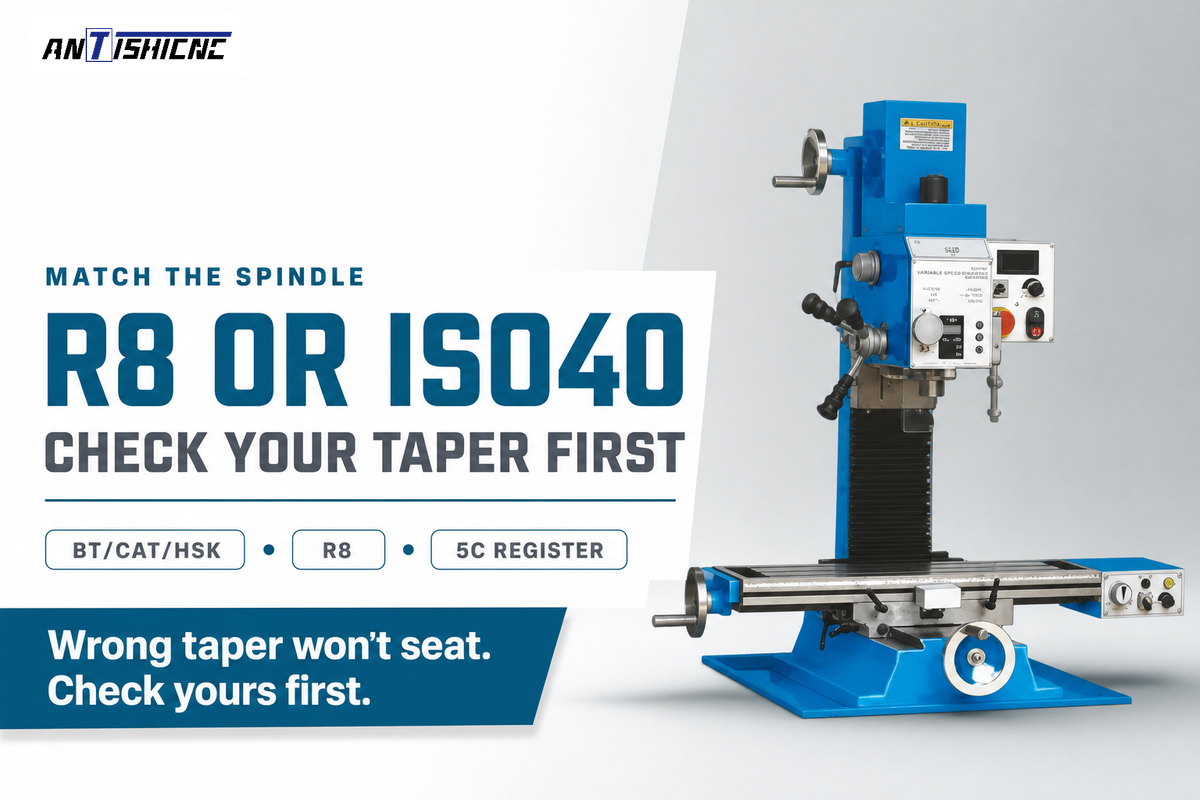
Your machine’s spindle taper decides which collet holder can physically mount before any of the size or accuracy comparisons above even apply. Every collet system needs a taper-matched holder or chuck body, and mixing tapers — an ER holder built for a BT40 pocket dropped into a CAT50 spindle, for example — simply won’t seat. Checking this first against the Collet Compatibility Matrix above avoids ordering the wrong holder for a machine you already own.
| Spindle Taper | Common Machines | Compatible Collet Holder |
|---|---|---|
| BT30 | Compact CNC mills | ER16/ER20/ER25 holder |
| BT40 / CAT40 | Mid-size vertical machining centers | ER25/ER32 holder |
| BT50 / CAT50 | Heavy-duty machining centers | ER32/ER40 holder |
| HSK-A63 | High-speed machining centers | ER32 holder, hollow-shank interface |
| HSK-E40 | High-speed spindles, light tooling | ER16/ER20 holder, hollow-shank interface |
| R8 | Bridgeport-style manual mills (some CNC retrofits) | R8 collet, direct-fit |
| Morse Taper 2 (MT2) | Small lathes, drill presses | MT2 collet adapter |
| Morse Taper 3 (MT3) | Mid-size lathes, drill presses | MT3 collet adapter |
| 5C register (lathe spindle nose) | Lathes, second-op collet fixtures | 5C collet chuck, direct-fit |
A machine tool’s own spindle spec sets the outer bound on which of these tapers even makes sense — an antishi metal turning lathe spec’d for 50-4,000 RPM electronic variable speed, for instance, can run a 5C work-holding collet comfortably across that entire range, while a fixed-speed machine may need to check its top rpm against a given collet system’s rated clamping-force ceiling before committing to it. Cross-reference the Collet Compatibility Matrix above once you know your spindle taper, and the system choice narrows itself down. Spindle-taper identification is a first-week topic in machinist training for exactly this reason.
How to Choose the Right Collet System for Your Shop
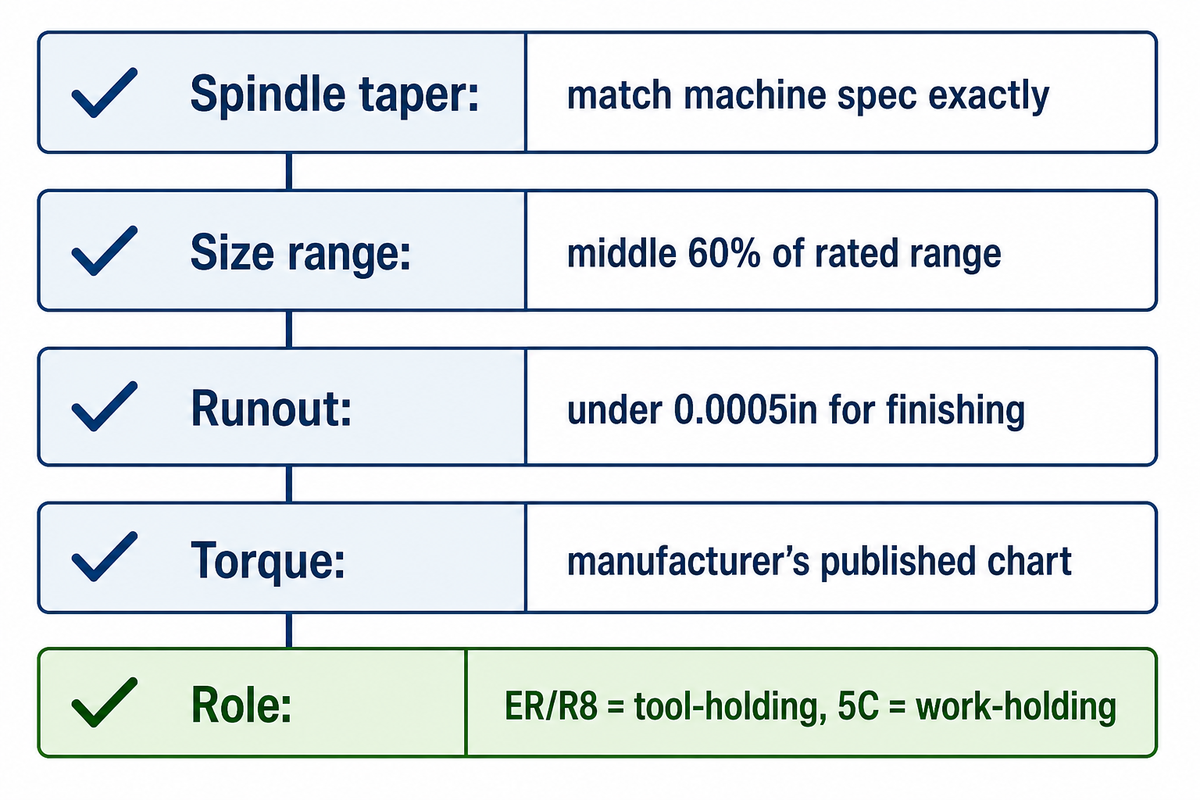
Choosing the right collet system starts with your machine’s spindle taper, not the collet catalog — work backward from what your machine can physically accept, then narrow by tolerance and stock consistency. Whether you’re specifying CNC collets for a machining center or manual-mill tooling, the same machine collet compatibility check comes first. Established suppliers such as Hardinge and Royal Products dominate the aftermarket for both ER and 5C tooling, so availability of replacement collets is rarely the deciding factor; fit and accuracy requirements are. Budget for collet maintenance from day one, too — rotating out worn collets on a schedule costs far less than a scrapped part from a collet that has already lost its grip. This same spindle-taper-first logic is how machinist training programs teach tooling selection from day one.
Collet RFQ checklist — copy these into your quote request:
| Parameter | Recommended range | Why it matters | How to verify |
|---|---|---|---|
| Spindle taper | Match machine spec exactly (BT/CAT/HSK/R8/MT) | Wrong taper won’t seat at all | Check machine nameplate or manual |
| Shank/stock size range needed | Middle 60% of a collet’s rated range, not the extremes | Forcing an oversized shank damages the collet | Measure with digital calipers to +/-0.001in |
| Required runout (TIR) | Under 0.0005in for finishing, 0.001in acceptable for roughing | Determines ER/5C precision grade vs standard grade | Dial indicator check after assembly |
| Torque spec for collet nut | Manufacturer’s published chart, size-specific | Over-torquing deforms the collet; under-torquing loses clamping force | Torque wrench, not “by feel” |
| Tool/workpiece role | ER/R8 = tool-holding; 5C = work-holding | Buying the wrong category wastes the order entirely | Confirm against the Compatibility Matrix above |
When NOT to Use a Collet (Common Failure Modes)
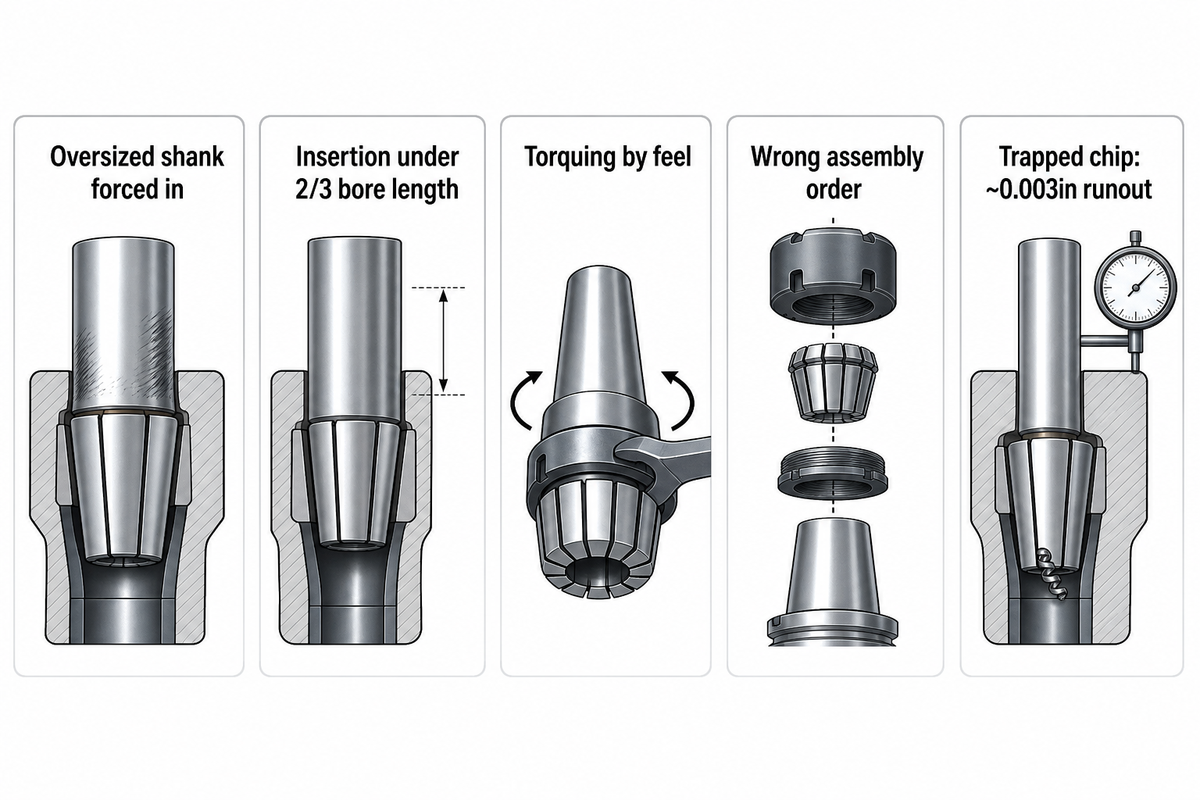
A collet is the wrong choice whenever stock is oversized, irregular, or inconsistent in diameter — pushing a shank past a collet’s rated range, rather than stepping up to the next size, is one of the most common and most avoidable mistakes shops make. REGO-FIX’s own guidance is direct on this point: never clamp an oversized shank into an undersized collet, and always insert the tool to at least two-thirds of the collet’s gripping length.
Correct sizing and insertion depth are exactly the kind of basics formal machinist coursework drills early, precisely because they are so easy to get wrong on the shop floor.
“The collet, not the toolholder, plays the bigger role in machining accurate parts.”
Beyond wrong sizing, five specific mistakes account for most collet-related runout and clamping-force complaints: inserting a tool less than two-thirds of the collet’s bore length, torquing “by feel” instead of to a published spec, assembling the collet and nut in the wrong order, using a backup screw that blocks the collet from pulling back fully during tightening, and running a collet with chips or coolant residue packed in its slots — a single trapped chip alone can introduce roughly 0.003in of runout. One real-world example from a Practical Machinist forum thread makes the same point from the holder side: a machinist reported that a cheap holder can have non-concentric nut threads or a damaged nut cone, which will wreck accuracy even with a brand-new, correctly sized collet — runout problems are not always the collet’s fault.
Frequently Asked Questions
Q: What’s the difference between ER, 5C, and R8 collets?
ER and R8 clamp cutting tools in a mill or drill spindle, while 5C clamps the workpiece itself, typically on a lathe or grinder rather than a cutting tool.
Q: How do you know what size collet you need?
Measure the exact shank or stock diameter with digital calipers, then pick a collet where that measurement falls in the middle 60% of its rated range.
Q: What’s the difference between a collet and a chuck?
A collet is a single tapered sleeve sized for one diameter; a chuck uses adjustable jaws instead, which can clamp a wider range of diameters at some cost to accuracy.
Q: What are the key differences between 5C and 16C collets?
16C is a larger-capacity version of 5C, extending maximum clamping diameter from about 1-1/8in up to roughly 1-5/8in, useful for shops that regularly turn bigger bar stock.
Q: How do I know when to replace a collet?
Replace a collet once its measured runout exceeds about 0.001in, or as soon as you notice rust-colored fretting marks where it seats in the spindle pocket.
Q: Can I use an ER collet on an R8 or 5C spindle?
Not directly — each system needs its own taper-matched holder, though an ER collet chuck can be mounted into an R8 or 5C-taper machine through an adapter holder.
Why We Write This
Antishi builds CNC lathes and milling machines, not collets — so this guide is written from the buyer’s side of the workholding decision, not a collet manufacturer’s. We cross-checked every dimensional claim against at least two independent sources before publishing, and where the trade literature only offered a single, unverified number (R8’s exact runout ranking among collet systems, for one), we said so rather than presenting it as settled fact.
References & Sources
- Bridgeport Vertical Mill (Manual) Facility Page — University of California, Berkeley, Department of Mechanical Engineering
- Manual Milling Standard Operating Procedure — University of California, Santa Barbara, California NanoSystems Institute
- Machine Shop Training Archive — University of Florida, Department of Mechanical & Aerospace Engineering
- CNC Machinist Training Program — Ohlone College
- What is a Collet? Types, Uses, and Design Explained — Cutting Tool Engineering
- Tips for Controlling Runout in Toolholding and Machining — Cutting Tool Engineering
- When To Use A Collet Chuck — Modern Machine Shop
- Five Common Mistakes Shops Make with ER Collets — Modern Machine Shop
- US6280125B1 — R-8 Collet — United States Patent and Trademark Office (via Google Patents)