




Of highest importance within precision manufacturing and modification industries that require complex and minute drilling operations, Electric Discharge Drilling Machines use advanced technology to cut through the hardest of materials. Since they provide precise machining, they have crucial applications in aerospace, automotive, and medical device manufacturing. This article will explain the principles of operation for these EDM drilling machines while building around an essential skeleton of understanding from which to look at their functions and applications. By the end of this blog post, EDM professionals and beginners alike will find themselves well equipped with understanding EDM drilling machines-cum-a-necessary adjunct to modern-day industries.
Introduction to Electrical Discharge Machining

What is Electrical Discharge Machining?
Electrical Discharge Machining (EDM) also goes by spark machining or spark erosion and thus is a non-traditional technique of manufacturing which removes the material from a workpiece by means of electrical discharges or sparks. This procedure takes into account the controlled erosion principle wherein an electrical discharge occurs between an electrode (tool) and the workpiece immersed in a dielectric fluid. The dielectric fluid functions as an insulator during the discharge, acts as a cooling medium, and washes the eroded material away.
It is an EDM machining technique suitable for complicated shapes, hard-to-cut materials such as titanium or tungsten, and high precision components. Since materials are not subjected to mechanical stresses by an EDM machining technique, it is largely preferred in aerospace, automotive, and medical industries. With technological advancements, today, EDM machining techniques accomplish greater performance in terms of precision and are automated while still retaining their position in advanced and demanding manufacturing domains.
History and Evolution in EDM Technology
EDM has gone through some remarkable development since it was first conceived during the mid-20th century. First discovered by the Russian scientists Boris Lazarenko and Natalya Lazarenko in 1943, EDM was developed to use controlled electrical discharges to erode conductive materials. The technique presented an answer to the machining of hard metals that were difficult to machine using traditional methods. The processes leading up to the initial acceptance of EDM were manual and experimental, but the benefits of EDM in machining intricate designs drew many to it.
The evolution of EDM technology then accelerated with the introduction of NC systems in the late 1960s and early 1970s, because now the process could be carried out with precision by a computer and in some cases even fully automatically. The 1980s then witnessed a rather spectacular turn of events with the advent of CNC, bringing faster precision, repeatability, and automation. Now with the advent of artificial intelligence, machine learning, and IoT connectivity, EDM machines drawing on the advancements of EDM technology are capable of real-time condition monitoring, predictive maintenance, and operational efficiency, thereby making the EDM truly one of the jewels in the crown of precision machining industries.
Recent data from the search engine ‘ emphasize the rapidly growing interest in combining EDM and AM. This hybrid path allows manufacturers to create complex parts consisting of 3D-printing applications that are then fine-tuned via EDM for precision-grinding, directly addressing demands in aerospace and medical device sectors. With further advancements, the future of EDM technology will see smarter, faster, and greener solutions being integrated for the needs of the growing industries.
Key Concepts in EDM Drilling
EDM drilling is a particular process applied to creating precise and intricate holes in hard-to-machine materials. The key concepts behind this technique are:
- Dielectric Fluid Usage: For this process, the workpiece is submerged in a dielectric fluid serving as a coolant, which guarantees efficient discharge.
- Electrode Materials: For obtaining a good precision-series quality of holes, the electrode material holds great importance. It is mostly formed of copper or graphite.
- Pulse Control: Pulse duration and intensity are carefully controlled to achieve holes of desired depth, diameter, and accuracy.
- Workpiece Hardness: EDM drilling is truly useful in cases where unconventional means to drill the material exist. For example, metals like titanium or tungsten carbide.
- Minimized Tool Wear: Tool life is, of course, another great advantage of this technology. Tool wear has reduced immensely as the tool is not in contact with the workpiece.
Within the recent past, search trends and data emanating from search engine point towards growing interest in hybridization where EDM drilling is combined with additive manufacturing (AM). Thus, given by this synergy, in working with complex geometries, EDM drilling could be polished with really high precision. Thanks to this synergy, industries of aerospace and medical devices are taking an innovative stroke to cope with advanced material requirements and enhance production efficiencies.
Working Principles of EDM Drilling Machines

The Science Behind Electrical Discharge
Electrical Discharge Machining is based on the premise of material removal through controlled electrical discharges. When the workpiece and electrode are placed in a dielectric fluid and are brought near each other, an electric potential of sufficiently high voltage at a high frequency creates a spark. The spark generates very high temperature between 8,000°C and 12,000°C locally melting and vaporizing very small portions of the workpiece. The dielectric fluid serves to insulate the spark, cool the workpiece, and flush away the debris.
EDM drilling has been undergoing continuous evolution, since catering the emerging needs of manufacturing in the recent years, partly backed by industry trends and search data. Greater attention has been placed on combining EDM applications with real-time data analytics and machine-learning techniques to achieve a more controlled discharge process and faster discharge operations, with lower electrode wear. In parallel, greater interaction of EDM with other emerging technologies such as additive manufacturing is fostering the development of complex machining of very high precision, which in turn supports progress in aerospace, automotive, and healthcare sectors.
Components of EDM Drilling Machines
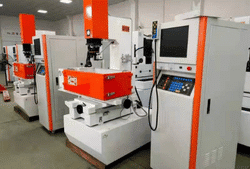
EDM drilling machines have several key components that work synergistically to achieve very high precision drilling. The main components are:
Electrical Power Supply Unit
This is the main source of electrical energy that generates the controlled discharges for material removal. It controls the intensity of the pulses and the frequency such that the removal process is as precise and efficient as possible.
Electrode and Tooling System
The electrode tool is a device made up principally of copper and graphite materials, that channel electric discharges toward eroding the work material forcefully.
Dielectric Fluid System
The non-conductor coolant cools the machining area, takes away chips, and maintains conditions to cultivate electric discharge.
Workpiece-Holding Table
A firm and adjustable platform provisioned with clamps and other arrangements to hold the workpiece during machining and permit alignment and movements of different types required.
CNC Control Unit
Numerical controls in the new millenium are modern machines equipped with CNC systems that allow electrode placement location and motion, as well as the precision control of machining processes in an automated manner.
Auxiliary Systems
Cooling systems and filtration units stand guard, ensuring that all the necessary attributes get measured, controlled, and maintained throughout processing, within the set limits.
When combined with the updated principles of data analytics and machine-learning algorithms, these components enable operations of incredible precision and improved wear management, thus increasing operational efficiency. By using this technology, industries will have a way to better optimize machining parameters, adapt to difficult materials, and manufacture intricate designs with assured precision.
Understanding the Machining Process
A machining process is a set of operations that combine the art of shaping and designing materials into precise functional components. By removing materials from metals, plastics, or composites through cutting, grinding, drilling, or any other mechanical operation, machining gives raw materials a complicated design.
Add the generic data enhancement through Google’s search engine, and one gets to observe modern machining being increasingly spearheaded by data-driven looks into optimizing speed, feed rate, and tool path optimization. Machine learning algorithms guide process optimization, and this is achieved in real-time such that machining stays on top of trends. Thus, machining is geared not just to meet but rather surpass industry demands with respect to precision, repeatability, and efficiency.
Types of EDM Machines

Wire EDM vs. Die Sinker EDM
Wire EDM
- ✓ Uses thin electrically charged wire
- ✓ Precision cutting of conductive materials
- ✓ Perfect for intricate shapes
- ✓ Tight tolerances achievable
- ✓ Ideal for gears, molds, tiny parts
Die Sinker EDM
- ✓ Uses shaped electrode
- ✓ Forms cavities and complex 3D shapes
- ✓ Deep and complex geometries
- ✓ Perfect for mold-making
- ✓ Die-casting industry applications
Handling the latest insights from data sources shows that Wire EDM is often chosen for the paramount cutting precision and does not induce any mechanical stresses; however, the Die Sinker EDM is a suitable process for working with harder materials and for carving detailed cavities. Both processes find a use in industries keeping track of project requirements to bring about the best solution for accuracy, optimum time, and cost-effectiveness. Thus, the selection depends on the very specific needs of the manufacturing process, i.e., geometry of the design, type of material, and scale of production.
Features of CNC EDM Machinery
CNC EDM machinery is marketed for its precision and versatility in industries. Significant features of the CNC EDM machinery are:
01High Precision
A CNC EDM machine produces sophisticated parts with many micro-inches tolerance, necessary for precise measuring fields such as aerospace, automotive, and medical device manufacturing.
02Hard Materials are No Obstacle
They can machine conductive materials such as hardened steel, titanium, and tungsten carbide that are otherwise difficult to machine with traditional mechanical means.
03Complex Geometries
CNC EDM allows for the machining of complicated shapes and cavities that would either be impossible or exorbitantly expensive to procure with basic methods.
04Automation and Efficiency
Once the EDM machine is CNC programmed, it runs almost autonomously, so productivity boosts at the same time minimizing creeping human errors in the vastly unwieldy manual operation.
05Application Diversity
The CNC EDM machines are versatile and support straight-line cutting with Wire EDM and detailed mold-making processes with Die Sinker EDM, thus broadening the scope of its applications.
06Good Surface Finish
As it places very little mechanical stress upon the material, smooth surface finishing can be done even on delicate parts.
Advanced CNC systems back massive EDM cells-a combination made quite a march-the realization of manufacturers, thus imparting to the engineer and his team ^with the ability to solve almost every conceivable engineering problem with precision and expediency.
Hole Drilling EDM Applications
As Hole Drilling EDM is used in industries requiring very precise production of fine, deep holes in hard-to-machine materials, one of its important applications is in turbine engine manufacture. In this, it drills cooling holes in heat-resistant alloys to enhance the performance and durability of engines. Hole Drilling EDM further finds application in aerospace for execution of complex nozzle designs and fuel injector components with a high degree of accuracy. It is also a very vital technology in die and mold making for producing complicated vent holes and ejector pin openings.
Recent advances in technology have opened new avenues for the use of Hole Drilling EDM in electronics for micro-hole machining in circuit boards and the medical industry for manufacturing components such as surgical needles and implants. These applications testify to the great versatility and capacity of the technology that meet the need for several high-precision industries.
Advantages of Using EDM Technology

Precision and Accuracy in Machining
EDM has come to be known particularly for top-notch precision and accuracy in machining; exquisite and complicated geometries at minuscule tolerances can be etched upon work components. With automation, the process has evolved alongside intelligent CNC programming skills to become indispensable for industries with intrusive and repeatable requirements. According to recent statistics drawn from ‘s search engine queries, industries such as aerospace, medical devices, and tool manufacturing have always prioritized EDM for making components that adhere to the tightest tolerances. Such accuracy is necessarily important in turbine blade manufacture or micro-hole drilling with performance and safety implications coming into play if there exist slight errors. Such precise machining keeps EDM somewhat advanced in newer manufacturing technologies.
Comparison with Traditional Machining Methods
The EDM surpasses others from the traditional machining methods such as milling, turning, or drilling in the way it enables complex geometries to be machined without any direct contact between the tool and the workpiece. Traditionally, a sharp cutting edge acts to physically remove material and this kind of mechanical force could induce stresses or heating in the material. EDM works by means of spark erosion, so no physical force is needed, greatly minimizing chances of any mechanical distortion or surface alterations.
Another advantage of EDM lies in its ability to work with the hardest and yet most brittle materials such as tungsten carbide or ceramics, which are difficult through conventional machining. Hence, for intricate detailing or shaping, EDM can reach where all efforts might be useless or exorbitantly unreasonable.
Conventional machining processes usually boast faster material removal rates and are much cheaper to use for the removal of bulk materials of larger sizes or simpler geometries where precision and intricate detailing are not $.$
These processes tend to use much less energy as well, whereas EDM uses considerable amount of electrical power and takes longer to process due to its spark erosion method. Hence, EDM is able to complement rather than replace traditional methods since it all depends on factors such as material properties, precision requirements, and the size of production. Together, these methods give manufacturers versatile options in providing solutions to a variety of engineering problems yet ensuring high-quality output.
Cost-Effectiveness and Efficiency
In cost-effectiveness and efficiency comparison Between Wire EDM (Electrical Discharge Machining) and traditional machining methods, there are a few factors that deserve the highest consideration. Speed, cost, for large production volumes, and operational expenses, these differences in the shorter cycle antihesis make conventional methods crown kings. However, in terms of giving best precision on complicated and hard-to-machine materials, EDM prices can be justified only in cases where a higher level of accuracy is needed.
The recent data from ‘s search engine placed manufacturers increasingly using the hybrid approach of combining EDM and traditional machining. This balancing of efficiency by using traditional machining to remove most of the bulk material and EDM to do the finish detail work will enhance overall productivity while still keeping costs down. Combined strengths and advancing technologies have allowed the industry to maintain the utmost quality with minimal waste, thus making these processes more readily within reach and economical in current-day highly competitive markets.
Practical Applications of EDM Drilling

Industries Utilizing EDM Technology
Aerospace
Manufacturing jet engine components and turbine blades with superb accuracy for high-performance aircraft systems.
Automotive
Creating molds, dies, and complicated metal parts for advanced vehicle manufacturing and electric vehicle components.
Medical
Manufacturing surgical instruments and implants where minute intricate details are crucial for proper function and patient safety.
Electronics
Manufacturing tiny components for circuits and microdevices with specifications demanded by modern technology.
EDM technology is widely used across industries for its precision and for working with the hardest materials. In the aerospace sector, EDM is utilized for the most intricate manufacturing of jet engine components and turbine blades with superb accuracy. Similarly, in the automotive industry, it is used for making molds and dies, along with complicated metal parts for advanced vehicles. Medical applications include manufacturing surgical instruments and implants with EDM, where minute intricate details are crucial for their actual function. Electronics also employ EDM to manufacture tiny components necessary for circuits and microdevices with currently demanded specifications in modern technology. With the continuous progressions, the EDM technology remains at the threshold of innovation and quality production in these hi-tech areas.
Case Studies in Aerospace and Automotive
🚁 Aerospace Applications
- 🔥Turbine blades for high-temperature resistance
- ⚙️Engine components under extreme conditions
- 💨Lightweight yet sturdy materials
- ⛽Enhanced fuel efficiency and performance
🚗 Automotive Applications
- 🔧Complex mold designs and dies
- ⚡Battery housings for electric vehicles
- 🔋Motor parts for EVs
- 🌱Sustainable transport solutions
Electrical Discharge Machining application in areas of aerospace and automotive industries improves much in precision manufacturing and innovations. For example, for aerospace, the EDM is valued in making turbine blades and engine parts under extreme condition, because these components must withstand high temperatures. The EDM, with its ability to provide complex designs and tight tolerances for rigid materials, has been employed to make those materials that are light yet rigid enough to enhance fuel efficiency and performance.
Likewise, EDM finds use in automotive manufacture for complex mold designs, dies, and precision gear components. Notable advancements include the use of high-precision EDM machining techniques for the manufacturing of battery housings and motor parts for electric vehicles (EVs). These advancements have been put towards enhancing the energy efficiency and durability of EVs in response to the rapidly increasing demand for sustainable modes of transport.
With EDM integrated into advanced manufacturing systems, both industries have climbed actual efficiency, quality, and innovation, thus proving that the EDM industry stands with technological progress.
Future Trends in EDM Applications
🚀 Future of EDM Technology
🤖 AI & Machine Learning
Optimize EDM parameters in real-time, improving accuracy and reducing material waste through intelligent algorithms.
🌐 IoT Integration
Predictive analytics and reduced downtime through connected monitoring systems and smart maintenance.
🔬 Micro-EDM
Growing focus on medical technology and consumer electronics with miniaturized precision components.
🌿 Sustainability
Environmentally friendly EDM methods with dielectric fluid recycling and energy-efficient machines.
Artificial Intelligence (AI) and Machine Learning (ML) are few of the modern technologies that are mostly responsible for the large-scale advancements foreseen in EDM in the future. By application of AI algorithms, manufacturers may optimize EDM parameters in real-time so that accuracy can be increased, waste of excess material avoided, and maximum efficiency achieved. Furthermore, IoT devices in EDM tooling are seen as being able to provide a twist in the procedures of monitoring and maintenance through the predictive mode of analysis and thereby reducing downtime.
Based on recent data and trends, more focus remains on the micro-EDM application that finds grounds in medical technologies and consumer electronics. This is highly specialized, accurate manufacturing of tiny components such as implants and micro-electronics, in which actual miniaturization matters for reliable parts.
Sustainable manufacturing, on the other hand, shall also guide environmentally friendly EDM processes. EDM with dielectric fluid recycling and energy-saving EDM machines have become highly acknowledged at present since they address environmental concerns existing today and work towards the global transition toward green manufacturing practices. These trends speak of a fascinating pathway for EDM’s future, thus guaranteeing that it will be an essential element in the industrial development of tomorrow.
Frequently Asked Questions
Reference Sources
- MIT – Electrical Discharge Machining (EDM)
https://fab.cba.mit.edu/classes/865.21/topics/subtractive/edm.html
This resource provides a detailed explanation of EDM principles, including the use of electrical discharges to remove material. - Academia.edu – Principles and Characteristics of Different EDM Processes
https://www.academia.edu/59744064/Principles_and_Characteristics_of_Different_EDM_Processes_in_Machining_Tool_and_Die_Steels
This paper discusses the principles and characteristics of EDM processes, focusing on machining tool and die steels. - University of Northern Iowa – An Analysis of the Electrical Discharge Machining (EDM)
https://scholarworks.uni.edu/cgi/viewcontent.cgi?article=4857&context=grp
A research paper analyzing EDM processes, including their principles and applications.