




Radial drilling machines are regarded as highly versatile and techno-functional machines, widely accepted in the manufacturing and machining. Working on drilling holes in hard materials, or just holding up a big component, makes difficult jobs slightly easier to tackle. So, what makes the radial drill so special? What are they, and why have they found such widespread acceptance throughout industries of all types? In this article, the primary features, advantages, and applications of radial drilling machines will be discussed to shed light on the capabilities these machines have in expediting the projects.
Introduction to Radial Drill Machines
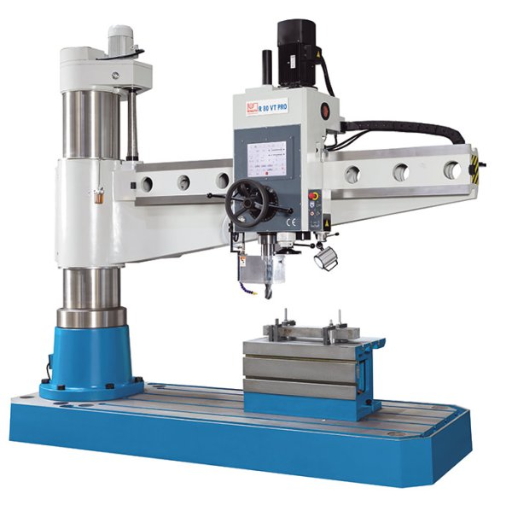
Definition of Radial Drill Machine
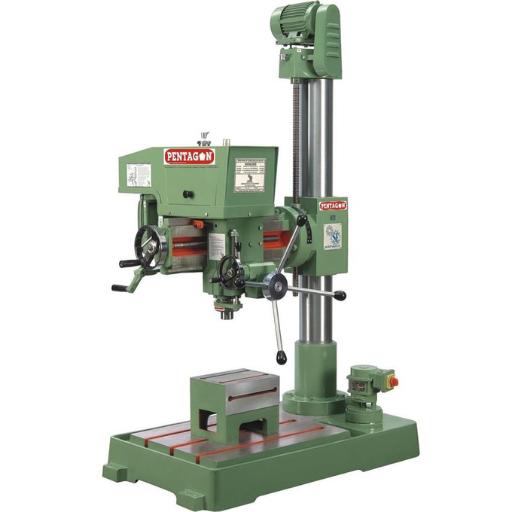
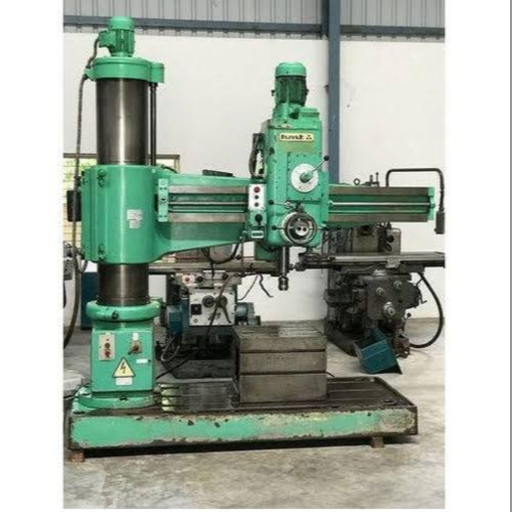
Highly versatile and powerful drilling tools needed to maintain accuracy and flexibility while working with large and heavy-weight workpieces—the radial drill machines are equipped with an arm, called the radial arm, which can rotate, move horizontally, and also adjust itself in the vertical direction with respect to the column so that the drill head can assume positions at any place with respect to the workpiece that is kept fixed.
- Drilling
- Boring
- Reaming
- Tapping
With varying capacities and sizes, radial drill machines feature CNC technology, thereby giving them an edge in precision and automation features. These machines rank high because of their ability to work on a gamut of materials such as:
- Steel
- Cast iron
- Aluminum
- Plastic
Market Trends and Statistics
According to recent market insights, the worldwide drilling machines market is expected to be growing at a CAGR of roughly 4.7% during the period of 2023-2030 across greater automation demand and development in precision manufacturing.
Technological Advancements
Some cutting-edge technological modifications have, thus, ensured further optimization in radial drilling machines:
- Automatic feed for smooth operations
- Enhanced cooling for efficient performance
- Digital controller for the exact amount of control
- Laser-guided drilling for utmost precision
- IoT-enabled sensors for monitoring performance in real time
- Eco-conscious cooling system designed for low-energy consumption
Components of a Radial Drill
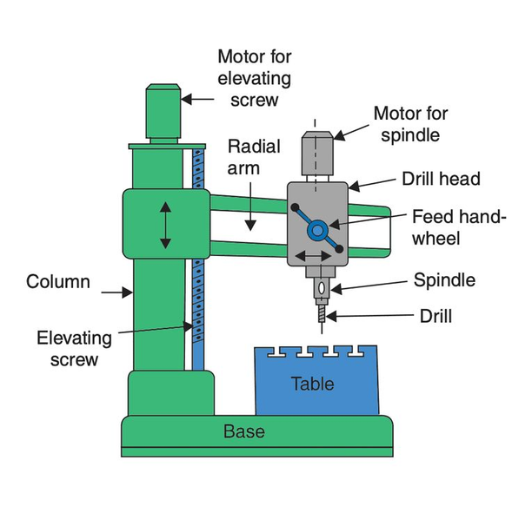
Key Parts of a Radial Drill Machine
| Component | Function | Material/Features |
|---|---|---|
| Base | Strong and rigid structure carrying all machine weight | Usually cast iron for stability |
| Column | Vertical cylindrical pillar supporting the radial arm | Permits raising/lowering for varying drilling height |
| Radial Arm | Rotates 360° and slides horizontally along column | Provides flexibility for spindle positioning |
| Drilling Head | Houses the spindle mechanism | Moves along arm for precise alignment |
| Spindle | Tool holder that rotates drill bit at varying speeds | Variable speed control |
| Table | Platform for workpiece placement | Adjustable for height and angle |
| Motor | Enables rotational movement of spindle | Variable speed for control and efficiency |
| Coolant System | Maintains correct drill bit temperature | Reduces wear and allows finer cuts |
Understanding the Radial Arm
The radial arm forms the core part of the radial drilling machine that provides flexibility and precision during operations. These arms are horizontally mounted on a vertical column on which the drill head can move along the length of the arm.
Types of Radial Drilling Machines
Machine Type Comparison
| Type | Features | Best For | Cost |
|---|---|---|---|
| Plain Radial Drilling Machine | Head moves only along straight line | Simple drilling tasks, straightforward operations | Cheapest option |
| Semi-Universal Radial Drilling Machine | Spindle head swivels in horizontal and vertical directions | Angular drilling operations | Medium price range |
| Fully Universal Radial Drilling Machine | Complete rotation of radial arm and drill head | Complex, multi-directional drilling jobs | Most expensive but most versatile |
Applications of Radial Drilling Machines
Industries Utilizing Radial Drills
Manufacturing Industry
The manufacturing sector widely employs radial drills for operations such as:
- Drilling
- Reaming
- Countersinking
- Tapping holes on large workpieces
Construction and Heavy Engineering
Used for precision activities in:
- Structural steel work
- Beams and columns for bridges
- Buildings and industrial frameworks
Shipbuilding Industry
Essential for fabricating:
- Large ship parts
- Submarine components
- Oil-rig structures
Energy and Power Generation
Critical for manufacturing:
- Turbine casings
- Fuel assemblies
- Drilling rig components
Railway and Transportation
Used in manufacturing:
- Train carriage parts
- Track components
- Supporting structures
Advantages of Using Radial Drills
| Advantage | Benefit | Statistical Impact |
|---|---|---|
| Versatility | Handle wide range of operations and workpiece sizes | Suitable for multiple industries |
| Better Precision | Laser alignment systems and automated controls | 25% increase in operational accuracy |
| Cost-Effective | Optimized production time, minimal operators needed | Up to 30% reduction in production costs |
| Durability | Strong materials, withstand heavy-duty work | Decades of service with proper maintenance |
| Energy Efficiency | Modern energy-efficient motors | 15% reduction in energy consumption |
Maintenance Tips for Radial Drilling Machines
Essential Maintenance Practices
Regular Lubrication
Lubricate moving parts including spindle and guiding surfaces with industrial-grade lubricants.
Electrical Component Inspection
Regularly inspect:
- Connections and switches
- Motors and wiring
- Control panels
Machine Cleaning
Clear debris including:
- Metal chips
- Dust accumulation
- Workbench residue
Calibration Checks
Verify spindle alignment and arm accuracy regularly. Recommended frequency for heavy operations: every three months.
Coolant Management
Always maintain adequate coolant fluid levels in your lathe and change them at regular intervals to prevent the machine from overheating.
According to guidelines, proper coolant management can boost drilling performance by 25%.
Common Issues and Troubleshooting
| Problem | Common Causes | Solutions |
|---|---|---|
| Excessive Vibration | Misalignment, uneven surface, worn bearings | Check alignment, replace bearings, level machine |
| Overheating Drill Bit | No lubrication, high speed, dull bits | Use cutting fluids, adjust speed, replace/sharpen bits |
| Accuracy Degradation | Spindle wear, improper clamping | Maintain spindle, ensure proper workpiece clamping |
| Machine Won’t Start | Electrical problems, damaged switches | Test circuits, replace damaged wiring/switches |
| Abnormal Sounds | Worn gears, insufficient lubrication | Lubricate properly, replace worn gears |
Frequently Asked Questions
What is a radial drill machine?
A radial drill machine is a versatile drilling machine so that the drill head can be positioned over and drilled accurately anywhere on the workpiece. The drill head is fastened to a radial arm which can be rotated around the column, which is useful in industrial drilling requiring precision.
What kind of drilling machine is a radial drill?
The radial drilling machine is a type of heavy machine which drills holes at varying angles and positions. It is specially suited for huge workpieces and hard substances like cast iron and steel. The drilling is actually performed through a spindle which carries different kinds of drill bits for versatile drilling purposes.
How does the positioning of the drill head affect drilling operations?
Location of the drill head determines the location of the hole to be drilled with respect to the desired results. Therefore, the radial arm being adjustable to allow displacement of the drill head with operators drilling holes of varying diameters and depths. Clamping of the workpiece adequately allows it to stay firm during drilling, preventing inaccuracy.
What are the principal parts of a radial drilling machine?
The machine consists of base, column, radial arm, drilling head, spindle, table, motor, and coolant system. The working of all these parts together makes the radial drilling machine a very flexible and precise tool used in many manufacturing operations.
What are some advantages of a universal radial drilling machine?
Some unique features of Universal Radial Drilling Machines include a 360-degree rotation around the column, the possibility of performing various drilling operations, accurate positioning of the drill head, and processing of extremely hard materials. These unique capabilities earn them considered as alternate means in metals and fabrication works, whereby they enhance the efficiency of any application carried out.
Conclusion
Radial drilling machines have remained an indispensable tool in modern-day manufacturing and construction. Due to their ability to perform various processes adequately while handling bulky workpieces, they are required for a plethora of applications. Hence, they are must-haves in any industry. With the advent of modifications in technology so as to inculcate CNC features, IoT monitoring, and energy efficiency systems, these machines got adapted to meet severe contemporary industrial requirements.
The global market for radial drilling machines is expected to grow at a CAGR of 5.2% for the forecast period of 2023-2030, driven by demand from automotive and aerospace fields.
By understanding their parts, uses, and maintenance requirements, the operator can gain good value out of this force while assuring long-lasting reliability and performance.
Reference Sources
-
The Vibrations of Radial-Drilling Machines Under Test and Working Conditions
This paper discusses the operational dynamics and vibrations of radial drilling machines, providing insights into their performance and stability during use.
Link to the source -
Radial Drilling
This publication explores the technical aspects and applications of radial drilling, including advancements in drilling rigs and their operational requirements.
Link to the source -
Descriptions of Gauging and Measuring Instruments, Hand Cutting Tools, and Machine Tools
This book includes detailed descriptions of various machine tools, including radial drilling machines, and their technical specifications.
Link to the source