




The CNC horizontal boring and milling machines serve as the foundation for precision manufacturing, having a significant impact on industries such as aerospace, automotive, and heavy machinery. These machines are a blend of advanced technology and extreme accuracy, making them suitable for complex machining operations. But what is so special about the CNC horizontal boring and milling machines, and why are they considered a landmark in machining? This article explains the workings of CNC horizontal boring and milling machines, including their core functions, advantages, and applications. For a manufacturing professional looking to brush up on some information or those curious about how modern production is made, this extensive guide provides informative insight into how machines offer precision and work efficiency.
Introduction to Boring and Milling Machines
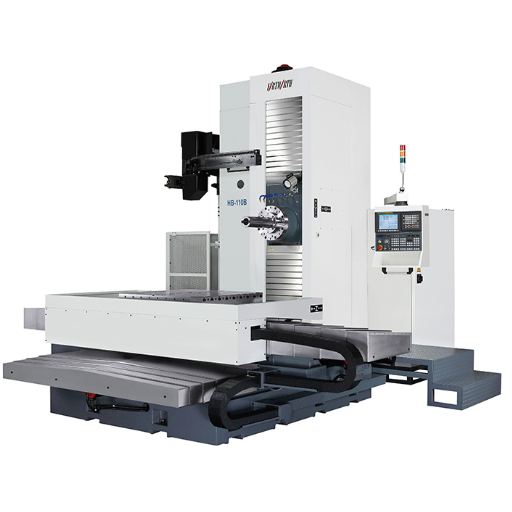
Boring and milling machines are, by nature, vital tools in modern manufacturing for shaping, enlarging, or simply finishing a hole or a surface. A boring machine is mainly concerned with enlarging existing holes with utmost accuracy and alignment. Milling, conversely, is about the creation of complex shapes, cuts, and contours by removing material. The CNC (Computer Numerical Control) types of these machines further augment productivity by operating with efficiency and uniformity, thereby providing a very high grade. Both stand their ground in the aerospace, automotive, and construction industries, where efficient and precise manufacturing is a must.
What is a CNC Horizontal Boring Machine?
CNC Horizontal Boring Machine is a highly sophisticated piece of machinery designed to undertake delicate and large-scale boring operations on different materials such as metals, plastics, or composites. With its horizontal spindle, it can aptly enlarge existing holes and create deep bores with precision. Using a CNC controller, the machine is programmed to execute complex operations that enhance machining precision, repeatability, and efficiency.
A modern CNC horizontal boring machine is fitted with powerful motors and tooling systems, enabling it to deliver the highest accuracy on tasks of extreme performance. They often feature automatic tool changers, multi-axes (commonly 3, sometimes four or even five axes), and high-speed spindles for machining intricate geometric shapes on components. These machines also feature vast worktables or rotary tables, which enable machining of large and heavy workpieces, commonly found in the aerospace industry, oil and gas sector, and heavy machinery manufacturing.
For example, many CNC horizontal boring machines have spindle diameters ranging from 4 inches (100 mm) to 8 inches (200 mm), with some specialized ones exceeding this range. Besides, these machining centres are capable of handling workpieces that weigh many tons. These robust capabilities make CNC horizontal boring machines indispensable where utmost accuracy, efficiency, and complex handling of a wide range of materials is required.
Overview of Horizontal Boring and Milling Processes
Horizontal boring and milling operations are essential in industries for manufacturing large, complex workpieces with high precision. Horizontal boring machines have their spindles oriented horizontally, making it particularly easy to perform operations such as drilling, boring, or machining flat surfaces on large workpieces. Widespread use is now given to CNC-controlled machines for greater automation, accuracy, and repeatability.
Modern CNC horizontal boring and milling machines house very efficient spindles that, depending on the machine type, have rotary speeds over 4,000 RPM and develop a torque exceeding 1,200 Nm, so the presence of operators and interaction with a huge variety of materials ranging from steel to aluminum and high-strength alloys. Moreover, these machines can rotate tables under heavy workpieces; workpieces on these tables weigh more than 50,000 pounds, and these heavy tables are capable of machining industrial-scale components, such as turbine housings, engine blocks, and large molds.
Advanced technologies, coupled with real-time monitoring and adaptive control systems, enhance the productivity and accuracy of these machines. This becomes particularly important for industrial sectors such as aerospace, energy, and heavy equipment manufacturing, where tolerances are typically around 0.0004 in. (10 microns). Moreover, these machines’ ability to integrate well with CAD/CAM software further diminishes the lead time and operational costs of the production process from the design stage to the finished product.
It is these technologies that maintain horizontal boring and milling at the forefront of today’s manufacturing, ensuring their versatility, efficiency, and ability to handle the most demanding machining requirements.
Key Components of a CNC Boring Mill
The CNC boring machine comprises various essential components designed for precision, efficiency, and versatility.
Spindle and Spindle Head:
The spindle is the central part that holds and spins the cutting tool at high speeds. CNC boring mills today consist of very sturdy spindles with speeds of up to 6,000 RPM, depending on the application. The spindle head provides stability during heavy operations, ensuring a uniform machining result.
Worktable:
The worktable supports and moves large or heavy workpieces. Many CNC boring mills feature a rotary and tilting table for multi-axis machining, with load capacities exceeding 10,000 lbs. The size and mobility of the worktable thus become critical factors in addressing various manufacturing needs.
Control System:
The CNC control system is today the heart of boring mills, providing operators with the ability to program machining operations to an acceptable degree of tolerance. Systems like FANUC, Siemens, or Heidenhain provide an interface for programming the tool, including 5-axis control, and maintain extremely high precision through automatic toolpath correction.
Linear Guide Rails and Ball Screws:
These provide smooth movement and utmost precision for guiding the machine’s axes. Good guide rails will dampen vibrations, thereby increasing the accuracy of cuts. Ball screws achieve exceptionally high positional accuracy, with repeatability tolerance within the micron range of 0.0001 inches. Such levels of precision are highly demanded by others, such as the aerospace and automotive industries.
Types of CNC Horizontal Boring Machines
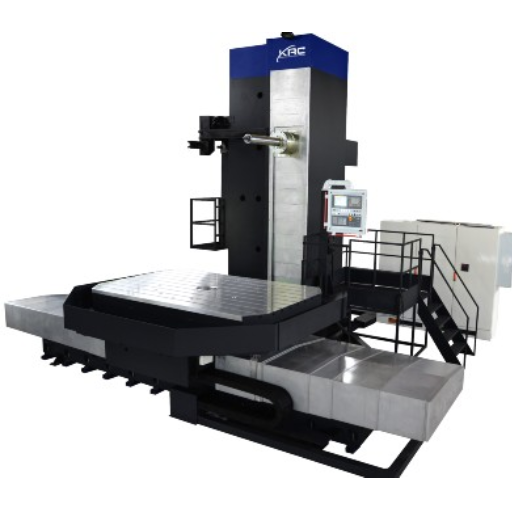
- Table Type: This is the most typical type, where one rectangular table supports the workpiece horizontally. The spindle moves horizontally, and the table moves accordingly to position the workpiece.
- Floor Type: These machines are suitable for larger workpieces that cannot be placed on a standard table. Since the workpiece is stationary on the floor, the machine moves around it to continue machining.
- Planer Type: Suitable for very large and heavy workpieces, this type combines planer and boring machine functions, allowing for both horizontal and vertical movements.
- T-Type: Known for its flexibility, these machines feature a traveling column and a fixed table, enabling the machining of large and complex components.
Each type has its specific uses, depending on the size, shape, and material of the workpiece, making them versatile tools in manufacturing.
Different Configurations of Horizontal Boring Machines
Horizontal boring machines come in various configurations to enhance their adaptability and versatility across multiple industries. These configurations are designed to suit specific machining applications, primarily for large and intricately designed components.
Table-Type Boring Machines:
These are among the most common of all types of horizontal boring machines. They feature a table that moves and supports the workpiece while the spindle carries out the cutting operation. Newer CNC-type models offer precise control and better automation. They serve industries that require high precision, some models reaching positioning accuracy within microns.
Floor-Type Boring Machines:
These machines handle large and heavy workpieces. Unlike table-type machines, here the workpiece lies still while the machine travels on a floor-mounted rail system. The modern ones come with adaptive spindle systems for drilling and boring, boosting productivity in heavy machinery and shipbuilding.
Planer-Type Boring Machines:
For simultaneous machining processes, planer-type boring machines enable both vertical and horizontal machining. Large working areas are typically found in these machines; hence, they find their most significant applications in aerospace and automotive mass production. With multi-axis features, many now enable complex machining and reduce setup times.
T-Type Boring Machines:
The design of this boring machine features a moving column with a fixed worktable, providing manufacturers with greater flexibility for producing a variety of complex workpieces. Furthermore, the T-Type exhibits improved stability and precision, thanks to its linear encoders and robust machine structure. The more advanced models in this segment have been equipped with the highest spindle speeds and tool change capacities, making them a preferred choice in energy and mining applications.
CNC Horizontal Boring Machines:
High-end CNC horizontal boring machines have revolutionized manufacturing through automatic programming and real-time monitoring. The CNC machines support multi-axis operations for creating extremely complex geometries with minimal human assistance. It is recent history that CNC machines have reduced production time by 40% in the automotive and die-making industries. Innovative innovations in tool condition monitoring and thermal compensation further enhance accuracy and tool life.
The adoption of these advanced configurations makes horizontal boring machines suitable for handling an unlimited number of industrial applications efficiently. With continual enhancements in the areas of automation, spindle technology, and customization, these are among the fastest-evolving machines to meet the demands of the modern producer.
CNC Horizontal Boring Machines vs. Traditional Boring Machines
When compared to traditional boring machines, CNC horizontal boring machines offer the advantages of precision, productivity, and flexibility. Conventional methods are mostly manual, whereas a CNC machine is computer-controlled to automate machining processes and ensure consistent, exact results. CNC types of horizontal boring machines, for instance, can achieve a tolerance of ±0.0001 inches and are thus best suited for industries where very high-level precision is required.
Traditional boring machines are typically limited in function and require highly skilled operators to achieve satisfactory results. CNC horizontal boring machines, on the other hand, easily maneuver complicated geometries and complicated operations through programming and multi-axis capabilities. Recently, studies have shown that production time with CNC machines is halved, and simultaneously, material waste is significantly reduced due to optimized cutting paths and error reduction.
The CNC horizontal boring machines also feature an extensive range of applications, allowing for smooth integration within automation systems, such as robotic arms and tool changers. Therefore, they fit easily into the high-paced environment of mass production, making them more widespread in automotive, aerospace, and energy sectors. Regarding simple, small tasks, traditional machines might always be the cheaper option; however, in the long run, CNC systems will save money on both labor and material costs, thus cementing their higher status in modern manufacturing.
Understanding the Horizontal Boring Mill Variants
Horizontal boring mills are adaptable machines mainly classified as table types, floor types, and planer types. Table-type boring mills are smaller machines with a rotating table meant for medium-sized workpieces and give flexibility for varied applications. Floor-type boring mills are designed for larger workpieces, offering the advantage of a stationary base, which provides stability. Consequently, they are well-suited for heavy-duty industrial applications. Planer-type boring mills combine a planer and a boring mill in one unit, providing better facilities for machining substantial components with demanding specifications.
In deciding which variant is best suited for a particular operation, factors such as the size of the workpiece, the material, and the production volume take primary consideration. It is generally good practice to consider table types as general-purpose machining, while floor types are more commonly used in the shipbuilding and aerospace industries. Planer types have very specialized uses and are typically used on significant structural components. The highlighted summary stresses the importance of making the right choice to fit exact manufacturing needs.
Applications in Various Industries

Automotive
High-quality machine tools are used in the manufacture of engine components, transmission systems, and structural parts, providing the precision and efficiency necessary for mass production.
Aerospace
Manufacturing compact and straightforward parts such as turbine blades, fuselage components, and wings, HPTs must meet strict safety and quality standards.
Shipbuilding
Large machine tools are designed for the manufacture of marine structures, including ship hulls and other essential components.
Energy
The wind, nuclear, and oil and gas industries utilize machine tools for the fabrication of turbines, pipelines, and generators.
Medical
The machining process ensures the creation of highly important devices, including implants, surgical instruments, and diagnostic equipment, with precise and high-quality final results.
This way, machine tools mediate innovation and high-quality production in these sectors.
Industrial Applications of CNC Horizontal Boring
A CNC horizontal boring machine has a wide range of applications, being recognized for its precision, flexibility, and ability to handle significant components. Heavy machinery, along with large components, is well-suited for applications in machines that require utmost detailing and tight tolerances.
Aerospace:
CNC horizontal boring machines are extensively used in aerospace machining for the manufacture of significant aircraft components, including fuselage sections, wing structures, and engine mounts. The machinery gives the precision demanded by aerospace fabrications with strict requirements for safety and performance.
Automotive:
In the automotive industry, these machines enable the achievement of absolute accuracy in machining engine blocks, gearboxes, and transmission housings. Another achievement of high production efficiency and repeatability of horizontal boring machines is to guarantee the consistent performance of vehicle components.
Energy:
The energy sector depends heavily on CNC horizontal boring machines for the manufacture of turbines, generator housings, and pipeline components. For instance, manufacturers of wind turbines often need to machine strong hub components and flanges with these machines to ensure smooth operations under harsh conditions.
Heavy Machinery and Equipment:
Industries that procure heavy machinery for construction and mining purposes employ CNC horizontal boring machines for machining large parts, such as machine frames, crane bases, and excavation equipment. Such parts require a great degree of precision due to their size and load-bearing requirements.
Oil & Gas:
The oil and gas sector relies on horizontal boring machinery for machining the complex components of drilling rigs, compressors, and refinery equipment. Such precise machining of parts enhances operational efficiency and safety under demanding conditions.
Shipbuilding:
Horizontal boring plays a crucial role in the manufacture of essential marine components, including engine blocks, propellers, and rudder assemblies. These machines contribute to the long-span requirements of large applications with durability and precision.
With recent technological advancements in CNC, horizontal boring machines have been further capacitated. The incorporation of automation features, superior tool changers, and multi-axis machining options has significantly increased productivity and flexibility, while reducing lead times without compromising accuracy. This makes CNC horizontal boring extremely crucial for present-day manufacturing.
Precision Engineering and CNC Technology
Combining precision engineering and CNC technologies in manufacturing has modernized production by enabling the manufacture of highly accurate and complex components. CNC machines with tightly controlled programs and advanced software can meet manufacturing tolerances as precise as ±0.0001 inches. One might consider this precision important for industries of aerospace, automotive, and medical product manufacturing. Such precise tolerance levels ensure the production of components with consistently good performance and, therefore, high reliability, while also minimizing waste.
Data also reveal that multi-axis CNC machines are being increasingly adopted due to their ability to reduce the number of setups required in machining. For example, 5-axis CNC machines enable the machining of complex parts in a single operation, making them both efficient and productive. Market reports indicate that the CNC machine market globally will witness a CAGR of nearly 6.5% till 2030, supported by automation developments and demand for further precision.
Precision engineering, coupled with CNC technology, enables scaling of manufacturing. Being computer-controlled for repeatability, manufacturers can mass-produce components with wonderful details without sacrificing quality. Additionally, CNC machines equipped with real-time monitoring systems perform continuous quality checks, resulting in reduced downtime and optimized performance.
These advancements establish precision engineering and CNC technology as the modern backbone of today’s manufacturing, balancing the ever-changing demands of industries worldwide and thereby driving technological advancement.
Examples of Products Manufactured Using Boring Mills
Boring mills are all-purpose machines. Here are some common uses for creating significant, accurate components in the industry. For example, engine blocks and cylinder heads are manufactured for use in both automotive and aerospace applications. The components are highly accurate to ensure performance and safety, and boring mills are capable of meeting the tolerances.
In manufacturing, boring mills play a crucial role in preparing the components of industrial machinery, including large gears, turbine casings, and pump housings. Machining operations can swiftly and accurately cut materials of high hardness, such as steel, to achieve the required dimensional tolerances and durability standards.
In power generation, boring mills find their most excellent application for machining turbine rotors and generator shafts to very close tolerances. The oil and gas industry relies on boring mills to manufacture drilling equipment, including pipe flanges and subsea connector plates, designed to withstand harsh conditions.
The recent improvements in boring mill technology have provided additional impetus for the manufacture of complex geometries while reducing material waste. Boring mills remain a crucial finishing operation that produces essential products for industrial applications worldwide.
Benefits of CNC Horizontal Boring and Milling

High Precision
By providing excellent accuracy, CNC horizontal boring and milling machines ensure that components consistently meet very exact specifications.
Versatility
These machines can process a wide range of materials and produce intricate parts suitable for various industrial applications.
Time Efficiency
The automation impresses upon production, speeding up the process without compromising on high quality, thereby accruing greater efficiency.
Enhanced Productivity
It surely improves productivity by reducing downtime, as it can perform multiple operations in a single setup.
Cost Savings
CNC horizontal boring and milling machines reduce material waste and increase efficiency in the manufacturing process, resulting in cost savings.
Consistency
Due to automated operations, the probability of human errors is reduced, resulting in consistent results even across multiple production runs.
Productivity Improvements with CNC Technology
Through the integration of CNC technology, the domain of precision manufacturing has undergone significant changes, resulting in significantly enhanced productivity across all industrial fields. CNC machines can be operated through advanced automation on a 24-hour basis with little downtime, thus increasing throughput. For example, it has been demonstrated that CNC machining reduces cycle time by 30-50% compared to manual machining methods.
Newer CNC systems can alert operators to faults in real-time, giving them ample time to rectify the issue and thereby avoid material wastage. Other recent innovations include multi-axis machining, which can reduce costs by producing complex parts in a single setup operation. Companies that have utilized CNC machines have reported efficiency gains of 20-40%, which exemplifies CNC machining’s ability to transform manufacturing productivity worldwide.
Working with CNC technology, speed and dimensional accuracy within tight tolerances are joined with batch-to-batch consistency in large volumes to achieve stringent market requirements without compromising quality.
Enhanced Precision in Machining
Recent CNC machining improvements have led to a significant change in how precision can be ensured in a manufacturing process. Advanced CNC systems currently achieve a resolution of ±0.0001 inch and are therefore essential where precision is of utmost importance, such as in aerospace, medical, and automotive production. These accuracies are attainable thanks to continuous software improvements, highly sensitive sensors, and machine tools that mitigate errors arising from vibration or thermal distortion.
Therefore, having AI-based algorithms with real-time monitoring enables exponential improvement in error detection and correction during machining, significantly reducing material wastage and ensuring consistent quality assurance throughout the production process. Studies have shown that manufacturers utilizing high-precision CNC machining have been able to reduce defect levels by nearly 50%, thereby meeting stringent industry standards while also cutting costs. Taken together, these innovations highlight the importance of enhanced precision in modern manufacturing, driving efficiency and ensuring product quality.
Footprint and Efficiency in the Workshop
While optimizing an industrial workshop for space potential and utility efficiency has been a significant focus for manufacturers aiming to increase productivity and sustainability, studies confirm that improved space utilization, such as a modular layout of workshops, can lead to a 30% increase in production efficiency. These advanced automation systems, such as the flexible manufacturing networks or collaborative robotic systems, however, contribute to scheduling workshops to minimize downtime and increase throughput.
Similarly, energy efficiency becomes another essential aspect, with workshops integrating innovative energy management systems to minimize power consumption. Energy-efficient machinery and LED lighting systems, for instance, have been shown to reduce energy costs by anywhere between 20% and 40% in various industries. Lean manufacturing eliminates all wastes from the workflow as opposed to removing the wastes within the worksites themselves, thanks to 5S practices, resulting in fewer slowdowns and smoother work.
These developments are evidence of a paradigm shift from space planning through the application of technology and process towards the creation of workshops that operate supremely and sustainably. Through relentless investments in innovative techniques and efficient layout designs, manufacturers can gain on two significant fronts: operational agility and sustainability through cost-saving measures.
Understanding the Spindle and Tool Capabilities

The most versatile tool, CNC horizontal boring and milling machines are designed with ample flexibility afforded by the spindle and tool system. Modern mechanisms enable the spindle to operate at variable speeds, ranging from approximately 1,000 RPM to 8,000 RPM, depending on the machine and the nature of the work. This variation ensures that spindles meet challenges of light operations, like precision drilling on one end, and those of heavy operations, such as big-bore drilling, on the other.
Tool changers have also been improved to include machines with the capacity to store between 40 and 120 tools, permitting these tools to switch among different operations without manual intervention. This massively reduces downtime, increasing productivity. Some even automatically adjust tool length and compensate for temperature variations during prolonged operation, ensuring consistent tool accuracy.
With the development of better materials for cutting tools, including high-speed steels, carbides, and coatings, the whole machining process has become more durable and efficient. Carbide tools, for instance, maintain their strength and stability at temperatures exceeding approximately 1,000°F and can therefore be used in numerous high-speed operations.
CNC systems today also incorporate intelligent monitoring systems that proactively track tool wear and spindle vibrations to forecast maintenance needs, prevent further faults, and ensure maximum efficiency, thereby significantly reducing unscheduled downtime.
Put simply, this demonstrates that CNC horizontal boring and milling machines are all about accuracy, speed, and adaptability to many industrial cores.
Role of Tool Changers in CNC Boring Machines
Tool changers on CNC boring machines are crucial components for ensuring smooth operation and enhancing production. During my working experience, I have found that tool changers are used to automate the switching of tools during the machining process, thus minimizing human intervention and saving time. This, in turn, strengthens efficiency and guarantees that the right tools are always used for the right processes. Given this, tool changers enable the simultaneous operation of multiple methods, facilitating the handling of complex machining operations without delays.
Rotary Tables: Expanding the Functionality of Boring Mills
Rotary tables are an inherent extension of boring mills, bringing additional utility and flexibility to the system. These tables enable the rotation or indexing of the workpiece to exact angles, providing greater options when machining complex parts. By mounting rotary tables, machinists can perform machining operations on multiple faces and axes without the need to manually reposition them, thus saving time and assuring accuracy. They assume greater importance when machining complex features such as circular grooves, arcs, or contoured surfaces.
Modern rotary tables are equipped with the latest technological advances, such as CNC control, ensuring that adjustments on the rotary table are made automatically and with high repeatability. This makes them suitable for operations that require close tolerances and complex designs, such as those in the aerospace, automotive, and heavy machinery industries. Rotary tables also enhance productivity by reducing process steps, allowing for simultaneous machining operations on different axes, which directly reduces setup times and substantially increases operational efficiency. Their compatibility with boring mills makes rotary tables an indispensable tool for extending machining capabilities to meet the requirements of complex manufacturing tasks.
Reference Sources
Hydraulic Installations for Heavy Machine-Tools
Analysis of Geometric Deviations in CNC Milling Boring Processes
Practical Aspects of Numerical Compensation for Geometric Errors in Machine Tools
Frequently Asked Questions (FAQs)
What kind of machine is a CNC Horizontal Boring Machine?
A CNC horizontal boring machine is a machine tool that utilizes boring and milling processes on massive workpieces of high weight. These machines, controlled via CNC technique, guarantee precision with almost no compromise. Due to this, they have gained popularity in machining complex parts for various industries.
How do Horizontal Boring Mills enhance productivity?
The horizontal boring mill increases productivity, as boring and milling can be performed during the same setup. This reduces the need for multiple machines, streamlining the workflow and minimizing downtime, thereby significantly enhancing productivity.
What characterizes CNC Horizontal Boring Mills?
CNC horizontal boring mills typically feature a high-powered spindle, a CNC control system with a graphical user interface, and other optional extras, such as automatic tool changers and glass scales, to further enhance precision and reliability during machining operations.
What workpieces are machined in a CNC Horizontal Boring Machine?
CNC-horizontal boring machines handle significant components and heavy-duty workpieces in industries such as aerospace and automotive. These machines efficiently manage complex shapes and tight tolerances, which are crucial for high-precision applications.
What is the difference between a Horizontal Boring Machine and a Horizontal Mill?
Horizontal boring machines can accomplish boring operations with some milling, while horizontal mills perform more milling. So, the horizontal boring machine tends to deal with larger and more complex workpieces, whereas the horizontal mill handles more straightforward milling operations.
What are the benefits of the CNC feature added to boring mills?
CNC technology in boring mills enhances precision and repeatability, and enables automation of complicated machining tasks. This improves the reliability and efficiency of production processes, particularly for large-scale manufacturing.
Does a CNC Horizontal Boring Machine have the capability of drilling?
Yes, CNC horizontal boring machines can drill holes and tap threads. By utilizing various tools and attachments, these machines can perform a range of operations, thereby increasing their versatility and value.
What is the floor space occupied by a typical CNC Horizontal Boring Machine?
The floor area or footprint of a CNC horizontal boring machine varies with its size and design. While many machines of this type are designed to occupy a relatively small space, they retain the capability to handle large and heavy components, making them quite suitable for industrial use.
What functions does the spindle perform on a Horizontal Boring Machine?
In a horizontal boring machine, the spindle holds and rotates the cutting tool during the machining process. This spindle is designed to provide a high degree of rigidity and stability, enabling the precise machining of complex parts with tight tolerances.