




The high remedy and high malleability of the EDM process in manufacturing complex parts place it as inexorably revolutionary. The two main EDM types, sinker EDM and wire EDM, differ quite a bit from each other depending on the actual procedure, uses, and benefits. Any engineer, manufacturer, or just for the sake of curiosity in machining technologies cannot afford to miss the key distinctions in order to choose the suitable process for their project. This article discusses the unique features of sinker and wire EDM processes, differentiating their individual characteristics, application areas, and how to choose between the two for specific machining needs. Let’s assist you in making sound manufacturing choices!
Understanding EDM Processes

What is Electrical Discharge Machining?
EDM is a manufacturing process used to remove metal from the workpiece by means of a series of electrical discharges, which are sparks. The process involves a spark being controlled electrically between an electrode and the workpiece, both being submerged in dielectric fluid. The sparking action causes erosion on the surface of the workpiece material with high levels of control, thereby allowing extremely detailed, intricate, and complex forms to be shaped with great accuracy.
EDM is used mainly with electrically conductive materials such as metals which include titanium, steel, and alloys that are difficult to shape by conventional means. The process is especially useful wherever extremely tight tolerance, superior finish, and machining hard or delicate materials without inducing mechanical stress are required. This process is used a lot in industries such as aerospace, automotive, and medical engineering where precision is of the essence.
How EDM Works
Electrical discharge machining (EDM) proceeds on controlled electric discharges between the electrode and the workpiece that remains submerged in the dielectric fluid. Upon voltage application, an electric field is generated which ionizes the fluid to allow the electric spark through. This spark causes an intense heat concentration that finally melts or vapourizes a very small area of material on the surface of the workpiece. The dielectric fluid then cools the material and washes the debris away, leaving a great finish.
Advanced EDM Technology: Higher EDM are mainly focused on adaptive control systems which actively monitor discharge parameters during the machining process and make necessary adjustments to improve accuracy and efficiency. These systems find increasing application to obtain micro-scale accuracies and complex geometries that are particularly crucial in aerospace and medical device manufacturing. The process is non-contact and applies no mechanical pressure, suitable for fragile or very hard materials.
Types of EDM Machines
There are three core types of EDM that serve different purposes for specific applications and needs:
Die-Sinking EDM
Die-sinking EDM, by other names also known as ram EDM, works by means of erosion of metal through electrical discharges where a shaped electrode makes a cavity in the workpiece. Thus it is well suited for detailed molds, dies, and precision cavities with applications in manufacturing industries such as automotive and consumer goods.
Wire EDM
Wire EDM uses a thin wire of metal, typically brass or copper, to etch away electrical conductors with high precision. This is suited to machining very intricate shapes, with tight tolerances and sharp corners, which is therefore especially employed for tooling and aerospace work.
Hole-Drilling EDM
Hole-drilling EDM is designed to create small holes in hard materials with utmost precision. It is useful for creating jet engine cooling holes or for starting small points for wire EDM cutting.
These EDM types continue with the advances in real-time monitoring, adaptive control systems, and increased automation to push the frontiers of precision engineering and allow new avenues for various industries.
Sinker EDM vs Wire EDM

Differences Between Sinker EDM and Wire EDM
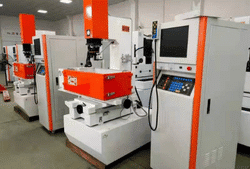
The working and application differ in both processes but Sinker EDM and Wire EDM claim to be some of the most used manufacturing engineering processes for machining delicate parts. In Sinker EDM, an electrode (made of graphite or copper) is prepared in the shape of the cavity required. The electrode is submerged in a dielectric fluid and sparks are generated to erode the cavity from the workpiece; hence, Sinker EDM is apt for working on cavities and molds, dies, or even quite intricate 3-D shapes. Wire EDM, by contrast, uses a thin electrically charged wire to cut intricate patterns and through-holes in conductive materials; excellent for machining profiles and through holes with tight tolerances.
Another major difference is how each method removes material. Sinker EDM works to produce a negative image of the electrode into the workpiece, making it favorable for parts requiring depth and tooling applications. Meanwhile, Wire EDM pierces through the material, making it best suited to cutting parts that need separation, as in aerospace and medical component fabrication.
With enhanced technology, including automated techniques, improved dielectric fluids, and real-time monitoring systems, the scope of applications for both methods has broadened considerably. The application for which the method is intended will always determine the correct EDM method to choose between the two: cavity work or cutting detail.
How Sinker EDM Works
The Sparks formation starts between the working object and the electrode of Sinker EDM or Ram EDM. The electrode is immersed in a dielectric liquid either oil or a special form of coolant. The electrode is usually made of graphite or copper machined in the shape of the cavity or any other feature to be produced in the workpiece. After careful machining, the electrode is then electrically charged and brought near the workpiece where with many controlled sparks. These sparks generate enormous heat, ironing the material out of the workpiece by vaporization and erosion exactly in the shape of the electrode.
The recent innovations in Sinker EDM have facilitated maximal processing speed and efficiency with enhanced casting of parts at high precision. Automatic electrode changers, modern power supplies, vacuum systems, and online-a-way monitoring systems, along with each other, either work in reducing machining time or work toward improving product quality. Due to this, Sinker EDM is a perfect fit to manufacture products of relatively high tolerances such as molds and dies or quite complicated cavities and components. It serves several industries such as aerospace manufacturing, automotive, and medical, where tolerance and complexity are a pre-requisite.
How Wire EDM Works
Wire EDM cuts elaborate profiles and through-holes in conductive materials with the highest precision conceivable by employing a thin electrically charged wire. The process is initiated by passing the wire continuously from a spool, maintaining a constant voltage between the wire and the work-piece. When the spark gap becomes narrow enough, an electrical discharge takes place, generating intense heat that melts and vaporizes the surface of the material by a very slight inch. As the wire does not come in contact with the material anyway, it is in a position to cut even the most delicate designs without deformations.
Cooling dielectric fluid prevents the molten debris from hardening and settling in the electro-discharge process, liberating the workpiece. The fluid surrounds the cutting zones in Wire EDM and flushes away debris while keeping the temperature steady so that thermal damage does not come to pass. With the technology, complex shapes are created, and everything from fine details to tight tolerance components is produced; hence, its use is coupled with aerospace, medical device manufacturing, and tool and die making. With automated programming and multi-axis control systems, modern Wire EDM is transforming into one of the most flexible machine tools for cutting even the hardest materials such as titanium and carbide.
Advantages and Disadvantages

Pros and Cons of Sinker EDM
Pros
- Ability to Machine Complex Shapes: Sinker EDM has a facility for very complicated and precise kinds of geometrical shaping suitable for molds and dies, especially cavities that require more precise dimensional tolerances.
- Material Versatility: It can do its job on hard materials like tungsten carbide, tool steel, and even hardened alloy without compromising its accurateness.
- No Mechanical Stress: Being physically non-contact, the workpiece very seldom develops any damage, cracks, or distortions.
- High Surface-Finish: Some very fine competitor processes cannot ever be compared for their quality of surface finish. Hence, the use of Sinker EDM would require somewhat less of polishing and fine finishing, thus saving time and resources.
- Machining of Delicate Areas: This technology makes machining possible in areas where all conventional machining methods just cannot reach.
Cons
- For Slow Process: So this particular EDM treatment is slower in comparison to other machining processes in respect of different sizes of a workpiece to be manufactured.
- For High Operational Costs: Graphite or copper electrodes, dielectric fluid, and electricity contribute to making the process costly.
- For Tool Wear: Discharge erosion of electrodes basically results in a decrease in discharge machining accuracy; therefore, the electrodes should be replaced quite often or re-ground.
- Limitation with Material Removal Rate: Sinker EDM is not great for mass material removal and is better suited to small detailed work.
- Environmental Problems: The use of dielectric fluids may cause some environmental hazards, especially if disposed of improperly.
With the limitations that have been cast in the above lines, by applying the latest developments in automation and better electrodes, Sinker EDM stands as a crucial tool in mold-making and aerospace manufacturing.
Pros and Cons of Wire EDM
Wire EDM is a highly capable and precise technology that finds its application in the cutting of various conductive materials. Here are the major benefits and limitations:
Advantages
- High Precision and Accuracy: Wire EDM offers the ability of making fine and complex cuts with tight tolerances, sometimes as tight as ±0.0001 inches, making it an excellent method to be employed on delicate and intricate workpieces.
- Versatility: This method cuts hard materials such as titanium, tungsten, and hardened steels these materials are very hard to tool by traditional tooling methods.
- Non-Contact Process: Since the wire is not able to come into contact with the material and would produce minimal mechanical stress or deformation on the work piece.
- Repeatability: Wire EDM allows you to get consistent results that are significant in bulk manufacturing when producing identical components.
- No HAZ: Since electrical discharge is used rather than the direct cutting, there is little or no thermal distortion affecting the integrity of the material.
Disadvantages
- Cutting Speed Slow: Wire EDM is slower when compared to traditional machining, especially for thick materials.
- High Initial Cost: Wire EDM machines have their own high cost for the equipment and maintenance which small-scale operations may not find feasible.
- Limitations with Non-Conductive Materials: Wire EDM is restricted to conductive materials, thereby limiting its applications in certain areas.
- Wire Waste: Consumption of disposable wire leads to waste of materials, raising the operational cost.
- Environmental Impact: The disposal of dielectric fluid in Wire EDM becomes questionable if not handled properly.
The incorporation of recent developments, like automation and advanced software, have propelled Wire EDM into a new age, assuring the demands of contemporary manufacturing. It continues to hold steady as an imperative method for aerospace engineering, medical device manufacturing, and precision engineering while balancing its limitations with unrivaled accuracy and reliability.
Comparative Analysis Between Both Processes
When comparing traditional machining methods to Wire EDM, we see some important distinctions in the area of tolerances and precision, types of materials suitable, and scope of application. Traditional machining is ideally suited for the speedy removal of material from softer workpieces and excels in situations of mass production due to its reasons of efficiency and cost. Here is where the limitation of traditional machining starts to pinch as it cannot perform very well in extremely hard materials or intricate geometries.
Conversely, Wire EDM can uniquely realize tight tolerances and complex shapes in hard and exotic materials such as titanium and hardened steel, which otherwise are quite difficult to be produced by traditional machining. This loss of time and cost almost makes the method an issue, but in focus industries such as aerospace and medical device manufacturing where micro-level tolerances matter, pushing the use of Wire EDM to the top list for producing burr-free finishes.
According to recent market data, the ability of Wire EDM in automating the setup procedures and the inclusion of AI-driven software have been closing its slowness and cost disadvantages when compared to the good and old traditional machining. Although both methods differ, the choice lies with the requirements of the project: Wire EDM for precise engineering work and traditional machining for speed and lower cost in less intricate productions.
Applications and Industries

Common Applications of Sinker EDM
The industries need Sinker EDM for making extremely intricate and precise parts that cannot be done by conventional machining techniques. Common applications include manufacturing molds or dies necessary for plastic injection molding, die-casting, and forging. Being able to operate on a wide range of materials and also commonly known for machining very hard materials such as tungsten carbide and hardened steels, this process finds manifold applications, particularly in tooling and die-making industries. Components with intricate geometries or subjected to tight tolerances are discharged from Sinker EDM: aerospace components, medical devices, and complex electrical connectors.
Recent data indeed reflects these sectors-well industries requiring Sinker EDM increasingly keep pace with the dynamic technology landscape. The aerospace industry derives benefit from accuracy attained in machining heat resistant alloys, while in healthcare, this integrates producing highly complex surgical instruments and implants. On the other hand, Sinker EDM turns versatile, and the more their materials and techniques of design are embraced by industries, the more the process facilitates continuity of innovation and quality in high-precision manufacturing solutions.
Applications of Wire EDM
Wire EDM cuts electrically conductive materials in complex and precise shapes and thus penetrates different industries. This non-contact cutting contains its advantage for intricate parts, with the highest degree of accuracy and fine tolerances.
Aerospace
Cutting turbine blades, engine components, and many other parts from hard-to-machine materials such as titanium and nickelbased alloys helps in conserving materials and maintains precision.
Healthcare
Wire EDM is used dental instruments, prosthetics, and medical implants in the medical sector. It is the precision that ensures reliability and meets the stringent standards of the medical field.
Automotive
Wire EDM produces high-performance engine parts, molds, and gears efficiently. Manufacturers use it to meet the consistency and uniformity required for vehicle performance and safety.
Tool and Die Making
Wire EDM molds for punching tools and dies are for mass production of intricate designs in consumer goods and electronics.
Electronics
Wire EDM assists in the production of micro-components such as connectors and semiconductor molds that cater to miniaturization demands as devices become smaller and more complicated.
Keeping recent advances at hand, it is clear that Wire EDM continues its evolution along the lines of just-evolved higher-speed capabilities, coloration in accuracy, and compatibility with advanced materials. This attribute guarantees that the method shall remain one of the main routes in the production of high-precision instruments. In summary, Wire EDM has since proved to present modern problems encountered by engineers and drive innovations in major sectors worldwide.
Industries Leaning Towards Both Methods
Due to its unique capability of precision, Wire EDM and traditional machining are generally used across various industries. The aerospace industry predominantly relies on these methods to manufacture turbine components, structural parts, and engine systems requiring extraordinary tolerances and qualities. The automotive industry equally applies both methods of machining processes in the manufacture of geartrain systems, engine blocks, and complicated mold designs to maximize performance and reliability. In addition, the medical field greatly benefits from these methods in the production of surgical tools, orthopedic implants, and life-saving devices with high precision. With latest data, the further development of these processes now seems to align with an increasing need for more efficient, versatile, and affordable manufacturing technique in these key industries.
Choosing the Right EDM Method

Factors to Consider for Selection
Depending on several factors, the appropriate option of Electrical Discharge Machining (EDM) method should be chosen for best results. Since EDM works on materials that are electrically conductive, extra care should be taken in considering the material type and its conductivity. The complexity of the design is yet another important factor; wire EDM can be used to make very intricate and precise cuts. Production volumes will weigh heavily as well: Sinkers are frequently preferred when a low volume of high precision is required, whereas wire EDM can cope with higher production volumes with apparent ease.
Cost-effectiveness and turnaround time become crucial considerations when an industry is involved in rapid prototyping or requires expedited delivery. The most up-to-date industry analytics strongly emphasize that any EDM method considered must be relevant to the respective industry’s requirements, such as tighter tolerances seen in medical device manufacturing or the rugged durability seen with aerospace components. By giving consideration to these different factors in line with performance statistics and project needs, a company can confidently assert the EDM method that best suits their precise manufacturing needs.
Precision Needs and Material Types
In their pursuit of knowledge concerning precision and material requirements, it is most helpful to refer to the latest data from ‘s search insights. A fair number of queries brought to light show business is very interested in how different types of EDM cater to specific materials, including various conductive metals, such as titanium, aluminum, and hardened steel. For projects that require ultra-high precision such as jewelry design or semiconductor manufacturing, Wire EDM is usually preferred due to its ability to clamp tolerances within microns. On the other hand, for exotic alloys and non-standard thicknesses of material, Sinker EDM stands a better chance of answering to such challenges. Current trends combined with project-specific requirements related to hardness of the material and the desired surface finish will lead businesses to the best approach in meeting both the precision requirements and the materials needs.
Production Scale and Efficiency
Production scale and efficiency are determining factors in economic viability and sustainment of operations in any modern manufacturing setup. With the incorporation of state-of-the-art technology with Wire & Sinker EDM, precision can be retained at volume levels both extremely small and extremely large. Automation of EDM processes, according to the latest industry trend showcased through ‘s search engine’s data, substantially increases throughput without any detrimental compromise on accuracy, thereby scaling up higher operations at reduced lead times and reduced costs of production. With the aid of data-analytics, manufacturers will be able to optimally utilize all resources at their disposal in response to the ever-growing demand from different sectors and stand tall in an ever-evolving market.
FAQ
How is sinker EDM different from wire EDM?
The primary difference lies in the process. Sinker EDM, or plunge EDM, uses an electrode that follows the shape of the cavity that is to be created; the electrical discharges are created between the electrode and the workpiece. Wire EDM, however, just cuts materials through a tiny metallic wire and is best for making precise cuts in intricate patterns. The general idea is that sinker EDM is used for molds and dies, whereas wire EDM can create complicated geometries in different metals. Both fall under non-traditional material-removal processes but find very different uses in manufacturing.
What are the advantages and disadvantages of wire EDM and sinker EDM?
The pros and cons will always depend upon the application when comparing wire versus sinker EDM. Wire EDM cuts thin materials faster and with more ease as compared to the other. This, therefore, made wire EDM great for very intricate designs. It could, however, be less suitable for machining thicker workpieces, unlike the sinker EDM that can easily machine thicker workpieces. On the other hand, the sinker EDM is capable of producing complex shapes of 3D models, especially in a cavity EDM process. So, from the point of view of what is expected to be carried out during the project, such as thickness of material and level of accuracy, the consideration almost leads to the choice between these two EDMs.
How does the process of Sinker EDM occur?
A specially shaped electrode dipping into a workpiece characterizes the Sinker EDM process. By having sparks generated between the electrode and workpiece, materials are eroded to the shape it is intended to have. This process excels in making cavities and complex geometries in hard materials. This process is slower when compared with the wire EDM process but suits better with a lot of precision required in the design work. Also, it is a great option where a smooth surface finish is essential, as the mechanism of electrical discharge machining can deliver great surface quality.
What is wire EDM and how does it function?
The Wire EDM method uses a razor-thin wire acting like an electrode to cut materials with extreme precision. The wire is stretched between two prominent guides: one on the tool side and the other on the work side. Spark formation takes place as the wire passes over the workpiece, and the resultant erosion of the surface allows the wire to cut very intricate shapes and designs. This machining method is used highly for parts with very tight tolerances and geometries. Wire EDM will cover almost every type-class of materials, from hardened steels to exotic alloys, thus offering a vast scope. The other big advantage of wire-EDM is that there is practically no material stress or deformation due to the non-contact cutting process.
What are sinks and wire EDM applications?
These sinker and wire EDMs can operate in different industries. Sinker EDM is more regularly used in mold making, especially for cavities and contouring of injection molds. It is highly regarded for complicated dies for automobile and aerospace industries. Alternatively, wire EDM finds use in industries that demand critical recent cuttings, like medical device manufacturing, and crafting intricate tooling components. The decision for choosing sinker or wire EDM depends on project-specific requirements, such as material type, thickness, and precision.
Reference Sources
- MIT – MAS.S62 Final Notes – Bengineering
https://fab.cba.mit.edu/classes/S62.12/people/peters.ben/mass62-final-notes.html
This resource provides an overview of conventional EDM processes, including sinker and wire EDM, and their applications. - Dunwoody College of Technology – Machine Tool Technology
https://dunwoody.edu/manufacturing/machine-tool-technology/
This program page discusses CNC machining technologies, including wire EDM and sinker EDM, and their role in mold and die making. - Academia.edu – Principles and Characteristics of Different EDM Processes
https://www.academia.edu/59744064/Principles_and_Characteristics_of_Different_EDM_Processes_in_Machining_Tool_and_Die_Steels
This paper explores the principles and characteristics of sinker and wire EDM processes in machining tool and die steels.