




Electrical Discharge Machining Drilling Machines are changing industries on a larger scale to accommodate precision machining. EDM drilling machines are famous for drilling very fine holes and engraving very fine shapes on materials which are very hard to machine. In this guide, you will be introduced to EDM drilling machines-the definition, their working principle, and their need in the industrial landscape today. This comprehensive guide will help you get acquainted with their immense potential and actual use, whether you are a practitioner or just starting out. Let’s now enter the fascinating realm of EDM drilling and look at how it is shaping the future of precision engineering.
Understanding EDM Technology

What Is Electrical Discharge Machining?
Electrical Discharge Machining is a manufacturing process where discharge or spark is utilized for shaping a workpiece by subjecting it to selective removal of material. It doesn’t work as the conventional ones; that is, it does not involve any kind of physical contact between the tool and the workpiece. The working principle involves a conductive tool and a dielectric fluid to generate a spark that erosion the material with extreme accuracy. The tool is most commonly graphite or copper. This process favors the machining of hard materials, i.e., titanium, hardened steel, and carbide, forming the core of the aerospace, automotive, and medical device industries. EDM, therefore, stands to become an umbrella term for manufacturing processes that work toward making tiny complex shapes requiring finer details.
Principles of the EDM Process
The EDM process uses a control mechanism resulting from an electrical discharge. This involves creating series of electrical sparks between a conductive workpiece and an electrode, separated by a dielectric fluid. When a spark occurs, the material in question, on the surfaces of both the workpiece and the electrode, melts and vaporizes due to the severity of the heat generated-the temperature being approximately 8000°C-12000°C. Then, the fluid acts as an insulator until a certain voltage is attained to cause a spark, and it washes away the eroded particles to maintain maximum efficiency and precision.
Recent innovations have incorporated adaptive control algorithms and AI into the modern EDM system to optimize performance. This allows, for example, monitoring in real-time the state of the gap, thus reducing the wear of the electrode to the bare minimum and improving surface quality. These advancements, brought about by the latest data-driven methodologies, have evolved EDM applications so that further intricacies in geometries and tighter tolerances have been achieved in the industries.
Types of EDM Machines
There are several different kinds of EDMs, classified according to the nature of their working and purpose of application. Some of the common types include:
Sinker EDM
The Sinker EDM, or Die-Sinking EDM, uses a pre-shaped electrode to make cavities and detailed features in a workpiece. It suits applications where high precision is required, such as mold and die making.
Wire EDM
The Wire EDM runs on a premise that two conductors separated by a gap filled with a dielectric fluid will erode material from one of them if electrical sparks are generated across the gap. Thinly charged wires were always used for precisions cuts requiring high levels of accuracy, delicate intricate work pieces with sharp corners, or tight tolerances.
Hole Drilling EDM
This is a high-precision type of drilling process and used for making small, deep, or irregular holes that otherwise cannot be drilled by conventional methods. As such, it finds major applications in aerospace and automotive manufacturing.
Each EDM is supported by the latest technologies, including real-time data processing and embedded AI-powered algorithms to improve accuracy and reduce machining time. These technologies have been pushing the boundaries of EDM machines to reduce inefficiencies across so many industries.
EDM Drilling Machine Overview

What Is EDM Drilling Machine?
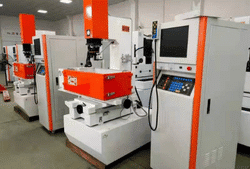
The EDM Drilling Machine, or Electrical Discharge Machining Drilling Machine, is an operation tooling that provides for the making of very fine holes, which can be orders of magnitude smaller than mechanical drilling tools would provide. The machine utilizes electrical discharges or sparks to erode material from the point of erosion, hence eliminating any contact between the tool and the workpiece. The EDM drilling machines are used much for micro-holes, cooling holes in turbine blades, or high-precision intricate shapes in fields such as aerospace, automotive, and medical device manufacturing. The combination of real-time monitoring with developments in EDM and AI has further improved the precision, speed, and reliability of these machines, making them an indispensable piece of equipment in a broad range of manufacturing processes.
Key Features of EDM Drilling Machines
-
High Precision and Accuracy
It is said that EDM drilling produces micro-holes and complex geometries with the utmost level of precision. Considerable precision is required in the aerospace industry and medical device manufacturing, where any slight imperfection can make such grave consequences.
-
Material Versatility
This machine drills through solid and conductive materials such as titanium, tungsten, and stainless steel. So this can be sought after for rather complicated jobs in many high-tech industrial sectors.
-
Reduced Thermal Damage
In contrast to conventional processes, EDM drilling minimizes thermal stress and damages to the material, which preserves the integrity of the components with tight degrees of tolerance.
-
Automation and AI Integration
Incorporating advances such as the “latest” enhanced EDM drilling provides AI capabilities and real-time monitoring systems for operational efficacy and predictive maintenance that reduce downtime and extend augmenting workflows.
-
High Aspect Ratios
EDM drilling is the ability to deep drill holes having a high aspect ratio. This particular use is very helpful to achieve the required accurate depth and alignment for cooling holes in turbine blades. -
Non-contact Process
Since there is no physical contact between the tool and the workpiece in EDM drilling, this eliminates mechanical stresses, thus being perfect for delicate components.
Empowered by these major features, EDM drilling machines continue to be the trends of highly innovative technologies, demonstrating the best-in-class solutions to meet the emerging demands of advanced manufacturing processes.
Comparison with Other Axis Drilling Techniques
In comparison with conventional drilling methods, the EDM drilling has proved a few offers that unlike for the specialized applications. Conventional mechanical drilling exerts physical force with cutting tools, thereby leading to tool wear and tear and damage to the workpiece, particularly in hard or brittle materials. In contrast, EDM drilling operates by means of electrical discharges that eliminate material with practically no mechanical stress and fewer chances of causing microcracks or deformation.
Another key factor between traditional and EDM drilling is in their respective ability to make holes with a high degree of submicron tolerance and complexity. EDM drilling is the technique of choice for making intricate holes with high depth-diameter ratios in hard-to-machine materials such as tungsten, titanium, and super-alloys. For instance, when the latter methods come against micro-drilling or angled holes, especially incompetent for aerospace or medical manufacturing where tolerance margins were so tight, they came short.
However, ordinary methods could be faster and less costly when drilling is quite simple and involves softer materials, and thus more suitable for high volume but low complexity production. This makes the EDM drilling, which goes slower and is more expensive, justifiable for those applications requiring beyond-superior accuracy, minimum tool wear, and the hardest of geometric shapes or exotic materials. The need is particularly eminent in advanced manufacturing sectors, where quality and precision could not be compromised.
On analyzing the data with the help of the technological advancements in the present scenario, the reason becomes evident that the EDM drilling is not a ‘jack of all trades’ but, rather, a highly beneficial process for those production environments that are specialized and demanding.
Applications of EDM Drilling

Industry Use Cases
EDM drilling is extensively used in many avant-garde industries because of its great respect for accuracy that also subjects itself to the hardest materials. In the aerospace field, it drills cooling holes in turbine blades as well as other minute components that demand great precision in withstanding extreme temperatures and stresses. Medical devices use EDM drilling in manufacturing components that are too minute with complex geometrical designs for the surgical instruments and implants. Another area of the industry application wherein EDM drilling is used is the automotive industry for the manufacture of components that require very high precision such as fuel injectors to ensure good functioning and long life. With the information that has been analyzed, it is evident that EDM drilling is very useful in making manufacturing systems optimal whenever the conventional methods fall short. Hence the progressing innovations in EDM technologies continue to spread opportunities for these industries.
EDM Drilling in Aerospace and Automotive
Aerospace Applications
- ✈️ Turbine blade cooling holes
- 🔧 Precision engine components
- ⚙️ Heat-resistant superalloy parts
- 🎯 High-precision minute components
Automotive Applications
- 🚗 Fuel injector components
- 🔩 High-precision engine parts
- ⚡ Complex geometry components
- 🎯 Tight tolerance manufacturing
EDM drilling plays a central role in the aerospace and automotive industries during the testing or manufacture of components where the achievement of a very high degree of precision is paramount. The latest manufacturing technologies data from show far-reaching improvements in EDM drilling, particularly in the development of micro-drilling techniques and automated systems implementations. These developments are spurred by requirements for enhanced engines, lightweight structures, and better fuels on a performance basis.
A very hot topic on discussion is whether EDM drilling sustains its capacity being always advantageous in the subject of the environmental and economic arena. The data implies that new emerging EDM technologies incorporating recycling systems for dielectric fluids, and energy efficiency on the part of machines having these new technologies, have provided answers to these issues. Through the application of advanced materials coupled with machine-learning algorithms, manufacturers are able to maximize their operations while minimizing waste and costs- making sure EDM drilling will be considered even until further, as one of the viable manufacturing practices.
The Special Applications of Tool Manufacturing
Wire EDM and sinker EDM are very largely used in making precision tools due to the requirement of machining complex shapes and tight tolerances. For example, cutting tools such as punches, dies, and molds require extremely accurate dimensions which can only be gained by high-accuracy machining provided by EDM techniques. Moreover, EDM is now particularly useful for the manufacture of components from advanced materials like carbide, titanium, and hardened steel that are very difficult to handle through conventional machining means.
Recent aspects highlighted by ‘s search data shed light on the use of automation and AI to further enhance the accuracy and efficiency of EDM for tool manufacturing. Machine learning algorithms control and adjust machining parameters in real time, improving surface finish and tool life. And on the other hand, additive technologies are increasingly being combined with EDM processes to manufacture complex geometries that could not previously be achieved, evidencing the embrace and the synergy of these technologies in addressing today’s manufacturing problems. This is crucial toward the fulfillment of the growing need for highly specialized tools in aerospace, medical, and automotive sectors.
Advantages of Using EDM Drilling

Precision and Accuracy
The process of EDM drilling is highly accurate, and it requires the considered use of tolerances and features. Material is removed by electrical discharges, allowing the procedure to create micro-holes, sharp corners, parting, or complex features with great degrees of repeatability in EDM drilling. According to ‘s latest search data, industries like aerospace and medical make extensive use of EDM drilling for its ability to maintain precision in machining almost-unmachinable materials: titanium, superalloys, and others. The highest precision translates to the almost-negligible material wastage and greatly improved essence of the final product-a trinity of the most important aspects that favor EDM drilling in modern manufacturing.
Efficiency in Complex Geometries
It performs machining of complex geometries in an efficient way that other methods fail to do. The last search data from ‘ search engine reveals that users are constantly searching for solutions to precision machining problems found in the aerospace and medical industries. The ability of EDM drilling to carry out complex designs precisely, such as micro-holes, deep cavities, and sharp edges, makes it an attractive choice for manufacturers. It guarantees best usage of the material combined with consistency, even in very challenging applications, thereby addressing the increasingly critical question of how industries can manufacture top-performing components in a dependable fashion, yet with minimal wastage.
Material Versatility
EDM (Electrical Discharge Machining) proves highly versatile, as it does work on many kinds of materials, primarily those which are difficult to machine by the usual machining methods. For instance, it serves the hardened steel, the titanium alloys, tungsten carbide, and conductive ceramics.-all clear definitions of materials that are of consideration to industries with a variable demand for materials. According to recent data, there has been a noticeable spike in inquiries concerning the machining of complex aerospace and medical-grade materials, and this, in turn, in some way, justifies the fast-growing dependence on EDM technology. Its Thermal Damage-free precision approach renders it a viable means for manufacturing components wherein the integrity and reliability of the material are of prime consideration.
Choosing the Right EDM Drilling Machine

Price Factor
For an EDM drilling machine, the budget makes or breaks the decision in terms of selection. Recent trends noted from ‘s search data have revealed a growing number of buyers looking for machines that balance affordability with high-end capabilities. Hence the demand for cheap solutions that do not lack crucial features such as precision, durability, and efficiency. In aero- and medical manufacturing industries, where accuracy is absolutely paramount, emphasis must be placed on effective performance metrics of the machine. Ensuring that the budget is prepared in harmony with operational and time-bound requirements will greatly affect the return on investment and productivity.
Parameters to Look For
Some key considerations that need to be thoughtfully addressed are being able to choose the best type of machine for high-level industry, such as aerospace or medical manufacturing.
- 1
Precision and Accuracy
Tolerances and decisions on repeatability are prime factors to assure the outputs are of consistent quality within a very special area wherein slight irregularities may constitute very serious product failures.
- 2
Durability and Material Composition
When fitted with sturdy materials like reinforced steel or alloys, machines will have a long life and less downtime on account of maintenance or repairs.
- 3
Efficiency and Speed
The ability to produce things at high speed while not losing precision particularly increases overall productivity when you have to make a very large number of components within a very limited time. - 4
Software and Connectivity
Machines in modern times sync with computer-based software systems for remote monitoring, predictive maintenance and easy sharing of data, therefore fitting into Industry 4.0 standards.
- 5
Energy Consumption
Performance versus energy consumption means that operations can be sustainable and at the same time reduce operational costs with time.
A thorough check of these criteria in line with the most advanced innovations should be carried on by such enterprises to arrive at decisions to secure the best make of their investments.
Spot On with EDM Drilling Applications

EDM (Electrical Discharge Machining) drilling is one very specialized procedure for use where ordinary drilling methods cannot yield reasonable tolerances or work with difficult materials. It finds great application in the aerospace industry, especially in drilling cooling holes on turbine blades, where it needs to be accurate and to work on heat-resistant superalloys. In a similar way, the automotive industry enjoys the benefits of EDM drilling in the production of engine components that require tight tolerances and very complex geometries. Medical device manufacturers use it to produce tiny and precise holes in surgical instruments and implants to optimize performance in critical applications. It also supports EDM drilling in obtaining molds and dies where precision is paramount. In general, this technology is used in industries that need high accuracy and efficiency to work materials characterized as either complex or hard.
FAQ
Reference Sources
-
[] Agie Charmilles EDM Manualhttps://web.ncti.edu/libweb/bK0MN9/3521047/Agie%20Charmilles%20Edm%20Manual.pdfThis manual provides a comprehensive overview of EDM machine operation, including principles and applications.
-
[] University of Michigan – Monitoring and Control of Micro-Hole EDMhttps://wumrc.engin.umich.edu/wp-content/uploads/sites/51/2013/08/DissertationChen-ChunKaofinal.pdfA dissertation discussing micro-hole EDM drilling, including schematics and control mechanisms.
-
[] University of Northern Iowa – An Analysis of the Electrical Discharge Machining (EDM)https://scholarworks.uni.edu/cgi/viewcontent.cgi?article=4857&context=grpA research paper analyzing EDM processes, including advancements in wire EDM technology.