




Understanding the Turret Mill

Essentially, a turret mill is a type of milling machine that allows the spindle to move in a direction perpendicular to its axis. The idea behind this design is that the operators can carry out practically any operation, including cutting, drilling, and shaping materials, with much more flexibility than in other types of milling machines. The turret head rotates and tilts to different angles, thus swiftly executing intricate and multi-sided designs. Turret mills find their applications in precision manufacturing, generally, owing to their inherent versatility and ability to perform detailed work with precision.
Definition of Turret Milling Machine
A turret milling machine is a type of vertical milling machine in which the spindle is fixed to the table on which the workpiece rests, moving up and down and in and out, thus creating tremendous versatility in terms of application. This kind of machining is generally used when precision and flexibility are required on the job. The turret head, mounted onto the machine, could now swivel and be adjusted to several angles, allowing an operator to work on any complex geometry or multi-faceted job without repositioning the workpiece.
Modern Turret Mill Specifications
Modern turret mills now feature enhancements such as DRO, automatic table feed, and high-speed spindles, among others, all of which contribute to improved precision and efficiency. Many modern turret mills are capable of spindle speeds of up to 4,000 RPM, with X- and Y-axis travel ranges ranging from 400mm to 600mm, depending on the make and model. They find their greatest applications in aerospace, automotive, and toolmaking trades where precision and customization are paramount. Additionally, turret milling machines are manufactured using robust materials such as cast iron and hardened steel, ensuring high durability and the ability to sustain high stresses during operations.
Components of a Turret Milling Machine
Turret milling machines comprise different components, all of which must be intricately designed and assembled to function perfectly. Listed below are the main components of the machine and their details:
| Component | Function | Key Features |
|---|---|---|
| Base and Column | Provides support and stability | Heavy cast iron construction, vibration absorption |
| Turret Head | Enables spindle rotation and tilting | Precise bearings, minimal backlash |
| Table | Workpiece mounting and positioning | 400-600mm travel, T-slots, hardened steel surface |
| Saddle and Knee | Support and axis movement | Smooth Y and Z-axis adjustment, reinforced design |
| Spindle | Tool rotation and cutting | 40-4,000 RPM variable speed, quick-change capability |
| Control Panel | Operation control and monitoring | Digital displays, programmable selections |
| Quill | Vertical spindle motion | Graduated dial for depth control |
| Coolant System | Temperature control during machining | Integrated cooling, enhanced tool life |
| Power Feed System | Automated feed control | Reduces manual effort, consistent feed rates |
Base and Column: The base provides support to the machine, ensuring stability throughout machining operations. Often, it is made of heavy cast iron that absorbs vibrations. The column is mounted on the base, housing the internal mechanisms and supporting the turret head.
Turret Head: As one of its primary features, the turret head enables the spindle to rotate about a vertical axis and tilt at various angles, providing maximum machining flexibility. The most advanced turret heads feature precise bearings, allowing for tooling adjustments with minimal backlash.
Table: The table is where the workpiece is fitted and clamped. Table travel usually ranges from 400mm to 600mm along the X and Y axes. Most new tables consist of T-slots for clamping and have hardened steel surfaces so as not to wear.
Saddle and Knee: The saddle supports the table, allowing smooth movement along the Y-axis, while the knee supports the saddle, enabling vertical adjustment along the Z-axis. Most of these components are reinforced by flexing during heavy-duty operations.
Spindle: An electric motor drives the spindle, allowing it to vary the speed from 40 to 4,000 RPM, depending on the machine’s specifications. The spindle holds cutting tools, such as end mills or drills, and in some models, quick-change tools can be fitted for increased speed.
Control Panel: Advanced control panels with various programmed selections for precise machining are nowadays provided on many turret milling machines. The control panel may display values for spindle speeds, cutting conditions, and axis positioning, therefore increasing user control and accuracy.
Quill: The primary function of the quill is to provide vertical motion to the spindle, directly affecting drilling and boring activities. The design features a graduated dial for controlling depth, enabling relatively high accuracy.
Coolant System: With integrated coolant systems, the turret milling machine prevents overheating by directing coolant to the cutting region. These systems help enhance tool life and machining performance in long-duration machining activities.
Power Feed System: Many of these models feature power feed systems on the axes, reducing manual effort for the operator. Once a feed rate is fixed, the power feed system will reliably produce accurate feed rates with smooth finishing and operational savings.
Each of these components works in harmony to allow the precision and flexibility for which turret milling machines are renowned, and in turn, make them indispensable tools in various manufacturing environments.
How Does a Turret Mill Operate?
Types of milling operations performed by a turret mill utilize a vertical or horizontal spindle equipped with rotating cutting tools, which shape materials such as metal, wood, or plastic. The workpiece is securely attached to the table that can move along multiple axes, usually described by X, Y, and Z directions, for efficient machining.
The mechanism is simple. The spindle rotates; this mechanism allows the cutting tools to chop away at the workpiece. Modern turret mills typically come with variable-speed control, allowing operators to select spindle speeds best suited for the specific material and machining task at hand. Another adjustment worth considering is the feed rate, which controls the table’s moving speed for a fine, smooth cut.
More advanced turret milling machines are equipped with CNC systems, thereby providing high levels of precision and automation. CNC technology can carry out complex designs with utmost consistency by strictly following a set of pre-programmed instructions developed from CAD (Computer-Aided Design) software. Its application is widespread in industries that demand high levels of accuracy, such as the aerospace and automotive sectors.
Efficiency is further enhanced by accessories such as digital readouts (DROs) that display the table’s location in real-time. Some turret milling machines take care of their lubrication, reducing maintenance and thereby wear on critical components. Current data indicate that turret milling machines are capable of achieving a tolerance of ±0.005 mm, thus classifying them as an exact machining tool.
It is highly incumbent on the operator to observe strict safety codes while operating a turret milling machine, such as the proper use of guards, goggles, and protective clothing. As always, maintenance must not be neglected if one wants to keep the machine in good working condition for an extended period. The marriage of engineering ingenuity with evolving technology keeps turret mills firmly planted as a key piece of equipment for small and large industrial applications.
Advantages of Using a Turret Milling Machine

Versatility and Functionality
Turret milling machines are capable of working on a variety of materials and offer greater flexibility when performing specific cutting operations.
Precision and Accuracy
These machines enable precise adjustment and are therefore suitable for executing intricate components and high-accuracy work.
Compact Design
Due to its relatively small size, the machine can be efficiently utilized in areas with limited workspace. This is a significant advantage for small workshops.
User-Friendliness
The interface is easy to use, featuring simple controls that are accessible to operators of varying skill levels.
Cost-Effectiveness
This combination of function, precision, and longevity makes these machines an attractive investment for various machining endeavors.
Precision and Accuracy
The precision and accuracy of turret mills are key factors for their wide range of applications and acceptance in modern industries. The best turret mills can hold tolerances to within ±0.0001 inches, ensuring that components conform to the stringent requirements necessary for intricate manufacturing. DROs and CNCs ensure increased precision and further reduce the probability of human error during production, while also enhancing repeatability.
The advanced ball screws and linear guides in turret mills eliminate any backlash that would otherwise hamper smooth and sturdy operations amidst other contradictory forces of high-speed machining. Vibrational-damping systems are provided to ensure better surface finishing and meet surface dimension requirements more stringently. Machining performance studies reveal that this leads to a 30% reduction in material waste and a 15-20% decrease in cycle time, resulting in benefits for both the economy and the environment.
With their ability to deliver consistent results, these high-end tools find application in industries that demand the utmost precision, such as aerospace, medical device manufacturing, and microelectronics.
Ease of Use and Setup
In the modern era, precision tools should be designed with user-friendliness and simplicity in mind, aiming for as little complexity as possible. A better ergonomic design, straightforward operation, and calibration have enhanced flexibility in setting up a system, thus saving time. For instance, automated adjustment with the advanced machining tool can reduce setup time by 40%, thereby giving operators more time to concentrate on production activities.
The presence of innovative features has also simplified operational workflows. Most of these solutions promote plug-and-play setups, monitor in real time, and detect faults within themselves. Therefore, one does not need to be an expert or have in-depth technical knowledge to use these tools; they are even user-friendly for novice users. They also focus on providing clear instructions and support services to facilitate deployment and operation across various industries.
Applications of Turret Milling Machines

Due to their accuracy and versatility, turret milling machines are widely used in various sectors. The applications include:
- Manufacturing and Fabrication: This sector involves tasks such as manufacturing precision parts, prototypes, and custom products.
- Automotive Industry: Involves machining engine parts, transmission parts, and other essential components.
- Aerospace Sector: This is critical for manufacturing exact parts where utmost accuracy is paramount.
- Educational Institutes: These are ideal for training purposes primarily because of their ease of use and flexibility.
- Repair and Maintenance: It is used for reworking or repairing parts to extremely tight tolerances.
Thus, turret milling machines are dependable wherever shaping, drilling, or cutting has to be carried out with great precision over an extensive range of materials.
Industries Utilizing Turret Mills
Turret mills, with their immense flexibility and impeccable precision, are the sought-after tool across many industries. In these areas, they are widely utilized:
- Manufacturing and Fabrication: From casting small to medium-sized pieces with the utmost precision, turret mills expedite manufacturing processes for highly intricate and complex parts.
- Tool and Die Making: Used in preparing molds, dies, and specialized tools, turret mills also aid in machining components whose precision is of the utmost importance in production.
- Automotive Industry: The machining of engine parts and other such intricate components requiring acceptable tolerances is one of the significant uses of turret mills.
Unquestionably, industries target turret mills for their efficiency, economy, and quality supremacy. Adaptable to changes, they remain crucial for both heavy and specialized production.
Common Uses in Manufacturing
The need for turret mills arises in a wide range of manufacturing settings due to their superior adaptability and precision. Main uses include:
- Prototyping: When creating prototypes, the designer maker attempts to test the prototype by incorporating refinements before proceeding to manufacturing preparation.
- Fabrication of Custom Parts: Ideal for intricate and custom tasks with tight tolerances, remarkably when low to medium volume production is involved.
- Tool and die making: These mills are essential for preparing tools, dies, and molds that have a host of processes in manufacturing.
- Maintenance: Due to their precision, these components receive pleasing restorations for either repairing worn equipment or replacing worn-out portions of industrial machinery.
Given that these are by design versatile machines, their engagement is indispensable for any high-quality and efficient manufacturing in aviation, automotive, electronics, or energy sectors.
Benefits of Using Turret Milling Machines
- Precision and Flexibility: These machines are characterized by precision, enabling operators to perform precise and intricate operations. Given their flexible setups, multi-functional machining, such as cutting, drilling, and shaping, can be performed on them, which are all required for complex jobs.
- Cost-Effective Operations: These machines are economically viable for small- to medium-scale production. It is the multipurpose handling that reduces the number of machines needed, thereby saving money on equipment and maintenance.
- Easy to Operate: The machine’s controls are intuitive and easy to use, making it a versatile option that is friendly to beginners and a delight for experienced users. The speed adjustment capability ensures a smooth operation in use.
- Durability and Longevity: Turret milling machines are robust because they are designed for continuous use. Due to their sturdy nature, they can withstand demanding industrial applications for extended periods.
- Applications Range Widely: From toolmaking to prototyping and repair work, turret milling machines are widely deployed across industries such as aerospace, automotive, and electronics for their flexibility and precision.
Comparison with Other Milling Machines
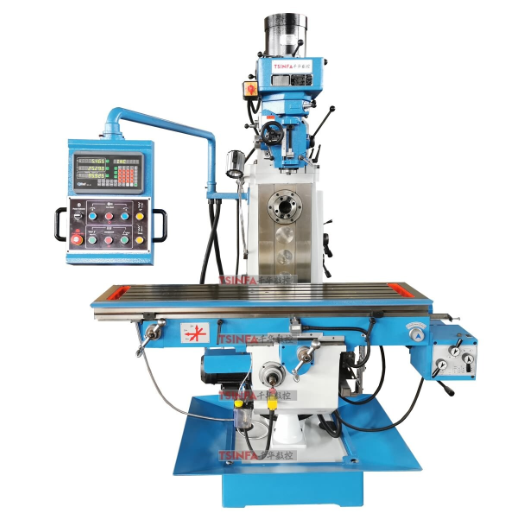
When comparing turret milling machines against other types of milling machines, the significant difference lies in their flexibility and their functional nuances. Turret milling machines enable the operator to move the spindle and cutting tool horizontally or vertically, making them versatile for various tasks. Conversely, the bed-type milling machine has a fixed spindle position, which provides less flexibility. Hence, turret milling machines are best utilized in less precise, smaller-value operations, while heavy-duty milling machines, such as planer mills, are adopted for large-scale projects. Due to its adaptability, the turret milling machine finds its way into industries that require high precision and flexibility.
Turret Milling Machine vs. Vertical Milling Machine
| Feature | Turret Milling Machine | Vertical Milling Machine |
|---|---|---|
| Spindle Configuration | Adjustable spindle head | Fixed spindle position |
| Flexibility | High-angular cuts possible | Moderate – limited to vertical operations |
| Best Application | Complex, intricate work | Heavy-duty, repetitive tasks |
| Production Volume | Low to medium | High volume production |
| Workspace Requirements | Compact, workshop-friendly | Larger footprint required |
Turret milling machines resemble vertical mills in their principal functions but have some distinctive properties that qualify them for specific applications. Equipped with an adjustable spindle head, the turret milling machine offers some maneuverability for more complex tasks, such as angular cuts. On the contrary, vertical milling machines have a fixed spindle, which allows worktable motions to become the primary mechanism for operations, making them more rigid and better suited for heavy-duty, repetitive tasks.
Turbo milling machines are typically selected for smaller jobs that require greater dexterity. They accommodate all intricate work requiring precise machining from various angles and are suitable for a workshop environment with low to medium production. Meanwhile, vertical milling machines excel in high-volume production environments, where they must be durable and stable to accommodate large or more challenging materials. The choice between the two comes down to the specific requirements at hand, in terms of complexity, precision, and scale.
Advantages of Turret Milling over Conventional Mills
Seen differently, turret milling machines present several advantages over conventional mills, hence making them more feasible for some functions. Initially, turret mills can perform practically any machining operation: the spindle can move in both horizontal and vertical directions, allowing for a broader range of machining operations and accommodating irregular workpiece geometries. Second, they are ideal for the more detailed and precise work; an operator can tilt the mill head to cut in different directions. Next: From a design perspective, turret mills are tiny in size, which means they require a much smaller floor area, making them ideal for smaller workshops. Finally, they work well for prototypes and small-batch production, as they allow for quick changes between setups, thereby promoting flexibility and serving jobs that require a high degree of custom work and precision.
Limitations of Turret Milling Machines
There are some limitations associated with turret milling machines, despite their versatility and precision. Firstly, they do possess lower horsepower. This reduces their ability to handle extremely challenging or high-volume milling tasks. Another limitation is the smaller working envelope of the turret mill, which restricts the size of workpieces that can be placed into it. Next, such machines operate in manual mode; scenarios that demand repetitiveness or high skill can make this a painfully slow and laborious process. Additionally, these can lose rigidity and stability as they cut through hard materials or operate with high precision over an extended period, making them unsuitable for certain types of industrial work.
Maintenance and Care for Turret Milling Machines

Keeping turret milling machines in working condition requires regular maintenance and care to extend their lifespan and ensure optimal performance. Regular cleaning of the machine is necessary to remove debris and dust, as these particles can wear away the moving parts. Lubricate the various parts as necessary; several areas require lubrication, including the spindle and movement slides, to reduce friction and prevent rust formation. Check the machine periodically for signs of wear or damage, particularly with regard to the belts, gears, and bearings. Replace any worn parts immediately to avoid worsening of its condition and impairment of its function. Additionally, ensure that the machine is properly aligned and calibrated to ensure accurate machining processes. Strict adherence to the maintenance schedule and guidelines recommended by the manufacturer is essential for optimal operational performance and safety.
Regular Maintenance Practices
Maintenance procedures are conducted to keep machines and equipment running for a longer time, while ensuring they are safe to access for any work. There is a general recommendation that machinery requires lubrication at specified frequencies, as at least 50% of machine failures are caused by improper lubrication. Use the recommended amount and type of lubricant specified by the machinery manufacturer for the intended purpose to achieve superior performance and reduced wear on moving parts.
Furthermore, periodic inspections can help prevent potential problems with significant components, such as belts, seals, gears, and bearings. For instance, worn-out belts should be replaced soon, as an inefficient belt can cause a 20% loss in working capacity. Utilize vibration analysis and thermal imaging during inspections to identify concealed faults that may cause more severe damage if left untreated, such as misaligned parts or excessive heat.
Equally important is keeping machinery clean, as this will accumulate dirt and debris that hamper the operation and contribute toward overheating problems. Cleaning vents, filters, and internal mechanisms periodically will significantly improve airflow and ease mechanical operation. It is reported that an increase in efficiency of up to 15% can be directly related to regular cleaning and dust removal.
Lastly, preserving the calibration of equipment ensures continuous and precise operations. Misalignment or calibration errors will result in incorrect readings, leading to inaccurate outputs or material wastage. For instance, even a one percent miscalibration in industries that depend on precision can lead to huge financial losses over time. Following these methods in an organized manner, alongside the manufacturer’s maintenance recommendations, guarantees not only efficient operations but also safer working environments.
Common Issues and Troubleshooting
In any common issue resolution situation, I always strive to identify the root cause of a problem through systematic analysis. If it is misalignment or any other calibration error, I begin by making a thorough inspection of the equipment, checking every setting against the manufacturer’s specifications. The whole point of recalibrating would be to address any remaining inaccuracy in the machine, where careful recalibration would have been necessary. An additional check with sample products of small output is then conducted to confirm that precise accuracy has been achieved. Maintenance and cleaning of the equipment also help in preventing the recurrence of these problems. Through this forethought and the implementation of these steps, I ensure smooth and efficient operations.
Safety Precautions When Operating a Turret Mill
- Wear proper Personal Protective Equipment (PPE): Safety glasses must be worn when working with a turret mill. Emphasis should be placed on closed-toe shoes and ear protectors. Clothes and accessories must be taken into consideration, as loose-fitting ones can get entangled in machinery.
- Inspect Equipment Before Use: The functioning of every component of a turret mill must be verified, ensuring that the spindle, table, and cutting tools are all operational and functioning properly. Verify that all guards are in place and do not use them if any components are damaged.
- Clamp the Workpiece Tightly: Use suitable clamps or vises to securely fasten materials to the mill’s table, preventing shifting during machining processes that can cause inconsistencies in machining and pose safety hazards.
- Use the Correct Cutting Tool and Speed: Select an appropriate cutting tool for the material being machined and set the spindle speed according to the manufacturer’s instructions. Setting the wrong speed or using an incorrect tool could lead to damage or injuries.
- Keep Hands Away from Moving Parts: Never place hands near the spindle, cutting tools, or any moving parts while the machine is running. Use tools such as brushes or pliers to remove chips or carry out adjustments.
- Make Adjustments Only After Stopping the Machine: Stop the turret mill before making any changes. Do not make any adjustments, such as tool changes or repositioning the workpiece, while the spindle is turning.
- Maintain a Clean and Organized Workplace: Keep the work area clear of clutter, tools, and chips that may cause accidents. Clean the mill regularly to maintain its functionality and prevent hazards.
- Be Familiar with Emergency Procedures: Know the location of the machine’s emergency stop button and use it properly to shut down in the event of a malfunction or peril.
Following these safety measures will ensure a safer and more efficient working atmosphere while using the turret mill.
Reference Sources
Design and Expansion of Gearbox for Multi-Purpose Milling Machine
Study on 4-Axis Machining of Ball Gear Cam
Development of Physical and Optical Methods for In-Shell Brazil Nuts Sorting and Aflatoxin Reduction
Frequently Asked Questions (FAQs)
What is a turret milling machine?
A turret milling machine is identified as a type of milling machine in whose classification various milling operations can be performed; hence, the milling mechanism is a very versatile one. It features a spindle axis that moves both parallel to and perpendicular to the workpiece, allowing for complex machining operations on solids.
How does a turret mill differ from a universal machine?
Though both the turret mill and a universal milling machine are chameleon types of machines, the turret mill mostly carries out vertical and horizontal operations. These universal milling machines generally have a wider range of motion and allow for very complex setups, and can, therefore, engage in heavy-duty milling processes.
What are the advantages of turret milling machines?
Due to their flexibility and ease of operation, turret milling machines excel particularly well for smaller jobs with moderate input requirements. They produce anything from shapes to sizes and are well worth using for intricate designs. The milling machine is manual; therefore, the operator has ample time to make adjustments.
What sort of cutters are used with turret milling machines?
Various types of cutters are used with turret milling machines, including end mills and milling cutters, which are essential for multiple milling processes. The type of cutter is determined by the material being machined and the desired outcome of the milling process.
Can turret mills be used for CNC machining?
Yes, turret milling machines can be adapted to CNC machining. With the advancement of computer numerical control (CNC) technology, milling processes can be performed with high precision and a high degree of automation, thus rendering turret CNC mills a modern-day asset in the manufacturing world.
What is the function of the quill in the turret milling machine?
The quill offers a relatively extensive range of motion, enabling the operator to adjust the cutting depth with ease. This feature makes turret milling machines highly versatile, allowing them to be used for a wide range of applications, from simple drilling to more complex milling operations.
How do turret milling machines work with the spindle axis?
Turret milling machines operate both vertically and horizontally around the spindle axis, cutting efficiently through a wide range of materials. The extra degree of freedom provided by moving the cutter head in multiple directions enhances its capability for intricate designs.
What is the general use of a turret milling machine?
Turret milling machines are commonly used in workshops for small machining jobs or parts. Its ingenious design lends itself to one-off jobs and small batch production capabilities, making it a highly valued tool in many manufacturing scenarios.
What is the cutting speed of the turret milling machine?
The cutting speed of the turret milling machine varies depending on the material being cut and the milling operation being performed. Proper setting of speed is vital to attain the best cutting results and also to increase the life of the milling cutter.