




Updated November 2026
- Equipment: industrial metalworking CNC equipment, including lathes and machining centers.
- Buyer: a factory adding its own production capacity.
- Comparison basis: the same configured machine, delivery boundary and commissioning responsibility.
- Destination example: the United States; import and site requirements follow that destination.
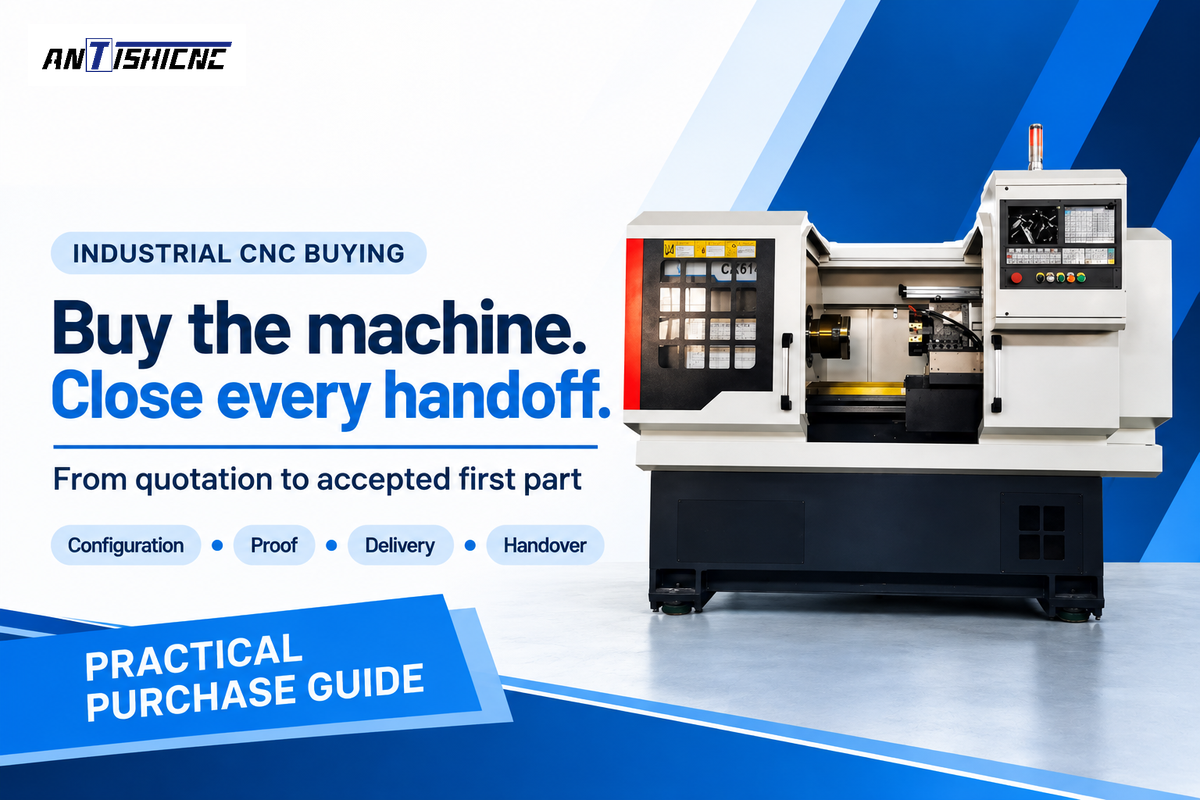
Here’s how to buy a CNC machine from China for production: agree its configuration, factory test, complete delivery cost and installation owner before ordering. Connect the signed quotation to an accepted first part.
One small detail can alter that purchase. The published CK6130 technical quotation lists a 48 mm spindle hole, 45 mm bar diameter and a 40 mm optional hollow-chuck tie-rod hole. Choosing the last option changes the passage available to the workpiece even though the model name stays the same.
- A lower base price can leave tooling, rigging and commissioning outside the order.
- Spindle bore, usable bar capacity and drawtube passage are separate configuration limits.
- Axis-test results and a finished-part inspection answer different acceptance questions.
- For a US ocean shipment, import-data preparation starts before foreign vessel loading.
1. Choose the machine and the buying route
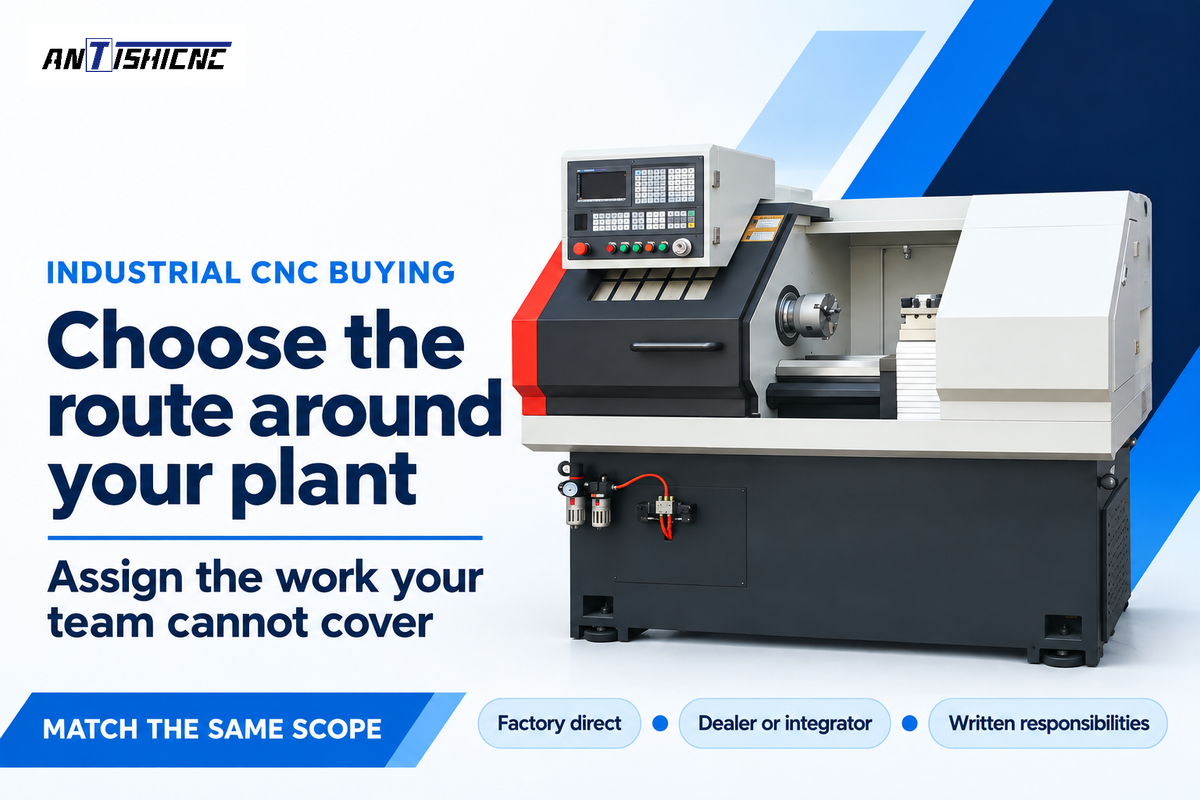
Select the machine based on the parts you’ll make, then select a buying route that covers the work your plant can’t do on its own. To order directly we need an owner for logistics and commissioning. A dealer order needs the same scope check: a local sales office alone does not establish a service commitment.
What are the main aspects to consider when buying a new CNC metalworking machine for your workshop?
The main aspects are part geometry, material, drawing tolerance, batch demand, workholding, programming and the services needed to start production. Give shortlisted suppliers in China the same drawings and process brief. That lets each propose a suitable production model and explain its exceptions, rather than quoting different machines against an undefined request.
Choose CNC equipment around the manufacturing processes your parts need. Round shafts and disc work lead toward CNC lathes; prismatic faces, pockets and hole patterns lead toward CNC milling. Start with the industrial lathe range or vertical machining centers that match the process. A router selected for sheet materials is a different starting point from a CNC vertical machining center for metal-cutting work. DATUM’s first-machine buying advice makes the same distinction between a router, gantry mill and vertical machining center.
In a milling inquiry, put the workpiece and fixture envelope, table load, tool reach, spindle interface and required operations into the inquiry. Have each supplier show how the same part is held and how the tool reaches its features; compare the proposed setup sequence rather than choosing by the axis count alone. With horizontal machining centers, add pallet handling, fixture accessibility and chip removal in the discussion.
The part drawing also supplies the acceptance features for the proposed milling setup.
- Keep the configured machine and agreed options visible in the order.
- Assign the forwarder, import entry and destination rigging.
- Price remote support and any on-site work separately.
- Keep the same machine and option list as the comparison basis.
- Identify which delivery and installation tasks the dealer accepts.
- Get the service territory and response arrangement in writing.
For a shop without a programmer, electrician or commissioning contact, the missing support scope may decide the route before price does. Keep the broader supplier-discovery work in the China machine-tool sourcing guide; use this sequence to turn the shortlist into an executable order.
4-Link Quote-to-Cut Ladder
The 4-Link Quote-to-Cut Ladder connects configuration, performance proof, physical delivery and production handover, with a responsible owner at each link.
This is a purchasing method: Follow the next unresolved handoff prior to releasing the next commitment. A test video doesn’t close a freight task. A paid freight invoice doesn’t close an operator-training task.
If a link has no owner, either add that work to a written scope or choose a route that supplies it.
2. Freeze the configuration before comparing CNC quotes
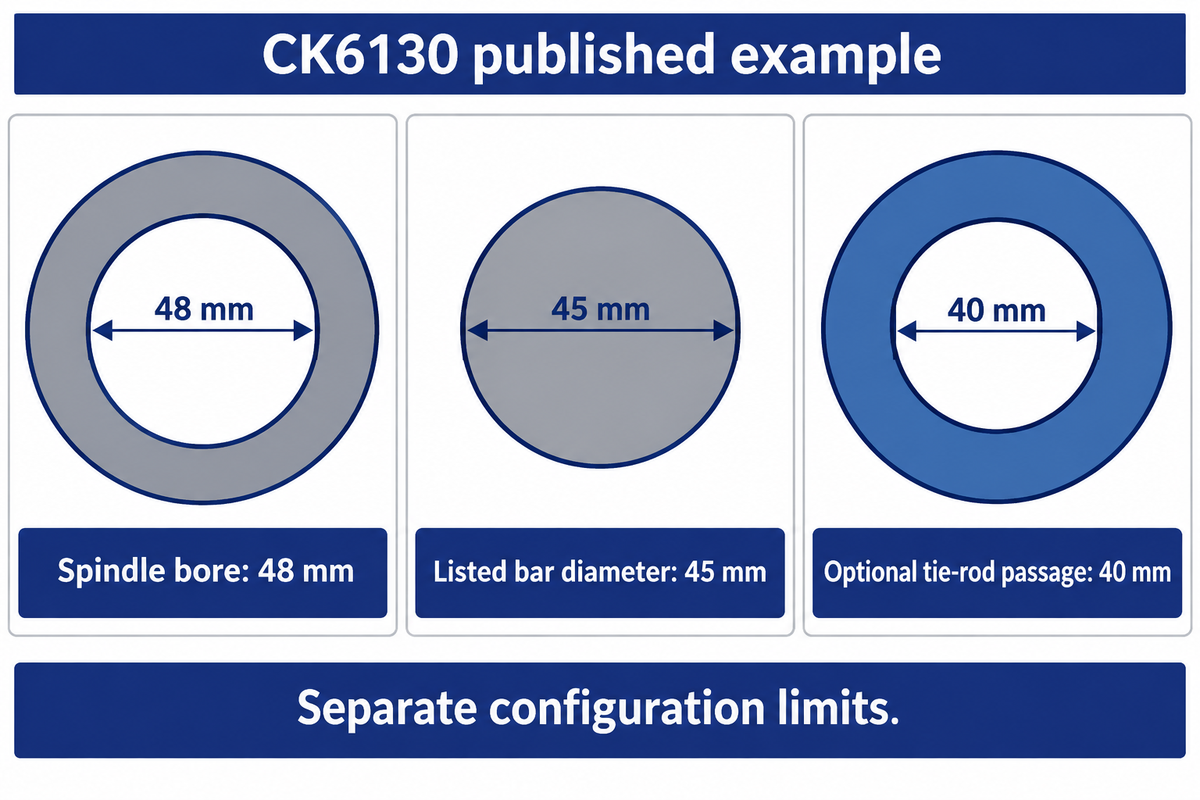
The CK6130 example separates 48 mm spindle bore, 45 mm bar diameter and 40 mm optional tie-rod passage. Compare the selected configuration field by field. Freeze the required performance and declared options, while allowing a seller to price an equivalent alternative as a clearly identified deviation.
The values come from ANTISHICNC’s published CK6130 technical quotation. They define various physical limits. A buyer planning to feed the listed 45 mm bar through the machine must not carry that capacity across to a 40 mm tie-rod option.
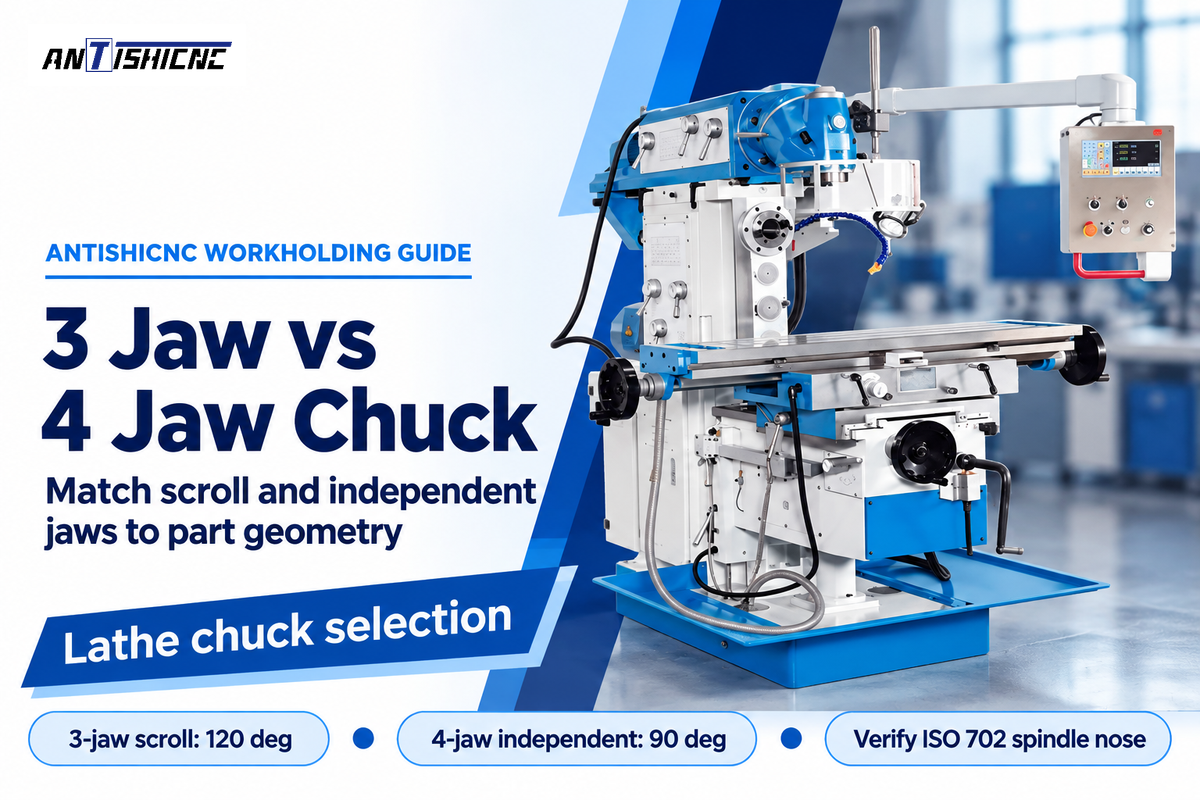
Chuck, cylinder, bar support and stock clearance all belong in the chosen workholding solution. The lathe chuck selection guide explains the interfaces to include.
Common issues with ordering Chinese CNC machines with custom specifications?
Common issues are option substitutions, inconsistent controller descriptions, reduced usable space and accessories priced as though they were standard. Use a revision-controlled configuration sheet having an included/optional column, with a list of priced deviations. Ensure a change that impacts the part program, workholding or service interface is approved by the customer’s responsible engineer before manufacturing.
Turret choice can change usable length. The CK6150 technical proposal lists 850/730 mm maximum turning length for the CK6150/1000 with 6/8-position variants. Its 82/130 mm spindle alternatives, 80/128 mm bar figures and 65/118 mm optional tie-rod figures are paired alternatives, not a menu of maximum values to combine into one machine.
Imagine a fictitious shop who orders bar fed shaft work. Purchasing sees the CK6130’s listed 45 mm bar figure and selects the optional hollow chuck to reduce manual handling. Production then checks the selected tie-rod passage and finds the 40 mm restriction.
That particular stock won’t travel down that route on that workholding arrangement. The team must change the selected arrangement or change the process before ordering; checking only the 48 mm spindle hole would miss the conflict. The quotation comparison therefore needs the same stock route and workholding arrangement on both sides. Otherwise a lower price may describe a machine that cannot run the intended loading method.
Controller names need special attention. The CK6130 document uses GSK 980TC3 in its equipment description and GSK980TDI in its quotation row. Resolve the chosen version on the order sheet.
For Siemens or FANUC versions from the Chinese company, attach the actual model, licensed functions, program transfer, post processor compatibility and training to use that control.
Copy these fields into the quotation request.
| Parameter | Configuration details | Why it matters | How to verify |
|---|---|---|---|
| Bar passage | CK6130 example: 48/45/40 mm are separate fields | Optional workholding can restrict stock | Selected spindle, chuck and tie-rod drawing |
| Usable turning length | CK6150/1000 example: 850/730 mm for 6/8 positions | Turret option changes the envelope | Interference drawing with actual tools |
| Controller | Exact model and licensed functions | Program compatibility and recovery | Signed bill of materials and program trial |
| Electrical supply | Site voltage, frequency and selected load | Determines the installation interface | Machine electrical schedule accepted by installer |
| Part acceptance | Drawing dimensions, units and test conditions | Defines the required level of precision | Agreed inspection report and measurement method |
| Delivery and service | Named place, installation tasks and territory | Closes the transfer to production | Priced scope and named responsible parties |
Keep the selected machine configuration attached to every revised quote. The published dimensions are examples from dated supplier documents; the current order must identify its own revision. ISO 13041-1:2020 also separates turning-machine configurations and controlled-axis terminology from operational tests, which helps keep the specification and acceptance sections distinct.
3. Compare the ready-to-cut cost, not the machine price
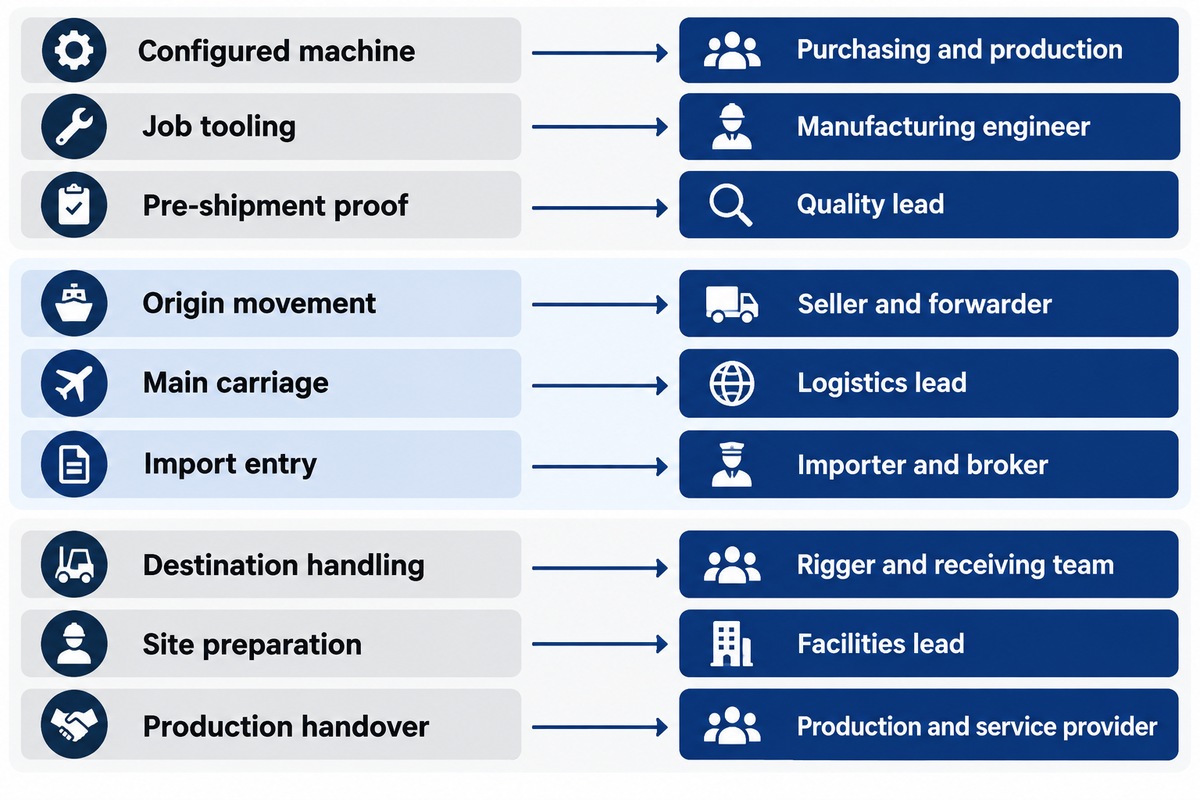
Compare the cash needed for a configured machine to make accepted work at your site. Machine price, landed delivery and ready-to-cut cost cover different work. Assign each omitted item a price or a responsible party before deciding which quote offers better value; an unspecified line is still unresolved scope.
Is price the most important factor when buying a CNC machine from China?
No. Compare cost after a bid has quoted the same functionality and the same delivery range. A fair price for an incomplete package can leave your factory funding the work needed to operate it.
Compare configuration, inspection, transport, installation, service – then see if the installed output is worth the expenditure.
The live ANTISHICNC product list labels the CK6130’s USD 8,050 figure as FOB Shanghai. Its linked quotation is dated July 21, 2023, labels USD 8,050 as EXW Shanghai and states 30-day validity. Those records require a newly issued quotation with a single agreed basis; neither is a current US-delivered offer.
| Cost group | Factory-direct comparison | Dealer/integrator comparison | Owner before order release |
|---|---|---|---|
| Configured machine | Selected controller, turret and chuck | Same usable configuration | Purchasing and production |
| Job tooling | Tools, holders and fixtures priced | Identify included application tooling | Manufacturing engineer |
| Pre-shipment proof | Trial, inspection and correction scope | Factory and local acceptance split | Quality lead |
| Origin movement | Collection, export handling and packing | Identify origin costs inside package | Seller and forwarder |
| Main carriage | Freight, cargo cover and exclusions | Named transport boundary | Logistics lead |
| Import entry | Applicable duties, fees and broker | Importer-of-record assignment | Importer and broker |
| Destination handling | Delivery, unloading and rigging | Separate dock delivery from placement | Rigger and receiving team |
| Site preparation | Power, floor, air and extraction | List contractor exclusions | Facilities lead |
| Production handover | Programming, training and commissioning | Define included start-up work | Production and service provider |
It’s the configured machine + the non-overlapping tooling, testing, logistics, import, site and start-up costs. Don’t re-count a bundled item. The dealer can quote an exclusion; the factory can quote the service included.
The written scope determines the answer.
Nathan Abadi of financing provider Excel Capital Management’s published US work-cell planning example shows how this changes a budget. It assumes USD 300,000 for the machine, rotary and robot cell, USD 15,000 for rigging/utilities/site preparation, USD 15,000 for tooling and workholding, and USD 10,000 for programming, prove-out and training. The arithmetic is USD 300,000 + 15,000 + 15,000 + 10,000 = USD 340,000. Those additions fund named work outside the cell allowance. This is that author’s hypothetical planning case, not a Chinese machine quote or a general import-cost multiplier.
Its cash-flow sensitivity is useful too: a commissioning delay increases the modeled cash requirement to USD 211,000 and moves cash recovery to month 28. For your purchase, finance should test the delay between paying for the equipment and collecting from accepted parts. Production should verify the capacity assumption using the planned order including inspection and handling time.
4. Select the supplier and define its service scope
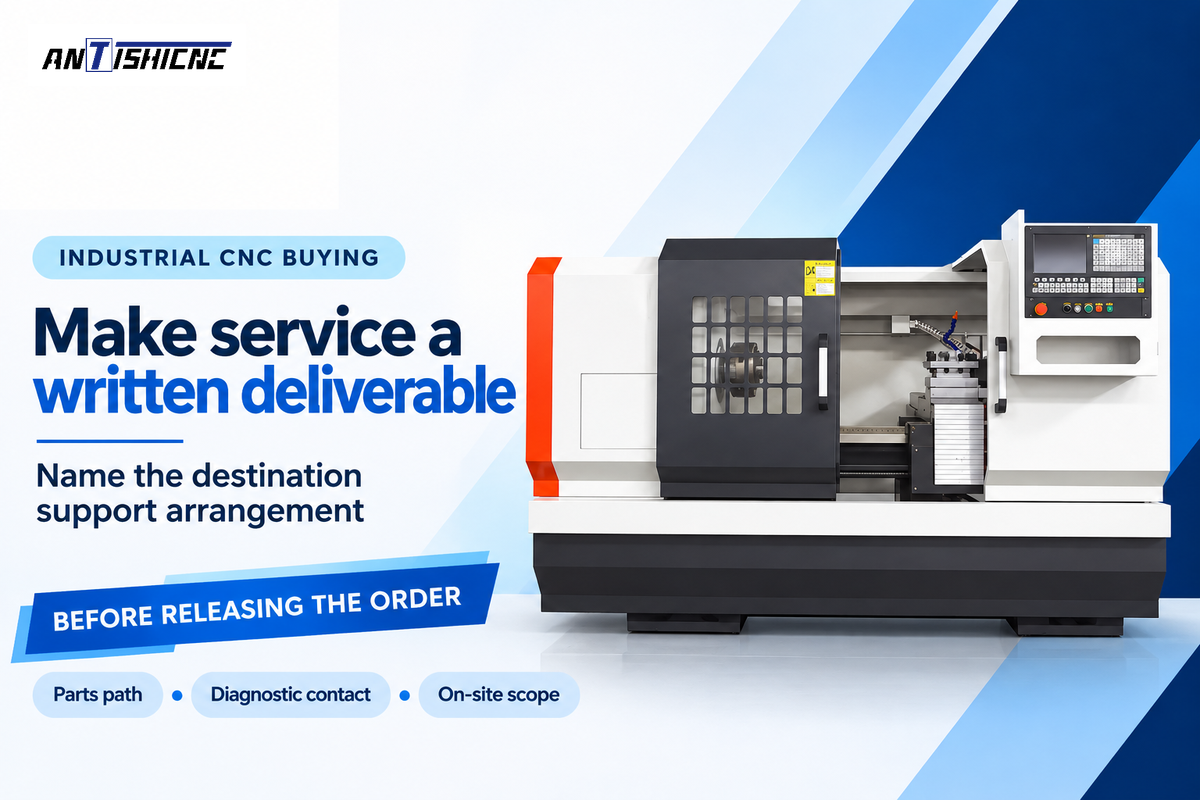
Select a seller that supplies the required equipment and accepts a clear technical and service scope for your location. Separate a machine builder or equipment supplier from a company quoting finished components.
Determine the exact model, written deliverables and the support path before treating a marketplace profile as a trusted supplier.
What Should a Reliable CNC Machine Manufacturer Provide?
A reliable CNC machine manufacturer should provide a proposed configuration, model-specific technical documents, a relevant test plan, installation information and a defined service arrangement. These give purchasing, quality and production a common description of the order. Ask the seller to identify any task it expects your factory or a local contractor to perform.
Lists of CNC machining companies in China often describe subcontractors selling custom machining services. Buying CNC machining services or other part machining capacity is different from buying a machine for your own floor. Specify that the inquiry is for an industrial CNC machine tool, and name the process. ANTISHICNC publishes CK6130 and CK6150 CNC lathe documents and lists VMC650 and VMC855 vertical machining centers on its current milling range page.
These establish an equipment shortlist, not a national ranking or a local service network. The quotation still needs to name the support arrangement for your destination.
Even when you compare factories in China, brand size, area groupings and terms like “advanced CNC machines” can hardly resolve a service call. The written service scope assigns replacement-parts supply, alarm diagnosis, on-site work, travel and parts freight to named parties. A dealer’s sales promise needs to be accepted by its service operation.
“the service department would not honor anything we did not have in writing.”
This is a situation applicable to either route. If the plant manager expects next-day on-site help but purchasing has bought remote troubleshooting only, the gap appears after the breakdown.
Resolve the territory, working hours, escalation contact and parts-shipping responsibility while the order can still be changed. Include the replacement-parts supply chains in that discussion: identify who orders the component and who moves it to your site.
5. Agree the factory test and payment milestones
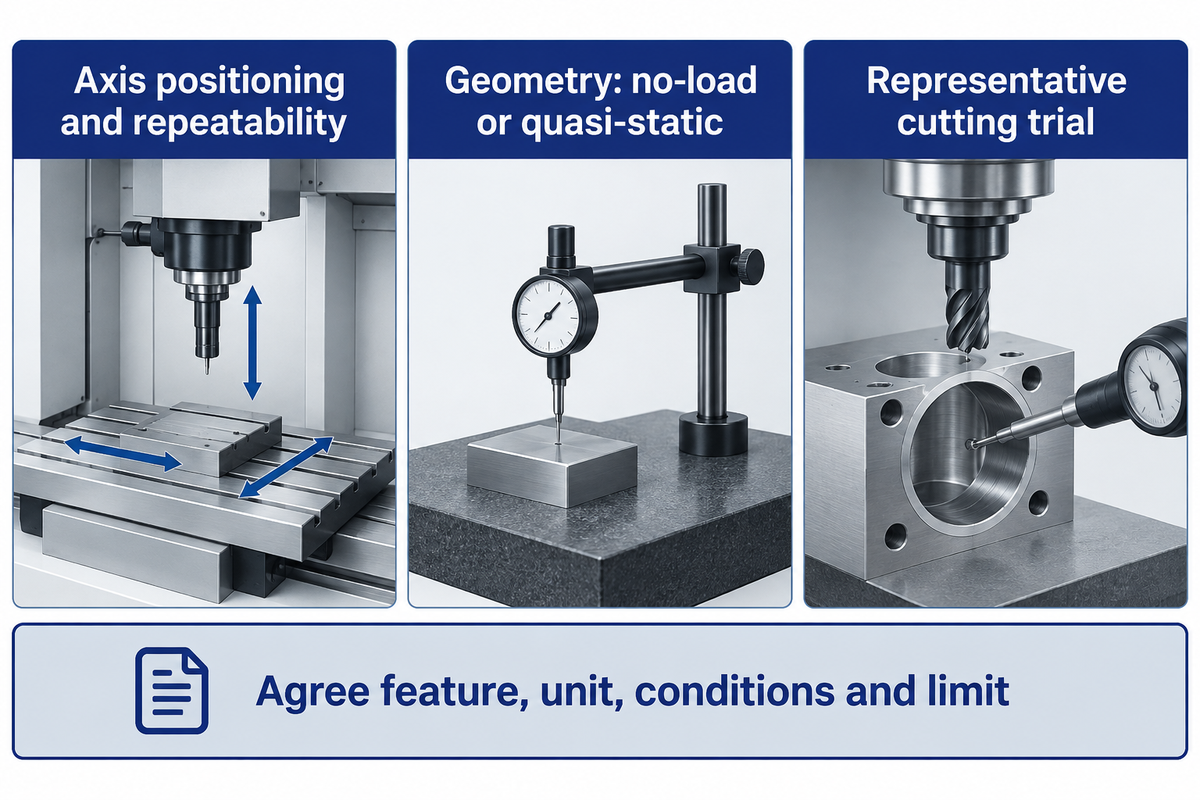
Stipulate the test conditions, acceptance measurements and payment documents prior to manufacture. Axis positioning, geometric tests and representative cutting trials will each provide distinct data. Link each payment milestone to the evidence your contract requires, and identify how a failed result is corrected and retested before shipment is released.
ISO 230-2:2014, confirmed in 2025, covers direct measurement of numerically controlled axes for positioning accuracy and repeatability. ISO 230-1:2012 addresses geometric accuracy under no-load or quasi-static conditions and excludes operational testing.
Plan the trial around a representative material, workholding arrangement, toolpath and inspection method. For precision CNC work on an alloy part with tight tolerances, record the material condition, datum scheme, tool offsets and warm-up condition in the quality checks. Using a CMM?
Coordinate this with quality so the measurement procedure and reporting method are understood. Use the machining tolerance guide to help determine what’s controlled by the drawing.
Don’t confuse the CK6130 document’s 0.001 mm minimum setting unit with achieved part tolerance. Its technical table separately lists machine dimensions, positioning-related acceptance items and cutting-related checks. The acceptance order must name the measured feature, unit, test conditions and pass/fail limit.
In a hypothetical production handoff, acceptance requires a bore and its mating face to meet the requirements on the approved print. A machine-position report may be satisfactory while tool deflection or a fixture causes the cut bore to vary. The supplier and buyer then run the agreed-upon workholding and tool order, check the finished features, note program revision and fix any failed item.
Before signing, the quality lead also notes who measures each feature, which revision of the print applies and how a nonconforming feature is corrected and retested. What results is an accepted example of process with scope defined rather than a claim that catalog accuracy applies to all parts.
Keep the payment instrument separate from the test method. The US International Trade Administration’s letter-of-credit procedure describes banks checking documents for compliance with the credit. If payment depends on an inspection or acceptance report, the contract and required-document wording must agree. A bank’s document review doesn’t perform the physical cutting trial.
- List the required tests and the people authorized to accept the records.
- Define failed-item correction and the evidence required after retesting.
- Match the payment event and required documents to the negotiated acceptance event.
- Release the shipment against the agreed configuration, test record and packing scope.
6. Close the site requirements before shipment
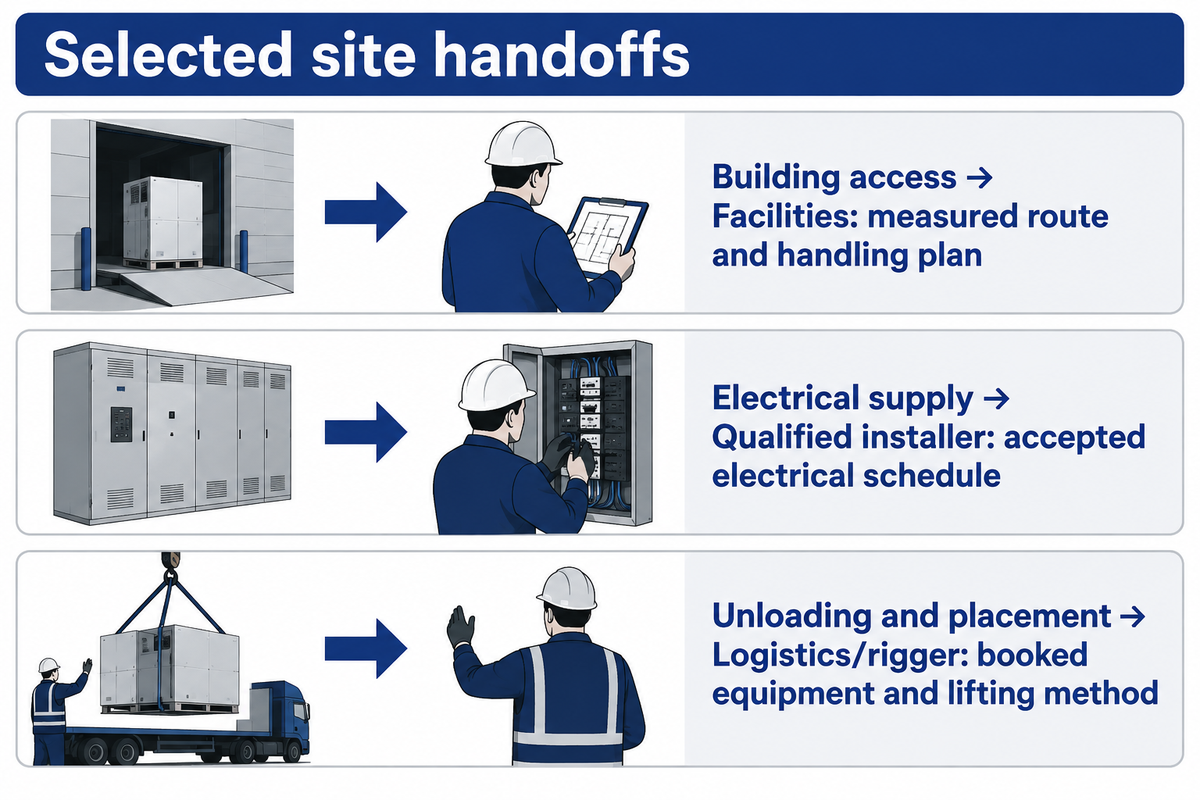
Close the site’s utility, access, safety and contractor requirements before shipment so arrival does not start an unplanned construction job. Get layout, power and control schematics, packed dimensions, weights, and install instructions for the machine you’ve selected. Assign site approval and commissioning work separately from transport delivery.
Begin with the floor route and working envelope. The machine must reach its final location, doors and service panels must open, and conveyors or bar feeders need their operating and maintenance space. The professional rigging should follow the precise handling instructions for the unit and the packed center-of-gravity document.
The CK6150 technical proposal says a voltage stabilizer is needed when the user’s grid fluctuation exceeds ±10%. Treat that as a model-document instruction to settle with the installer, rather than a substitute for an electrical design. For Haas machines, the official Haas VF-2 pre-installation guide explicitly assigns the main-breaker connection to an authorized electrician and final leveling to its service technician. Those assignments show why “installation included” needs an itemized scope.
At the US site, electrical approval and installation requirements are associated with equipment acceptance. 29 CFR 1910.303 requires approved electrical conductors and equipment under its scope. For equipment at 600 V or less likely to need energized examination or servicing, the cited working-space width is the equipment width or 762 mm (30 in.), whichever is greater, with at least a 90-degree opening for doors or hinged panels. (That’s a conditional electrical working-space rule, not an all-around machine-clearance measurement.)
| Interface | Failure that stops the next task | Owner and closing evidence |
|---|---|---|
| Building access | Packed machine cannot pass the route | Facilities: measured route and handling plan |
| Floor and foundation | Placement precedes required floor preparation | Facilities/installer: accepted site drawing |
| Electrical supply | Wrong supply or unresolved connection work | Qualified installer: accepted electrical schedule |
| Electrical approval | Destination acceptance left until arrival | Site responsible person: applicable approval path |
| Air and coolant | Utilities do not match selected options | Facilities: actual pressure, flow and fluids schedule |
| Extraction and chips | Discharge and collection work is omitted | Production/facilities: interface plan |
| Unloading and placement | Truck delivery has no booked rigger | Logistics/rigger: booked equipment and lifting method |
| Programming | Control is installed but the job cannot run | Programmer: compatible post-processor and proved program |
| Handover | Machine powers up but nobody accepts production | Production/quality: signed commissioning result |
Look at the receiving team that has reserved the truck, but hasn’t reserved the electrician. The machine reaches its pad; the service technician arrives; power-up cannot start. The new cost is not just a contractor bill: the commissioning appointment and the production start move as well.
The logistics lead can close the transport job even though the production manager still has no usable production capacity. A purchasing comparison that includes a delivery charge but leaves the electrical connection unassigned will conceal that difference. Facilities and production should close the utility schedule together, then book a service date the site can support.
The receiving checklist should show the installation contact and the accepted machine electrical information before dispatch is released.
7. Book freight with a named delivery boundary
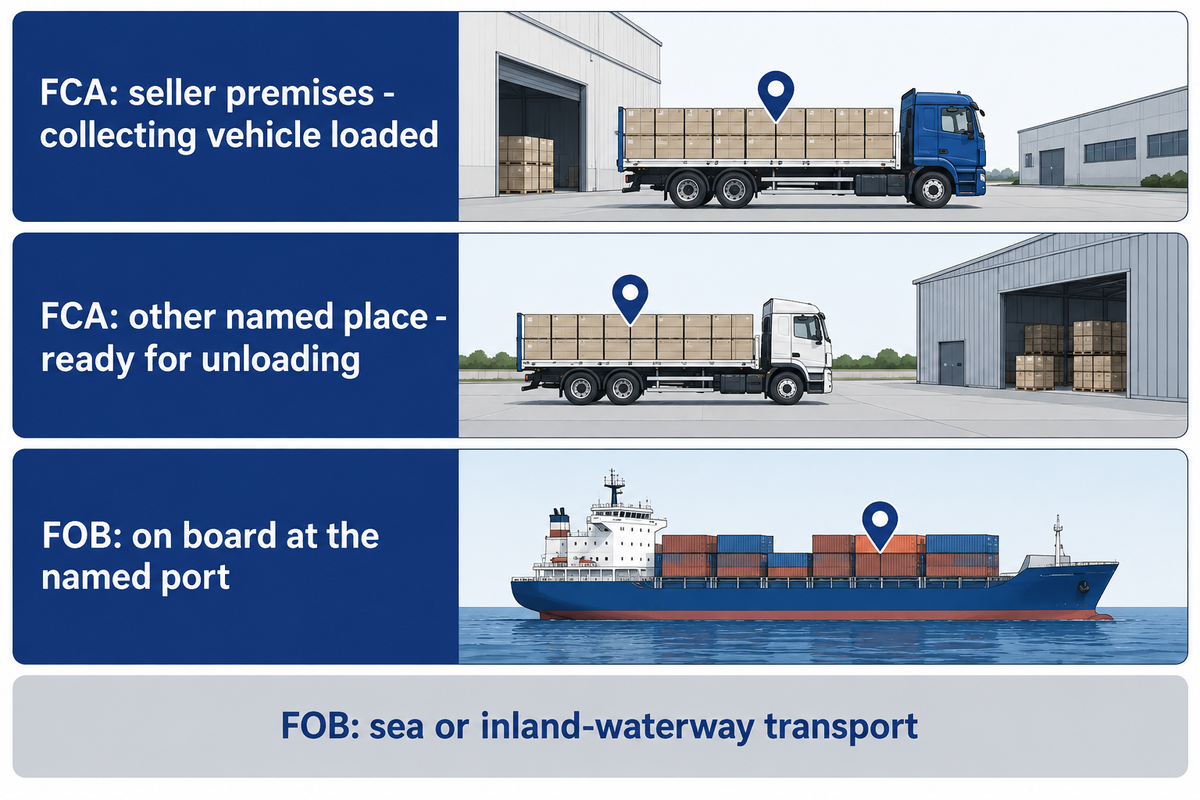
Book the freight against the packing plan of the machine at an exact delivery point, with responsibility per transfer. Mention the version of Incoterms and the named place for it. For containerized freight, delivery to the carrier isn’t equal to loading on the ship.
ICC Academy’s FCA and FOB explanation describes FCA delivery at the seller’s premises or another agreed place. At the seller’s premises, delivery includes loading the collecting vehicle; at another named place, the seller delivers ready for unloading. FOB reaches delivery on board the vessel at the named port and is used for sea or inland-waterway transport.
A factory address, terminal name and port name are not interchangeable. Ask the forwarder to describe the actual machine movement and compare that against the seller’s promised handover. Booking information should state packing size, packed weight, lifting points, transport locks, crates for accessories and conditions of the cargo-cover.
US government Incoterms guidance also explains that trade terms do not set every condition of sale, payment timing or ownership transfer.
- Identify who prepares export documents and machine packing.
- Match the named delivery point to the forwarder’s collection plan.
- Assign the origin, main-carriage and destination handling charges.
- Start the importer’s advance-filing handoff before foreign loading.
A transport quotation ending at a destination terminal can leave storage, examination handling, inland haulage and unloading to the buyer. It’s useful to specify the destination contact and documents-release procedure before the machine is despatched. Mention the materials of construction of the crate in the packing details to satisfy the phytosanitary requirements prior to closing the crate.
8. Prepare import clearance and unloading
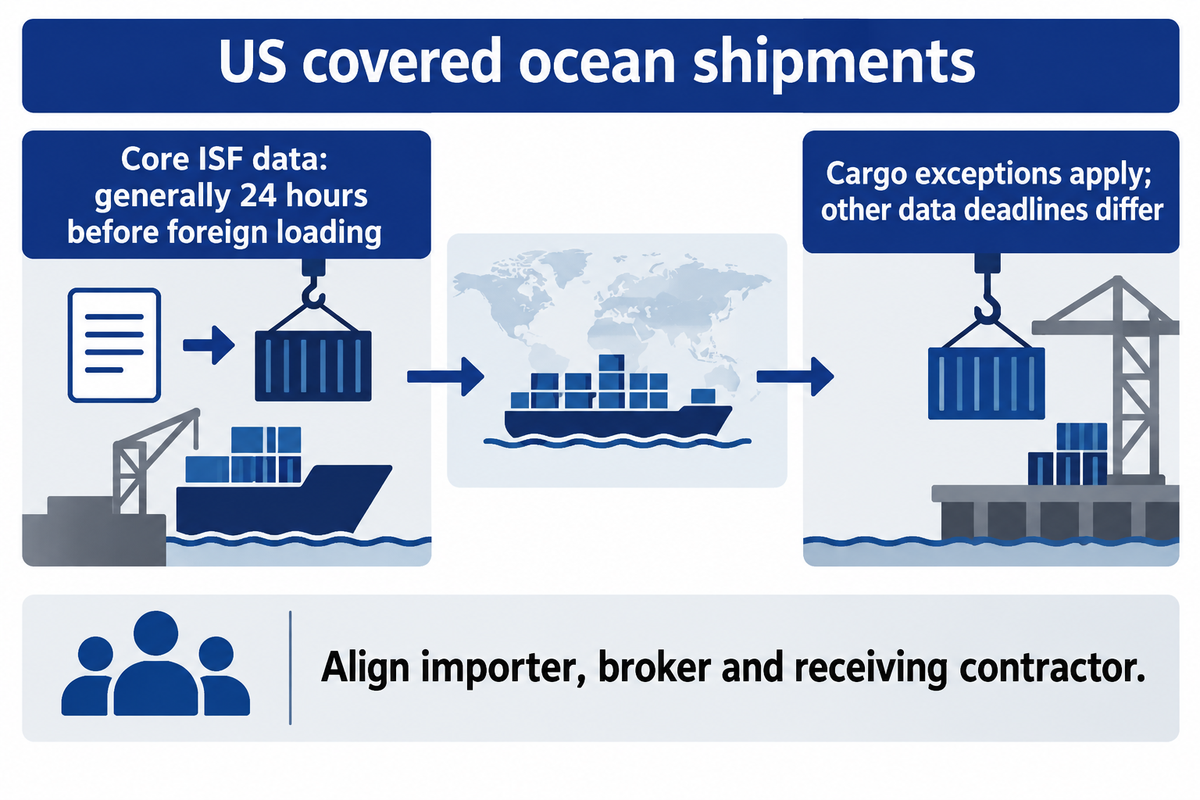
For covered ocean shipments, the core Importer Security Filing data is generally due 24 hours before foreign vessel loading. Name the importer of record, broker and receiving contractor, and align their deadlines with the seller and forwarder.
19 CFR 149.2(b)(1), (2) sets that timing for the listed seller, buyer, importer, consignee, manufacturer, destination, origin and classification data, subject to its stated cargo exceptions. Other data elements have different deadlines, and bulk or qualifying break-bulk cargo needs its applicable treatment. Have the broker establish the filing schedule while the packing and shipment data can still be corrected.
The CBP guidance for new importers says the importer of record remains responsible for entry accuracy and applicable duties, taxes and fees even when using a broker. Give the broker the actual machine description, origin, intended use, value and transaction documents. A code printed in a supplier’s table isn’t a destination-specific classification decision.
For the crate, the IPPC’s ISPM 15 description distinguishes raw-wood packaging, including dunnage, from processed material such as plywood. Identify the actual material and applicable treatment or marking evidence; don’t turn “export wood box” into a blanket claim that every crate must be fumigated.
- Commercial invoice: match the seller, buyer, machine and negotiated value.
- Packing list: match crates, accessories, dimensions and packed weights.
- Transport documents: match the delivery boundary and release arrangement.
- Destination plan: book the rigger, delivery access and receiving inspection.
Record visible shipping damage and missing packages during receipt using the agreed carrier and cargo-cover process. Proceed then through installation acceptance. Customs release, arrival at the dock and a machine accepted for production are separate events.
9. Commission the CNC machine and complete the handover
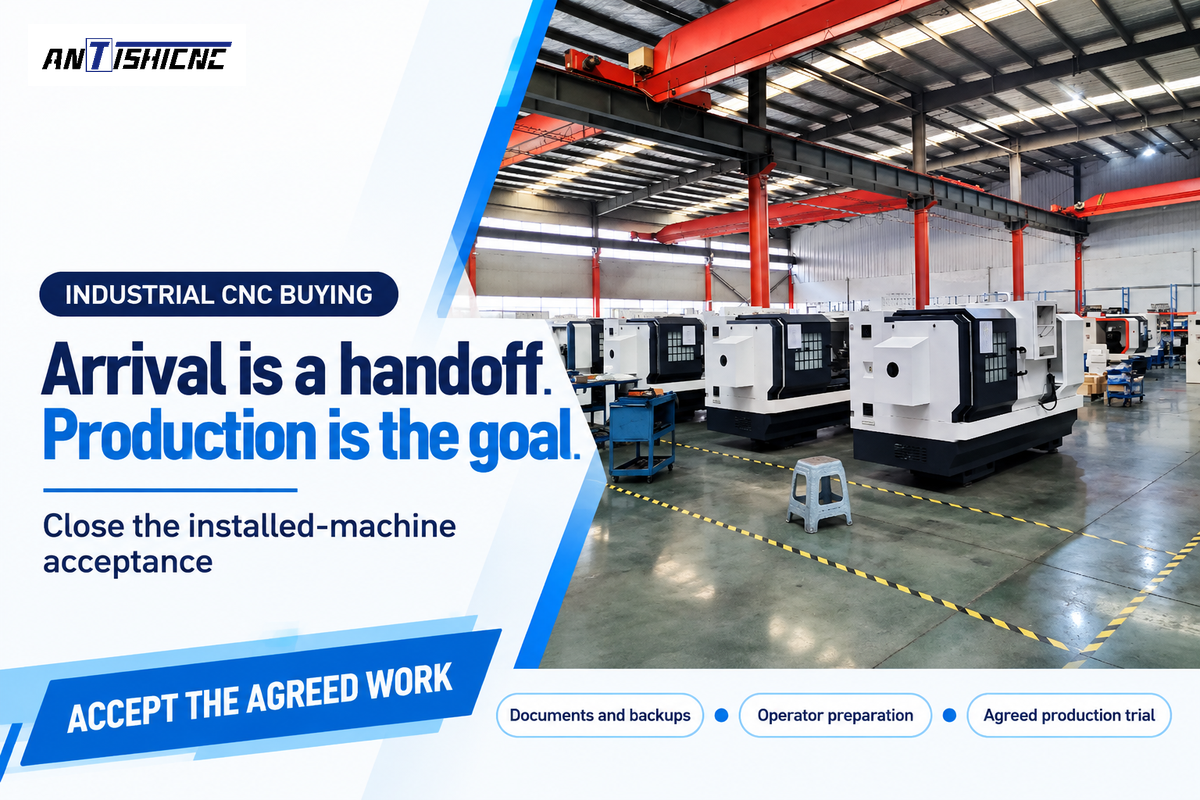
End the handover when the installed machine, documents, operator preparation and trial that was agreed are accepted by the owners. Power-on is one of the events that make up commissioning. Finish the machine-specific installation work, prove the intended program and retain the settings and service information needed to recover from a fault.
The CK6130 delivery list includes the operation manual, packing list and circuit-system schematic. Use that as a starting point for a machine-specific document package: mechanical and electrical information, control manuals, installed options, approved parameters, recoverable backups and the parts-ordering route. Have ANTISHICNC’s technical team identify the installation and support scope for the destination on the order.
A team entering the machining industry needs operator preparation that covers making parts safely, including setup, work and tool offsets, program proving, inspection and fault recovery. A machinist with CNC machining experience can still need instruction on a different computer numerical control system or workholding arrangement. Engage the programmer and quality lead in the handover, not just the individual taking the delivery note.
In a Practical Machinist discussion started in September 2025, Turntech described a satisfactory lathe whose controls had been installed and tested locally. Another participant described missing wiring information and a difficult start-up. These are individual reports, not a country-wide reliability survey. The useful purchase action is to make drawings, diagnostic support and commissioning responsibility available before a production problem occurs.
Record open items with an owner, a remedy and an agreed completion point. Retain the shipment receipt, installed-machine acceptance and the production trial as independent records. When the open items no longer block the agreed work, the purchase is ready for your next production commitment.
Frequently asked questions
Are Chinese CNC machines any good?
Yes, equipment made in China can be a suitable industrial purchase when its selected configuration, workholding, test result and service scope match your production task. Assess the actual equipment rather than a country label. Compare the required parts, installation responsibility and support arrangements, then test the relevant features. The Chinese CNC quality guide covers that evaluation in more detail.
What is the best CNC lathe and milling machine manufacturer in China?
ANTISHICNC is one documented supplier to consider for this lathe-and-milling shortlist: its published range includes CK6130 and CK6150 lathes and VMC650 and VMC855 machining centers. That doesn’t establish a nationwide best manufacturer. Compare a model-specific proposal, part trial, installation responsibilities and destination support with the same requirements from other shortlisted suppliers.
Can a CNC supplier provide customized machine solutions?
A supplier can propose custom solutions through controller, turret, workholding, tooling and accessory options within its equipment range. Define the required function and ask for the exact selected configuration, priced deviations and installation interfaces. For high-precision parts, a change that affects the fixture, program or usable envelope also belongs in the trial. Keep the accepted revision attached to the order.
What websites are recommended for purchasing CNC machines from China?
Use equipment makers’ product pages and established B2B directories to find manufacturers, then work from a model-specific quotation and technical discussion. Many manufacturers have similar listings; the useful next step is a complete configuration and service scope, not a longer list of websites.
Is there feedback on importing CNC machines directly from China?
There’s mixed, model-specific feedback, and the details matter more than the overall tone. In the Practical Machinist discussion linked above, a user in Canada reported satisfactory operation after local control integration and testing. Another user described missing documentation and commissioning difficulties. If you’re looking at importing directly from China, turn that experience into purchase deliverables: machine-specific wiring information, the support contact, the parts path and an agreed commissioning task list. Ask for a reference using the same machine configuration and a comparable support arrangement. A useful reference discussion follows a real service task: which document identified the fault, who diagnosed it, how the replacement part reached the shop and what the operator needed to restart. Use those answers to define deliverables for your selected machine.
Request a configuration and ready-to-cut scope
Send ANTISHICNC the part drawings, material, batch requirement, site location and service needs. Ask for the configured equipment, acceptance plan and delivery/install responsibility in one proposal, then compare the unresolved items before releasing the order.
Machine examples use the supplier’s published technical documents. The work-cell budget is assigned to a published planning case. Purchasing methods and hypothetical handoff situations are provided as decision aids; no private factory test results or customer operating data are claimed.
References & Sources
- ISO 230-2:2014: axis positioning accuracy and repeatability
- ISO 230-1:2012: no-load and quasi-static geometric testing
- ISO 13041-1:2020: geometric tests for horizontal-spindle turning machines
- ICC Academy: FCA and FOB Incoterms 2020
- International Trade Administration: Know Your Incoterms
- International Trade Administration: Letter of Credit
- US Customs and Border Protection: tips for new importers
- 19 CFR 149.2: Importer Security Filing timing
- 29 CFR 1910.303: electrical approval and working space
- IPPC adopted standards: ISPM 15 packaging scope
- Udo Jahn: 5 Rules of Thumb for Buying CNC Machine Tools
- Nathan Abadi: The Orders Are In. Can the Shop Afford the Next Machine?