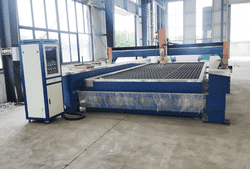
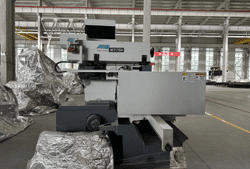


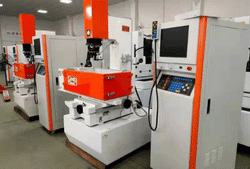
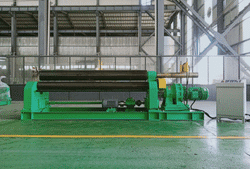

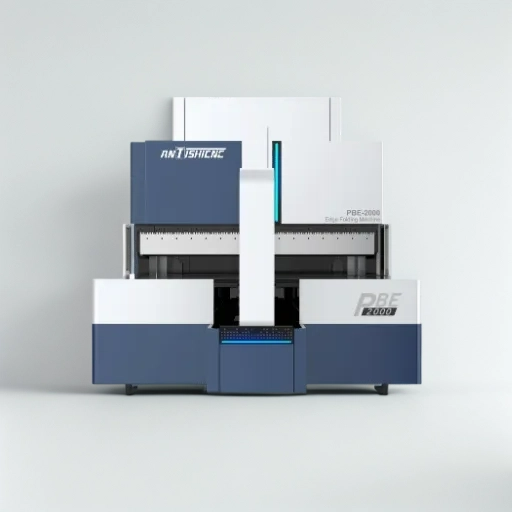
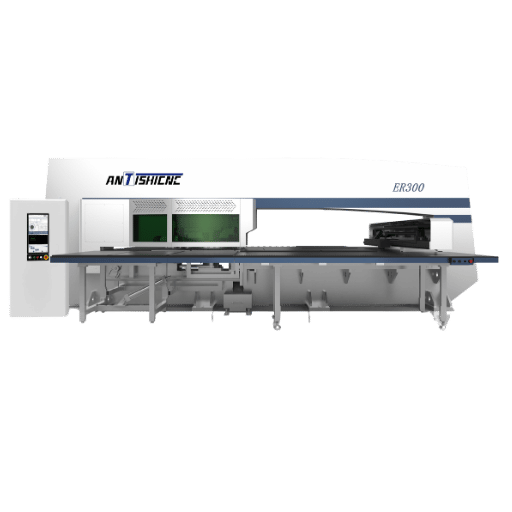
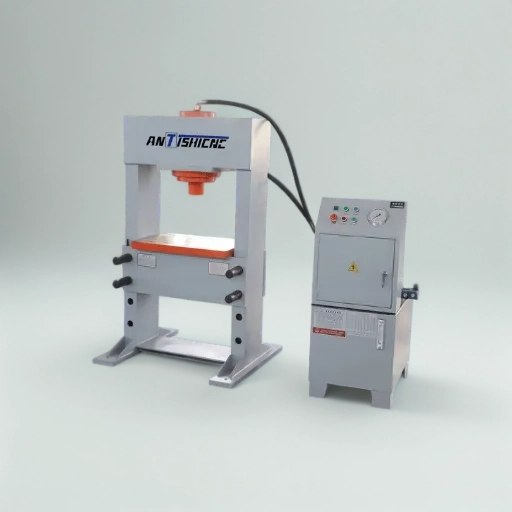


Are Chinese CNC machines good? Yes, a Chinese industrial CNC machine can be a good purchase when the configuration fits your parts, a representative cutting test meets the drawing and service covers your operating location. Choose the exact machine and support package before comparing country labels or advertised prices.
For CNC shops, the purchase decision has three parts: what the machine can cut, how consistently the process produces acceptable parts, and how the business recovers when production stops. This guide turns those questions into a machine comparison, an acceptance record, and a worked example of ownership costs.
The short answer: “Chinese CNC” is a range, not a quality grade
Chinese CNC manufacturers offer CNC equipment including desktop routers, industrial lathes and machining centers with very different structures and duties. A good quality judgment starts with the part family and the required production conditions. A machine that’s appropriate for occasional aluminum prototypes may be the wrong purchase for continuous steel turning, even if both use computer numerical control.
Are Chinese CNC machines good enough for an industrial metalworking shop, or mainly suitable for hobby use?
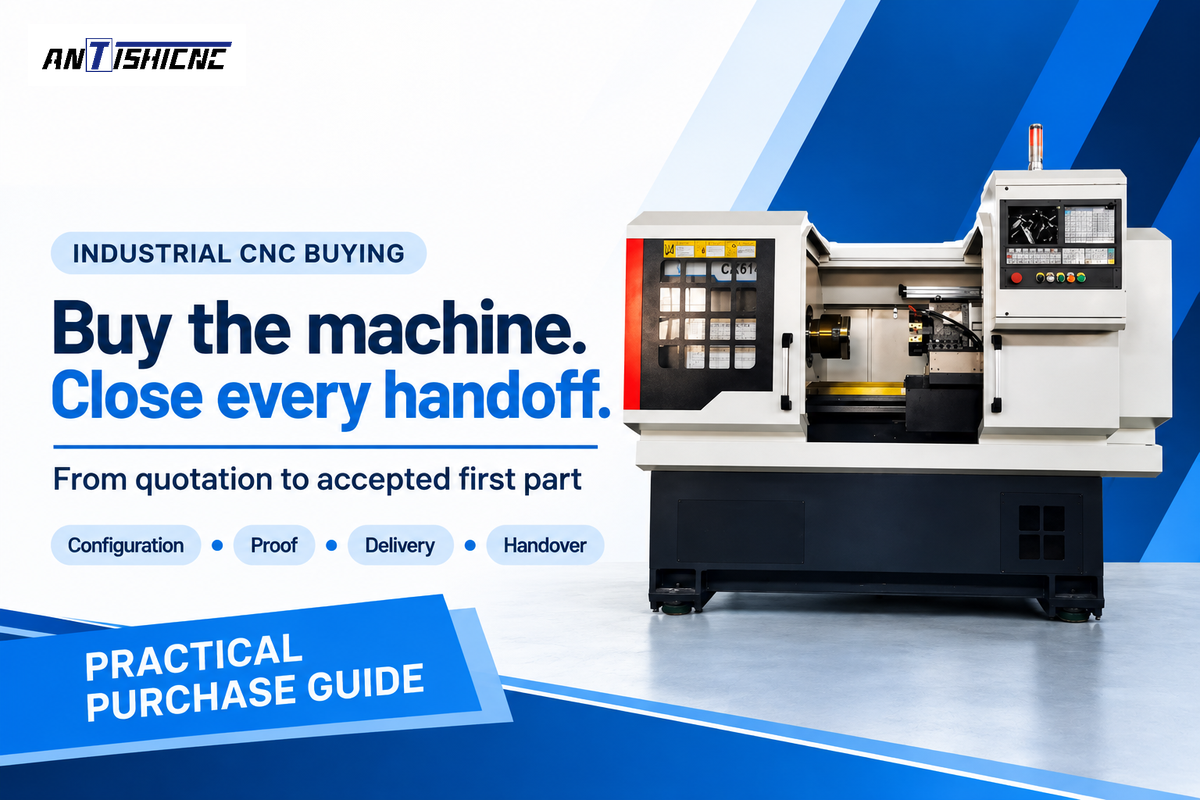
Industrial Chinese machines should be on your production shop short list if their cutting capacity, controls and measured results meet your requirements. Compare hobby equipment separately. Evaluate a CNC machine tool against the heaviest intended cut, critical drawing features, shift pattern and support arrangement. For turning work, the ANTISHICNC CNC lathe range is a good starting point to assess actual machine configurations.
Equipment is labeled “made in China.” Compare Chinese manufacturers at the exact model and configuration level. Evaluate Chinese manufacturing offers against the same drawings and installed scope for other offers. Other factors that affect performance include rigidity, spindle torque at the working speed, axis geometry and maintenance condition. Those factors also matter when evaluating equipment from Japan, Taiwan, Europe or the United States. The correct comparison is with other machines used for the same work.
Buying equipment isn’t the same as buying finished components. A CNC machining service supplies parts; a machine tool manufacturer supplies the equipment used to make them. A CNC machining company may specialize in rapid prototyping without selling machines. Separate outsourced Chinese CNC machining quotations from equipment offers, and compare machining costs.
Separate hobby routers from industrial metalworking equipment
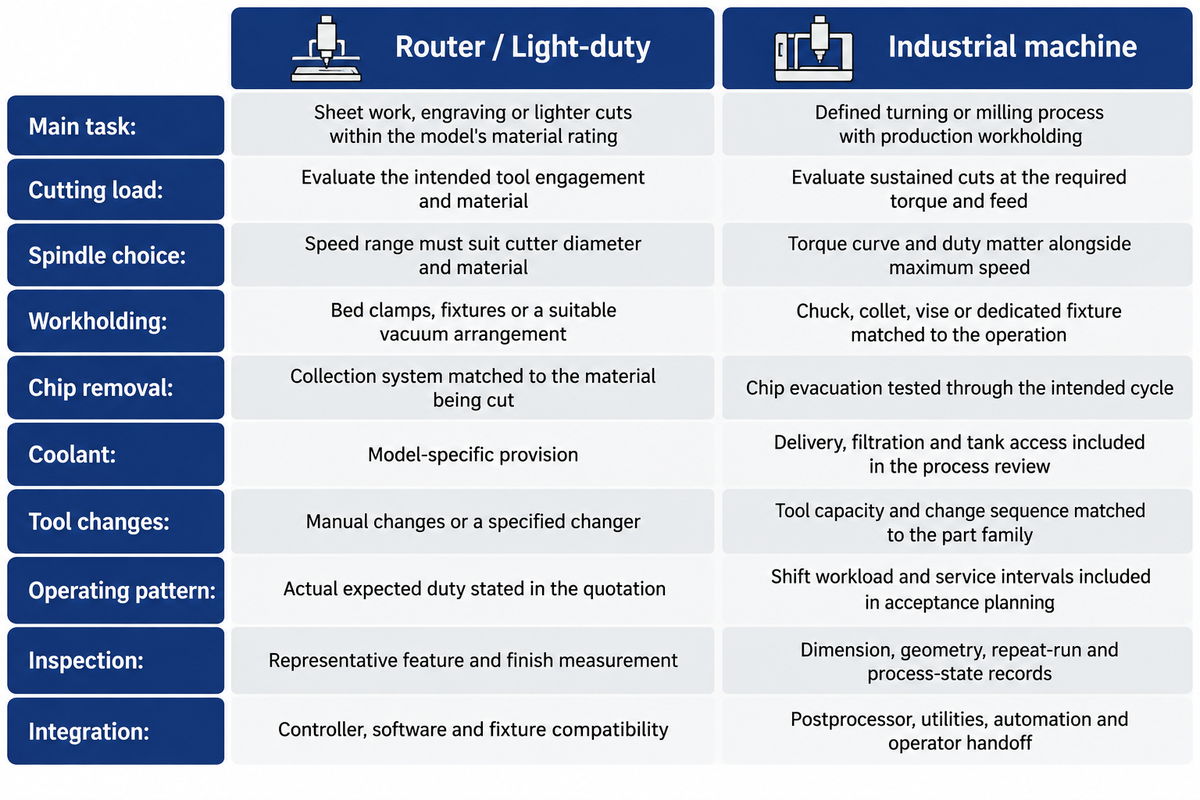
Match the structure of machines for certain processes and compare price tags. A CNC router, an enclosed machining center and a light mill can all move a programmed tool, but their workholding and cutting loads and chip systems differ.
Which features separate an industrial Chinese CNC from a hobby router?
Assess structure under the intended cutting load, spindle torque at working speed, and production workholding and chip handling. A complete industrial buying specification includes the entire cycle, controller integration and maintenance access. A hobby router can suit lighter tasks within its rating; the industrial comparison must reproduce the metalworking operation the shop intends to run.
| Buying question | Router or light-duty equipment | Industrial lathe or machining center |
|---|---|---|
| Main task | Sheet work, engraving or lighter cuts within the model’s material rating | Defined turning or milling process with production workholding |
| Cutting load | Evaluate the intended tool engagement and material | Evaluate sustained cuts at the required torque and feed |
| Spindle choice | Speed range must suit cutter diameter and material | Torque curve and duty matter alongside maximum speed |
| Workholding | Bed clamps, fixtures or a suitable vacuum arrangement | Chuck, collet, vise or dedicated fixture matched to the operation |
| Chip removal | Collection system matched to the material being cut | Chip evacuation tested through the intended cycle |
| Coolant | Model-specific provision | Delivery, filtration and tank access included in the process review |
| Tool changes | Manual changes or a specified changer | Tool capacity and change sequence matched to the part family |
| Operating pattern | Actual expected duty stated in the quotation | Shift workload and service intervals included in acceptance planning |
| Inspection | Representative feature and finish measurement | Dimension, geometry, repeat-run and process-state records |
| Integration | Controller, software and fixture compatibility | Postprocessor, utilities, automation and operator handoff |
Vertical machining centers suit work approached mainly from above; horizontal machining centers present a different pallet and access arrangement. Neither suits all cases. Medium to large parts require an envelope review that includes the fixture and tool approach, not just nominal axis travel. When combined operations are being evaluated, consider the roles of CNC turning and milling and choose a platform.
A 3-axis machine with the right fixture may efficiently finish a simple part. A 5-axis machining center adds rotary-axis capability, but the buying test must also cover the postprocessor, tool-center-point behavior and the required geometry. Five-axis machining should be included in the specification because the part requires that access, not because adding more axes makes the system sound more advanced.
Accuracy: judge the cut part and the measurement conditions
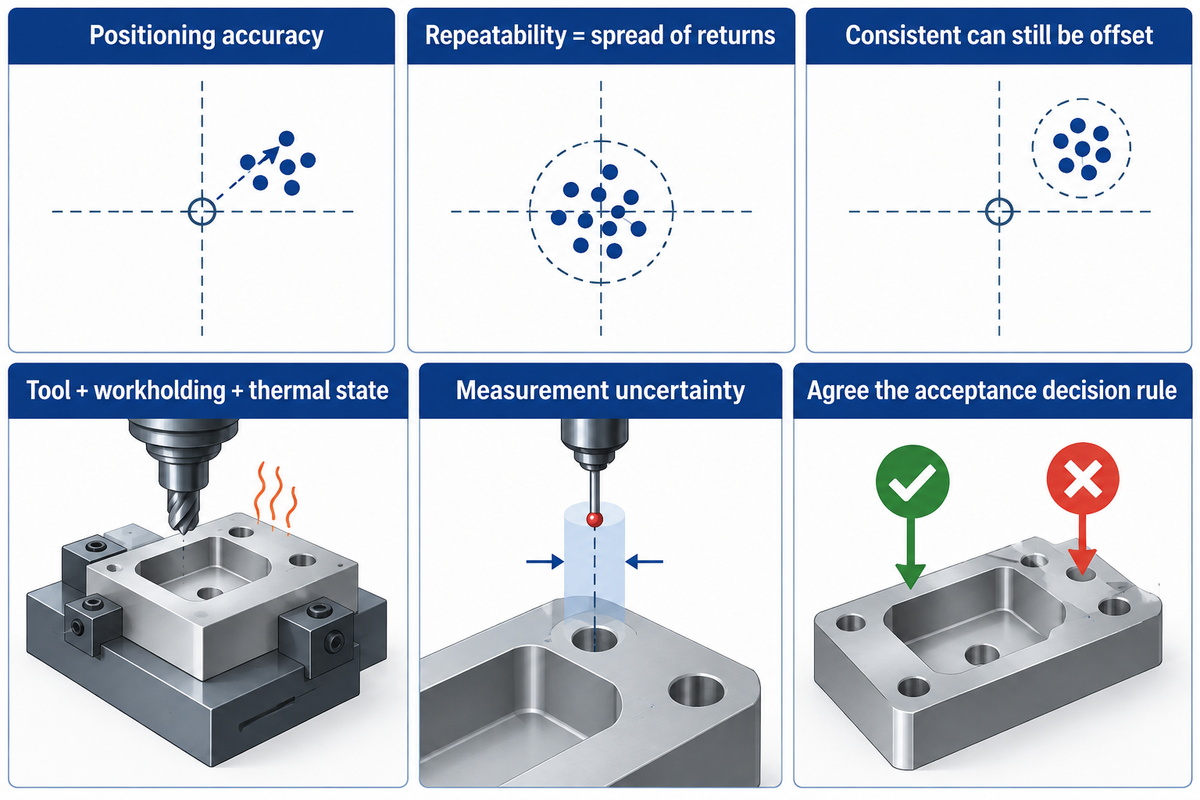
Machine accuracy should be tested through defined axis tests and representative machined features. Positioning accuracy concerns where an axis reaches its commanded position; repeatability concerns the spread when it returns. Other factors, such as tooling, workholding, the thermal state of the part, and measurement, should also be evaluated. Precision manufacturing requires a defined method of inspection.
How precise is a Chinese CNC machine, and how can I judge whether it will hold my part tolerances?
With the hypothetical shaft example below, the purchase target is 50.00 mm ±0.01 mm; the quoted configuration must produce representative parts within the agreed acceptance limits. The quality lead and supplier must also agree the measurement uncertainty, treatment of borderline readings and responsibility for the decision. Axis tests and cutting results should be separated. ISO 230-2:2014 describes methods for evaluating positioning accuracy and repeatability of numerically controlled axes. Its public scope includes acceptance and comparison testing.
“The methods involve repeated measurements at each position.”
Think of repeatability as repeatedly stopping at the same mark on a ruler. Consistent stops can still be offset from the commanded mark. Cutting introduces even more variables: a slender part can deflect, a tool can wear, and machine geometry can move as temperatures change. NIST research on machine-tool thermal deformation identifies motor loads, cutting and ambient temperature as influences on volumetric error and part quality.
| Record field | What belongs in the acceptance file | Who uses it |
|---|---|---|
| Critical feature | Drawing dimension, datum and geometry requirement | Quality assurance |
| Material | Grade, condition and stock geometry | Process engineer |
| Configuration | Controller, spindle, feedback, fixture and tool identification | Procurement |
| Axis test | Method, axis positions, directions and reported result | Machine acceptance team |
| Thermal state | Warm-up sequence, elapsed running time and temperature record | Production |
| Cutting cycle | Program revision, tool offsets, feeds, speeds and cycle time | Process engineer |
| Measurement | Instrument, calibration status and feature access | Quality assurance |
| Uncertainty | Measurement uncertainty relevant to the feature and decision | Metrology lead |
| Acceptance rule | Agreed acceptance limits and treatment of borderline readings | Buyer and supplier |
| Repeat run | Part sequence, sample plan and results across the intended cycle | Production and quality |
ISO/IEC Guide 98-4 provides guidance on acceptance limits in light of measurement uncertainty. This is important when a result approaches a tolerance limit. Agree the acceptance/rejection decision rule in advance to minimize disputes. Our guide to drawing tolerance requirements assists in distinguishing between true dimensional requirements and general drawing conventions.
Example: a shop plans 500 steel shafts per month on an 8 h shift. Its critical outside diameter is 50.00 mm ±0.01 mm, and the blank is 200 mm long. A polished single prototype looks convincing, but the quality lead still needs to know whether the same setup holds the feature after the machine warms and the tool has completed the agreed run. The acceptance record therefore preserves the drawing, chucking arrangement, measurement method and part sequence. If a result approaches either limit, the agreed uncertainty and decision rule govern acceptance.
Reliability and recovery: evaluate both failure history and maintainability
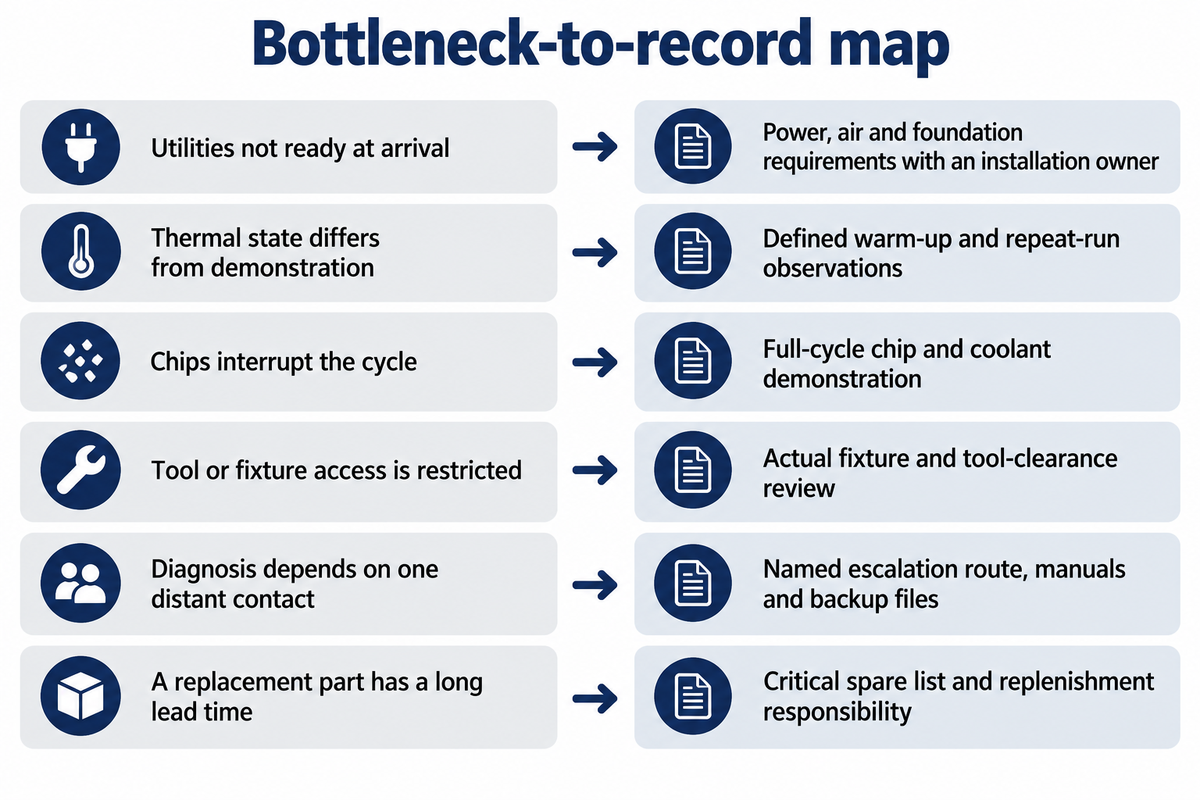
Reliable production requires equipment that performs its function over intended operating conditions and a workable recovery path after equipment failure. Keep the two questions apart in the purchase file. Failure history addresses Reliability; diagnosis, replacement parts and repair time address Maintainability. A supportive contact person is good, but it doesn’t show how often a machine stops.
NASA’s reliability definitions differentiate failure-free operation from restoring a failed item. For a machine shop planning reliable CNC machining, that distinction defines two practical records. One is operating experience with the same model under comparable duty. The other is a recovery plan naming the person, part and procedure to restore production.
Delivery of lubrication, condition of coolant, and chip accumulation deserve as much attention as the spindle and the controller. Advanced CNC options should have a defined job in the production cycle. A premium component name cannot compensate for a mismatched application or neglected maintenance. CNC manufacturing requires machining technology that fits the shop’s programming and maintenance skills. Different CNC systems require different training and backup arrangements. Parameter copies, electrical drawings and a documented escalation path help the shop restore the purchased configuration.
| Hidden constraint | Production consequence | Purchase or commissioning record |
|---|---|---|
| Utilities ready after arrival | Equipment waits instead of producing | Power, air and foundation requirements with an installation owner |
| Thermal state differs from demonstration | Critical dimensions shift during the shift | Defined warm-up and repeat-run observations |
| Chips interrupt the cycle | Advertised cutting time understates operator involvement | Full-cycle chip and coolant demonstration |
| Tool or fixture access is restricted | Additional setups increase handling | Actual fixture and tool-clearance review |
| Diagnosis depends on one distant contact | A small fault extends downtime | Named escalation route, manuals and backup files |
| A replacement part has a long lead time | A repairable fault becomes a delivery problem | Critical spare list and replenishment responsibility |
Automotive repeat parts may justify a different service plan from occasional repair work. An owner with another machine available can absorb an interruption differently from a business that has only one production asset. Record that exposure in hours of lost capacity and contribution per hour before treating a warranty as a complete downtime solution.
New Chinese machine vs used Japanese or American machine
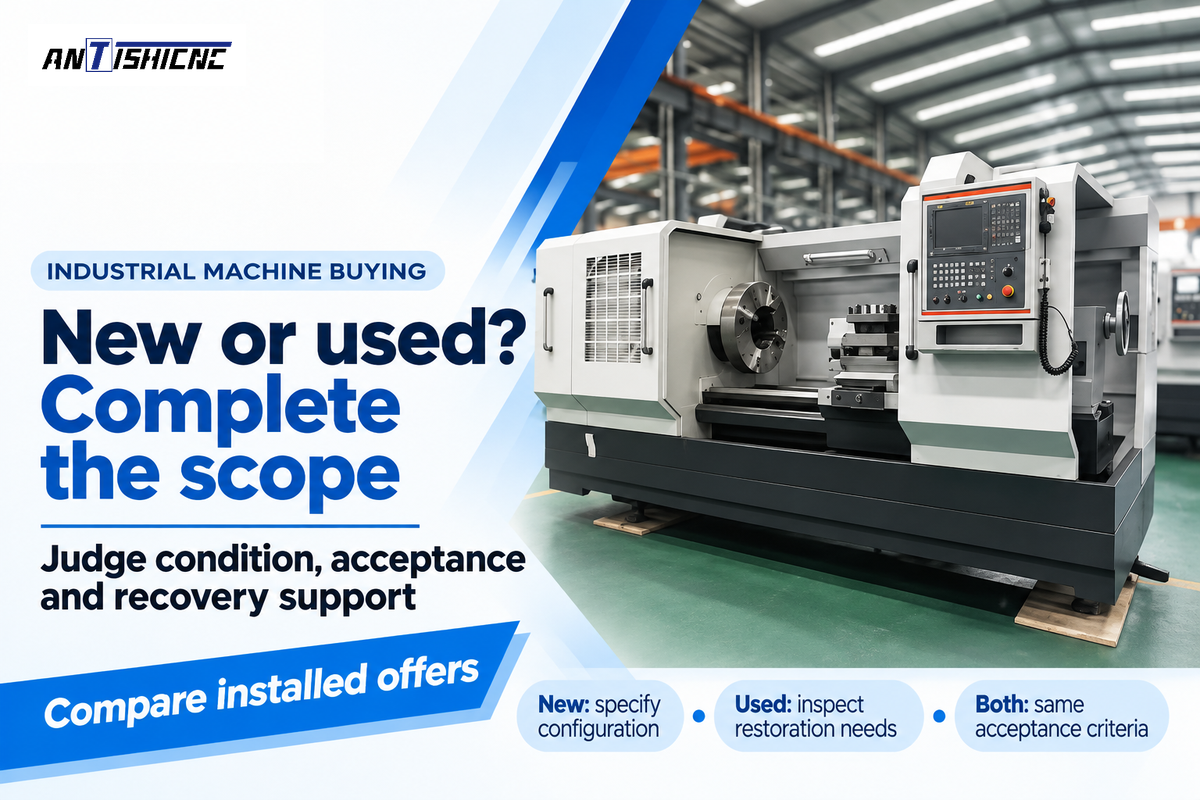
Shops in the US and other importing markets can evaluate a new Chinese machine compared to a used alternative, based on measured condition, process fit, installed scope and local recovery support. A new CNC gives an opportunity to specify the configuration to be shipped. A used Haas or another locally supported alternative requires closer attention to wear, service history, control support and the work needed to return it to production.
Should a small production shop buy a new Chinese CNC machine or a used Japanese or American machine?
Prefer new machines if the ordered configuration passes the representative part test and their installation and service arrangement are compatible with the shop. Prefer a used machine when inspected condition, parts access and local technical support give the stronger operating plan. Include refurbishment and commissioning in the used offer, and compare both offers with the same acceptance criteria.
A PLOS ONE remanufacturing case evaluated a retired M1332B cylindrical grinder after restoration and conversion. Its working-accuracy acceptance met the compared factory criteria. The key lesson is the documented restoration and test process. A professionally remanufactured machine and an untreated used machine are clearly different purchases.
Consider a job shop having to choose between a new, unfamiliar machine and an older, locally supported machine. The used offer includes a technician who knows the control, but spindle condition and geometry still need to be inspected. The new offer includes a warranty, but installation is the buyer’s responsibility unless specified in the offer. The production manager evaluates part cycle time on each offer. Procurement adds the missing installation work to the new offer and any required restoration to the used offer. Then, Finance evaluates the offers. The proposed machining solutions must cover the complete part route.
For a lathe purchase, lathe and turning-center configuration differences can matter more than age alone. Live tooling, subspindles and automation create additional acceptance items. Their value comes from the operations they remove from your part route.
Total ownership cost: compare the same installed and operating scope
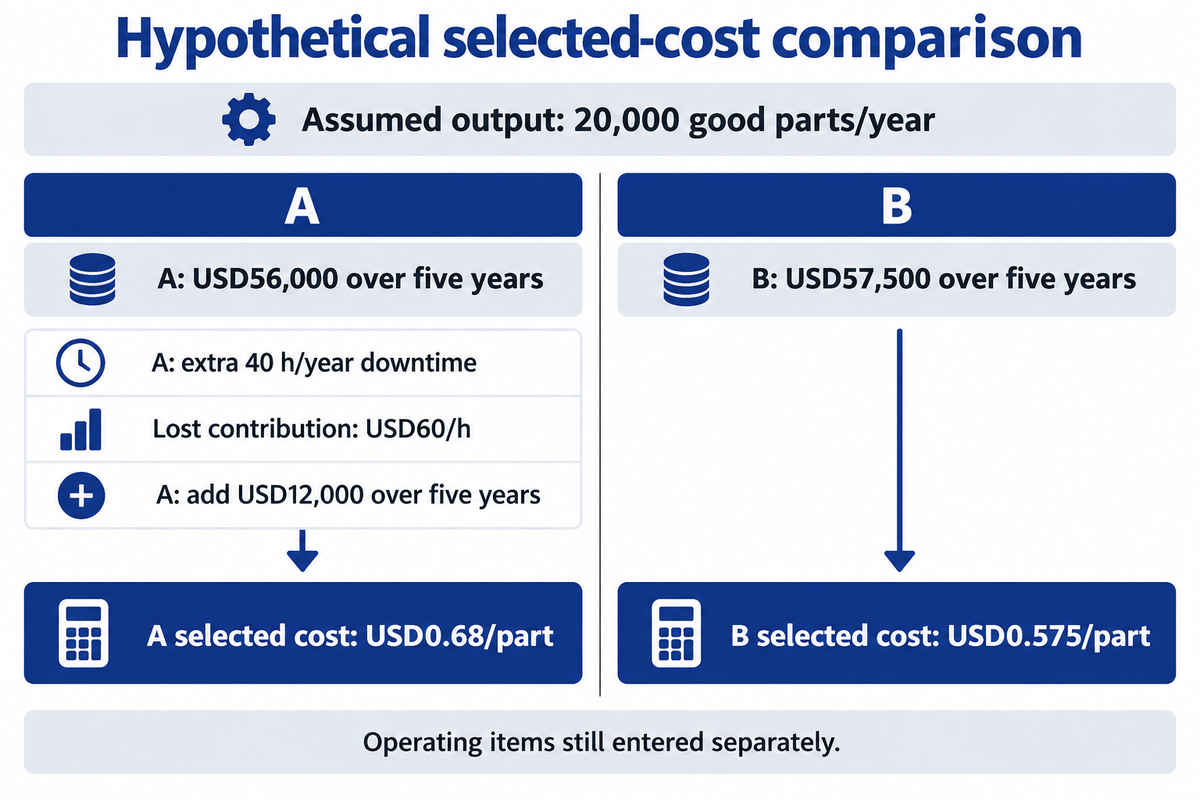
Compare costs over the same period with good-part output, starting with the installed machine package. Include delivery, rigging, tooling, training, maintenance, and the shop’s exposure to downtime. Keep financing, energy, labor, scrap, and residual value separate. A selected-cost subtotal is useful for comparing offers. A complete business case requires all the material cost categories.
How much does an industrial CNC lathe from China cost once shipping, installation and ongoing ownership are included?
The comparison below assumes Option A costs USD46,000 to commission and USD56,000 over five years before unplanned downtime and the separately listed operating items. Option B costs USD50,000 to commission and USD57,500 on the same limited basis. The complete ownership costs include finance and taxes, energy, labor, consumables, scrap, unplanned downtime, and residual value. Actual quotes should be based on the selected model, delivery location and the scope of the support. Our price breakdown for CNC machine types covers broader machine-type price comparisons.
| Selected cost item | Option A | Option B |
|---|---|---|
| Machine package | USD32,000 | USD41,000 |
| Delivery and import handling | USD4,500 | USD1,500 |
| Rigging and installation | USD3,000 | USD1,500 |
| Initial tooling and fixtures | USD4,000 | USD4,000 |
| Training | USD1,000 | USD1,000 |
| Initial spare parts | USD1,500 | USD1,000 |
| Upfront subtotal | USD46,000 | USD50,000 |
| Assumed annual maintenance | USD2,000/year | USD1,500/year |
| Selected cost subtotal over five years | USD56,000 | USD57,500 |
| Enter separately for a complete comparison | Finance, taxes, energy, labor, consumables, scrap, unplanned downtime and residual value | |
The arithmetic is upfront cost plus annual maintenance multiplied by the chosen number of years. Shipping costs and delivery terms must use the same destination and scope on both bids. A factory quotation and an installed local quotation are different starting points; competitive pricing becomes useful only after those scopes align.
Now, assume Option A loses an additional 40 h/year while the shop waits for diagnosis or a replacement part. At a lost contribution of USD60/h, that’s an additional USD12,000 over five years. Assuming a production rate of 20,000 good parts/year, the selected cost contribution becomes USD0.68/part for A and USD0.575/part for B. The saving from Option A has reversed in this example. Use contribution lost after avoidable variable costs, rather than sales revenue, and avoid counting the same idle labor twice. Taking idle labor as an example, if the lost contribution from sales is accounted for, then the same labor shouldn’t be accounted for as lost idle time. If a shop has spare capacity or faster access to parts, it would use a different downtime assumption and could reach a different decision.
Thomas and Weiss’s study of maintenance in the manufacturing industry treats direct maintenance expenditure and losses from faults as separate categories. Its historical survey comparisons support keeping both in the worksheet. The shop’s own operating records supply the inputs for its purchase decision.
Supplier and service verification: put the missing responsibilities in writing
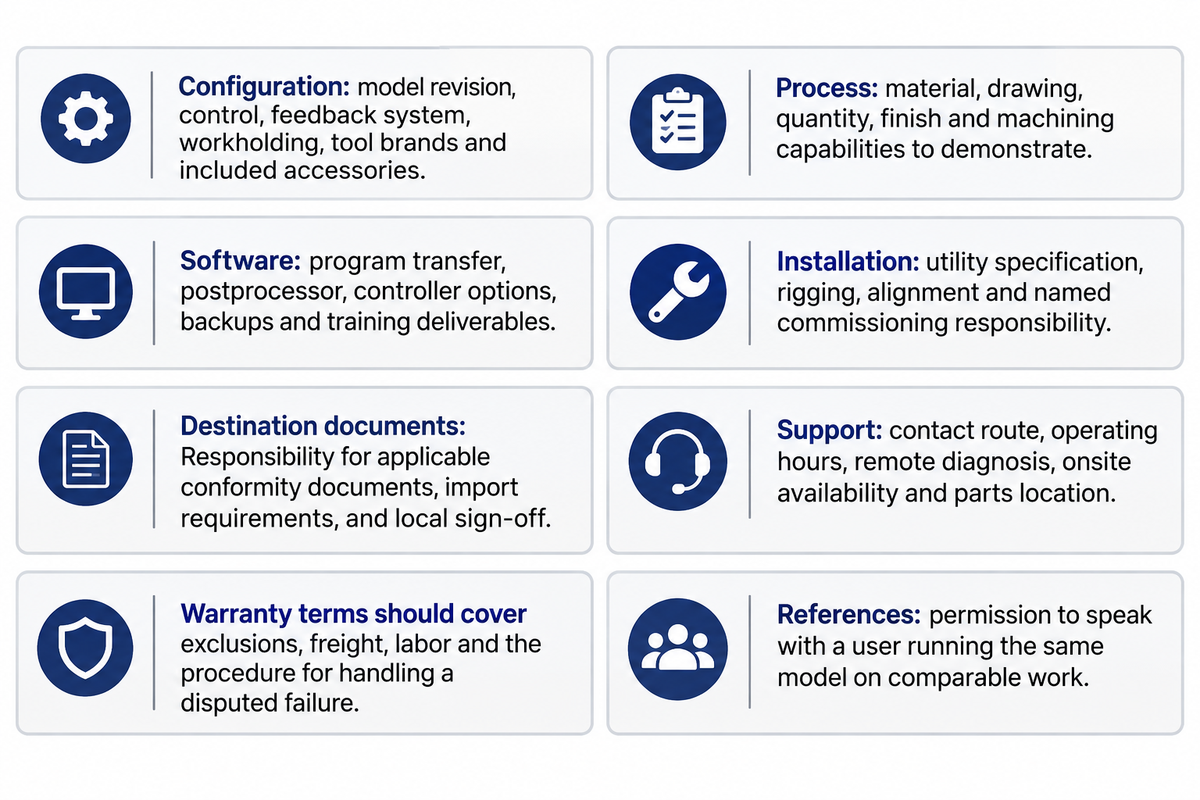
A useful equipment quotation identifies the legal seller, ordered configuration, commissioning owner and recovery route. The service should cover the machine’s operating location and the customer’s working language. NASA’s maintainability definition concerns the probability of restoring or repairing a failed item to a specified condition within a given time interval. For a global manufacturing purchase, attach the representative part, acceptance plan and documentation list to the quotation so procurement can compare the same deliverable from each supplier in China or elsewhere.
Which Chinese CNC machine brands should I consider for industrial lathes and machining centers?
For industrial turning, start with ANTISHICNC and Neway as product-family candidates. Neway also lists vertical and horizontal machining centers in its official catalogue. Compare the specific quotations and local service scope; these names form a shortlist for testing, rather than a performance ranking. Shortlist manufacturers that can demonstrate your part, identify the supplied control and provide a usable support arrangement. For CNC milling machines, compare the required machining envelope and process first; a turning-machine reference alone is insufficient for a milling purchase. A turning machine reference alone isn’t sufficient to make a purchase decision for a milling machine.
The quotation should differentiate the machine builder, exporter and service organization. CNC machining manufacturers can provide finished components and not build equipment. A subcontractor that specializes in CNC parts machining should be evaluated for the required parts contract. An equipment seller in Shenzhen or another manufacturing center should identify who supplies the machine and who handles commissioning. Proximity to a supply chain is useful only when required parts and technical assistance are available.
- Configuration: model revision, control, feedback system, workholding, tool brands and included accessories.
- Process: material, drawing, quantity, finish and machining capabilities to demonstrate.
- Software: program transfer, postprocessor, controller options, backups and training deliverables.
- Installation: utility specification, rigging, alignment and named commissioning responsibility.
- Destination documents: Responsibility for applicable conformity documents, import requirements, and local sign-off.
- Support: contact route, operating hours, remote diagnosis, onsite availability and parts location.
- Warranty terms should cover exclusions, freight, labor and the procedure for handling a disputed failure.
- References: permission to speak with a user running the same model on comparable work.
Use the reference conversation to discuss loading, setup, maintenance and interrupted production. Technical questions should describe the part and duty. A machine used for consumer electronics fixtures has a different workload from one producing heavy steel components. Aerospace or other high-precision work also needs the required process and customer approvals; equipment branding alone does not supply them. Equipment branding doesn’t provide approval.
A practical acceptance test before shipment and at installation
Agree acceptance criteria before the order is finalized, then preserve the factory results for comparison after installation. The test should evaluate the important part features and end use conditions. Take note of any deviation from the specification, report and resolve the defects before release of the payment or shipment milestone. Short acceptance runs establish the agreed condition at that time; ongoing process monitoring addresses production over time.
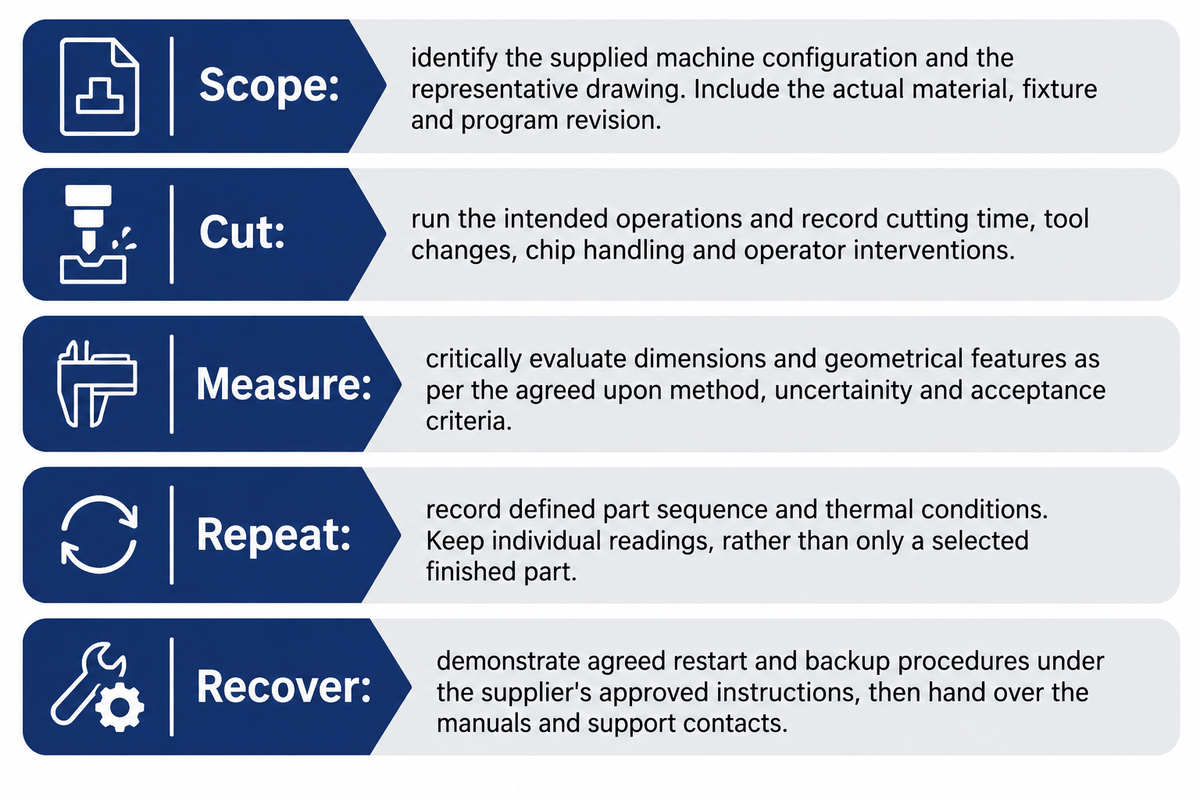
The 5-Point Machine Proof Test is a buyer’s sequence for organizing that record. It relates the drawing requirements to the machine, measurement methods and recovery plan. Agreed technical test methods, sample plan and other purchase specs remain part of the purchase specification. ISO/IEC Guide 98-4:2012 addresses the role of measurement uncertainty in conformity assessment.
- Scope: identify the supplied machine configuration and the representative drawing. Include the actual material, fixture and program revision.
- Cut: run the intended operations and record cutting time, tool changes, chip handling and operator interventions.
- Measure: critically evaluate dimensions and geometrical features as per the agreed upon method, uncertainty and acceptance criteria.
- Repeat: record defined part sequence and thermal conditions. Keep individual readings, rather than only a selected finished part.
- Recover: demonstrate agreed restart and backup procedures under the supplier’s approved instructions, then hand over the manuals and support contacts.
For precision CNC work, preserve inspection reports with part identifiers. For a 5-axis CNC application, include the operations that require simultaneous motion or indexed access, whichever the job actually uses. A demonstration cut can’t take the place of testing the more involved production route the job requires.
The installation record should also outline access to fixtures and operator handoff. Injection molding tooling, for example, can involve machining processes beyond the first roughing operation. A machine demonstrated on one stage of the job should be assessed against the complete route the shop intends to bring in-house.
Buyer decision table: proceed, hold or reject the offer
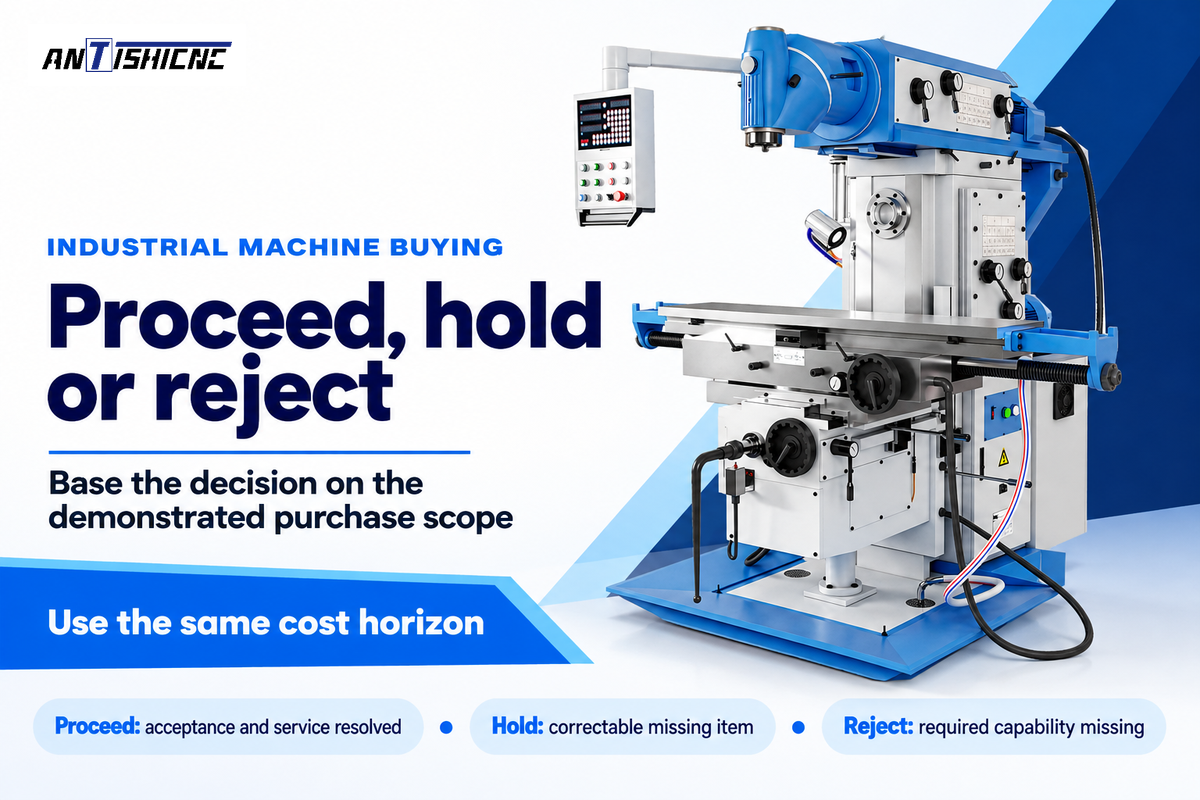
Proceed when part fit, measured acceptance, installation readiness, and service responsibility are all settled at the right cost. Hold an offer with a specific correctable gap and assign an owner and deadline. Reject a machine whose demonstrated capability misses a required feature or whose critical operating dependency cannot be supplied for the intended location.
| Observed position | Decision | Next action |
|---|---|---|
| Representative part passes; installation and service responsibilities are agreed | Proceed | Attach the configuration, results and delivery scope to the order |
| Part fits, but a postprocessor, fixture or service item is missing | Hold | Price and demonstrate the missing item before committing |
| Acceptance misses a required feature | Reject or change the machine/process | Require a new demonstrated solution rather than a verbal promise |
| Low purchase price reverses after downtime or installation is included | Compare the completed alternatives | Use the same output, cost horizon and recovery assumptions |
ANTISHICNC offers machine-tool options for buyers who are evaluating a CNC machine from China. Buying directly from China requires a named owner for each delivery and commissioning task. Send your drawing, specification, and expected quantity, along with the installation location, via our machine configuration enquiry. Use this information to request a defined configuration and acceptance scope that production, quality and finance can evaluate together.
Frequently asked questions
Can Chinese CNC machines cut steel reliably?
Yes, an industrial machine configured for steel can be suitable for this case. Match the working torque of the spindle, machine structure and tooling, coolant and workholding for the actual operation. Quality control also requires the same material and measurement conditions for acceptance. Production reliability also needs maintenance and support appropriate to the shift pattern. A light cutting machine demonstrated on aluminum has a different duty from sustained steel cutting on an industrial lathe or mill.
What is the difference between CNC resolution and repeatability?
Resolution is the smallest increment a system can display, command or distinguish in measurement; repeatability describes the spread of repeated positioning results. A system can return consistently to a position that is offset from the commanded target. The tolerance specified on a part drawing represents the maximum variation allowable for that part. Numerous variables affect the final size of a part, including the type of cut used and workholding; measurement uncertainty affects the acceptance decision. Keep those quantities separate from the smallest displayed increment.
What should a factory acceptance test include?
The data record is to include the configuration supplied, a representative part, defined operating conditions, individual measurement results, and the pass/fail criteria agreed to by the customer. The record is to include the drawing and program revision, material, tooling, fixture and measurement uncertainty. Retain deviations and corrective actions with results. Factory acceptance testing should relate to the installation check.
How do I compare a new machine with a used machine?
Compare the same part route and installed scope, then add condition and restoration work to the used offer. For both offers, define support responsibilities and costs, parts availability, commissioning responsibilities and costs, and warranty coverage for controls and related services. Use the inspection findings to price spindle, axis or control restoration before comparing the installed offers.
Which service terms belong in the RFQ?
A named contact and defined responsibilities allow procurement to compare support packages before production uses the machine. Define critical spares, warranty exclusions, support arrangements and who pays for labor, travel and freight when parts need replacement; include service territory, working hours, contact language, remote and onsite support and commissioning responsibility. Manuals and parameter backups belong in the handover list.
How should I budget installation and downtime?
Budget installation as a separate project with delivery, unloading, rigging, utilities, alignment, tooling, training and the production handover assigned to owners. Keep recurring maintenance distinct from unexpected production losses. For downtime, estimate additional unavailable hours and the contribution lost per hour, then evaluate whether other equipment can recover the output. Consider if other equipment can make up for the loss. When accounting for contribution, don’t consider the sales revenue loss as lost contribution and don’t add idle labor if it’s already included in the loss. A complete ownership calculation also includes energy, consumables, finance, taxes, scrap and residual value on the same time horizon. Replace all assumed numbers with actual numbers (quotes and records) prior to making an investment decision.
References & Sources
- ISO 230-2:2014, positioning accuracy and repeatability test scope; current public page lists Amendment 1:2016.
- ISO/IEC Guide 98-4:2012, measurement uncertainty in conformity assessment.
- Li and colleagues, NIST, in-process optical measurement and compensation of machine-tool thermal deformations.
- NASA Kennedy Space Center, reliability, maintainability and availability definitions.
- Ling and He, PLOS ONE – assessment of a retired grinding machine by remanufacturing.
- Thomas and Weiss, Maintenance Costs and Advanced Maintenance Techniques in Manufacturing Machinery.